


Reading now: Slope angle in construction – definition, calculation and practical tips
Zusammenfassung Summary

The slope angle determines how steep excavation pits and trenches can be constructed without soil slipping.Depending onSoil typeDifferent guidelines apply according toDIN 4124: e.g.45° for clay,60° for sand. AlsoDepth, groundwater, contamination at the edgeandweatherinfluence the permissible inclination.

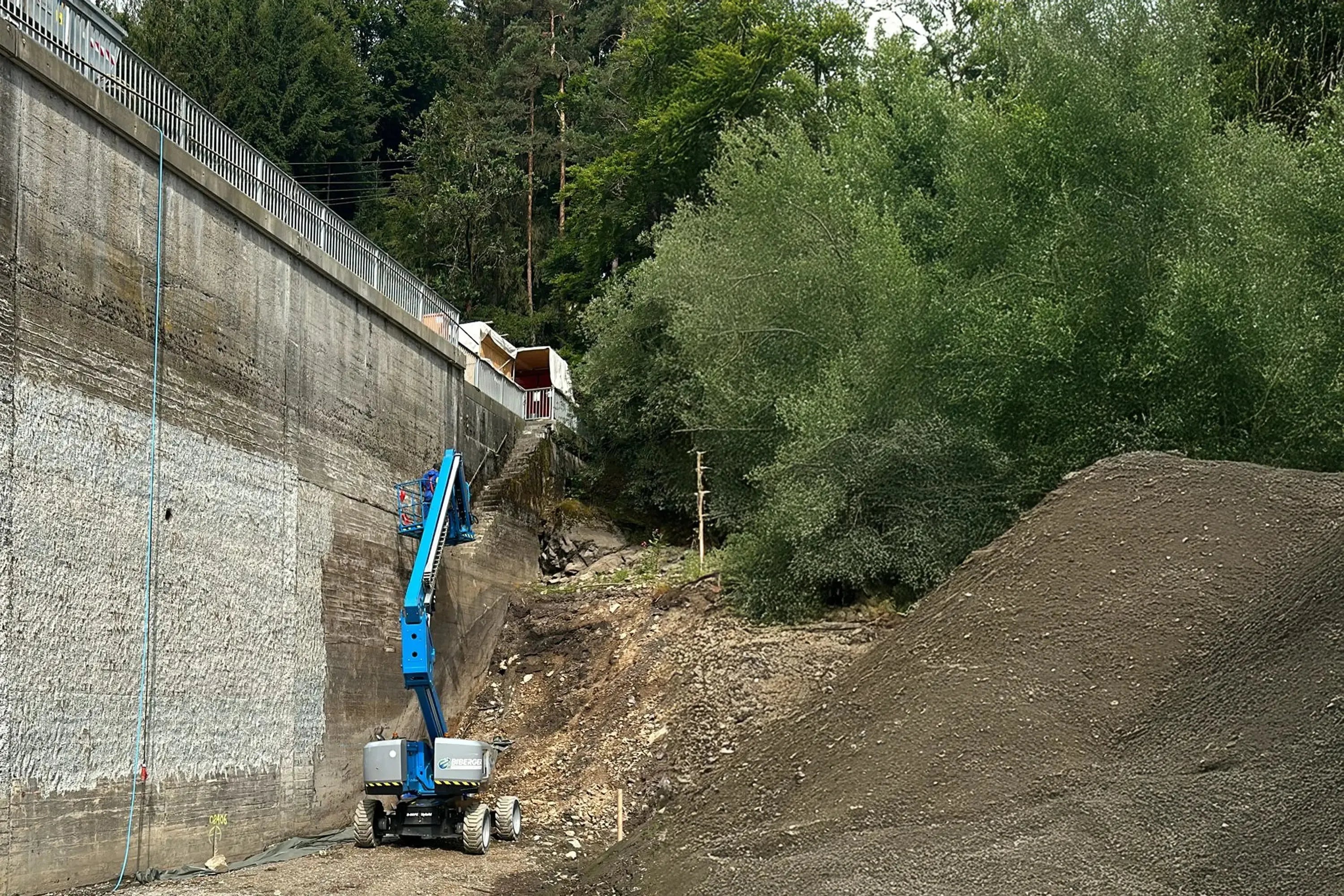
Too steep? Then protection measures such as shoring, drainage, or geotextiles are mandatory.When conditions are cramped,Articulated telescopic platformsto safely work on hard-to-reach areas –without driving on the embankment. Always important:Analyze soil, comply with regulations, ensure safety.

Zusammenfassung Summary

The slope angle determines how steep excavation pits and trenches can be constructed without soil slipping.Depending onSoil typeDifferent guidelines apply according toDIN 4124: e.g.45° for clay,60° for sand. AlsoDepth, groundwater, contamination at the edgeandweatherinfluence the permissible inclination.

Too steep? Then protection measures such as shoring, drainage, or geotextiles are mandatory.When conditions are cramped,Articulated telescopic platformsto safely work on hard-to-reach areas –without driving on the embankment. Always important:Analyze soil, comply with regulations, ensure safety.

When excavating excavations and trenches, the slope angle determines stability. It determines how steep the walls can be to prevent the soil from sliding. This protects not only construction workers and machinery, but also adjacent buildings and pipes. In this guide, you'll learn how the slope angle is determined according to DIN 4124, which factors influence it, and what measures you need to take in problematic soil conditions.

What is the angle of repose?

The slope angle describes the inclination of a embankment and is measured in degrees. The steeper the angle, the more space-efficient the excavation pit is—but also the greater the risk of a landslide. An angle that is too shallow, on the other hand, provides safety, but requires more space and increases the excavation. The trick, therefore, lies in finding the right balance between safety and efficiency .

Slope angle according to DIN 4124

DIN 4124 is the authoritative standard in civil engineering for sloped pits and trenches. It specifies guideline values that apply depending on the soil type and pit depth . These values serve as the basis for planning and must not be exceeded for safety reasons.

Soil type Maximum slope angle
rock 80°
Clay and loam approx. 45°
Gravel and sand approx. 60°
Non-cohesive soils approx. 45° to 60°

These guidelines are intended as a guideline. Deviations may be necessary in practice – for example, in the presence of groundwater, frost, or high loads at the slope edge.

Slope angle comparison

What factors influence the slope angle?

In addition to the DIN, several conditions play a role that directly influence the slope angle:

Soil type

Rocky soils are very stable and allow for steep slopes up to 80°. Cohesive soils such as loam and clay are less stable and require shallower angles. Non-cohesive soils such as sand and gravel are considered particularly critical because they tend to give way when exposed to moisture or vibration.

Depth of the excavation pit

The deeper the excavation, the greater the lateral earth pressure. From a depth of 5 m, stricter regulations apply, often requiring additional safety measures such as retaining walls.

Groundwater and weather influences

A high groundwater table can soften and unstable slopes. Rain and freeze-thaw cycles also weaken stability. In such cases, drainage or shoring are essential.

Load at the embankment edge

Heavy machinery, stored construction materials, or traffic near the slope increase the risk of collapse. Therefore, the edge area should always be kept free of loads. If this is not possible, the slope angle must be increased or the slope must be additionally secured.

How is the optimal slope angle determined?

The determination takes place in several steps:

  1. Soil analysis: Examination of soil type, moisture content and bearing capacity.
  2. DIN guideline values: Application of the specifications from DIN 4124.
  3. Individual adaptation: consideration of groundwater, loads and space conditions.

Practical example:

  • A 3 m deep excavation pit in clay soil: approx. 45° slope angle.
  • A 3 m deep excavation pit in sandy soil: approx. 60° slope angle.

If the space does not allow for a sloped excavation pit, a shoring system is the only safe solution.

Safety measures for steep slopes

Where the DIN angles cannot be maintained, additional safeguards must be installed:

  • Retaining walls: prevent slipping and secure the excavation pit.
  • Drainage systems: drain groundwater and prevent softening.
  • Geotextiles or greening: protect against erosion caused by rain and wind.
  • Shotcrete or sheet piling: for deep and heavily loaded excavations.

Common mistakes on construction sites

In practice, problems often arise because basic rules are ignored:

  • Slopes too steep due to lack of space
  • Heavy loads directly at the edge of the embankment
  • No consideration of rain or frost
  • Missing or delayed drainage

These errors massively increase the risk of slope collapses – with dangerous consequences for people and machines.

Slope angles and work platforms

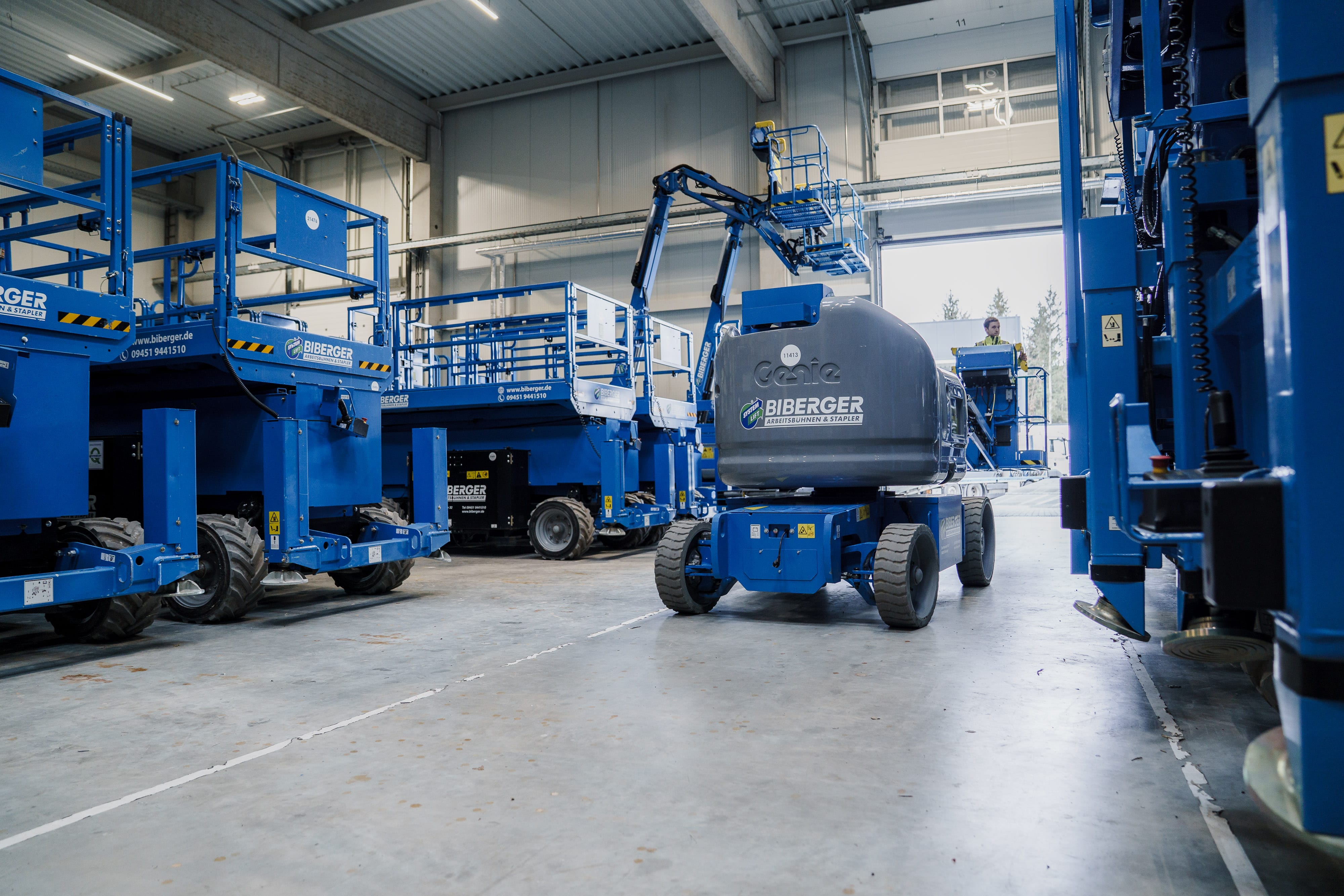
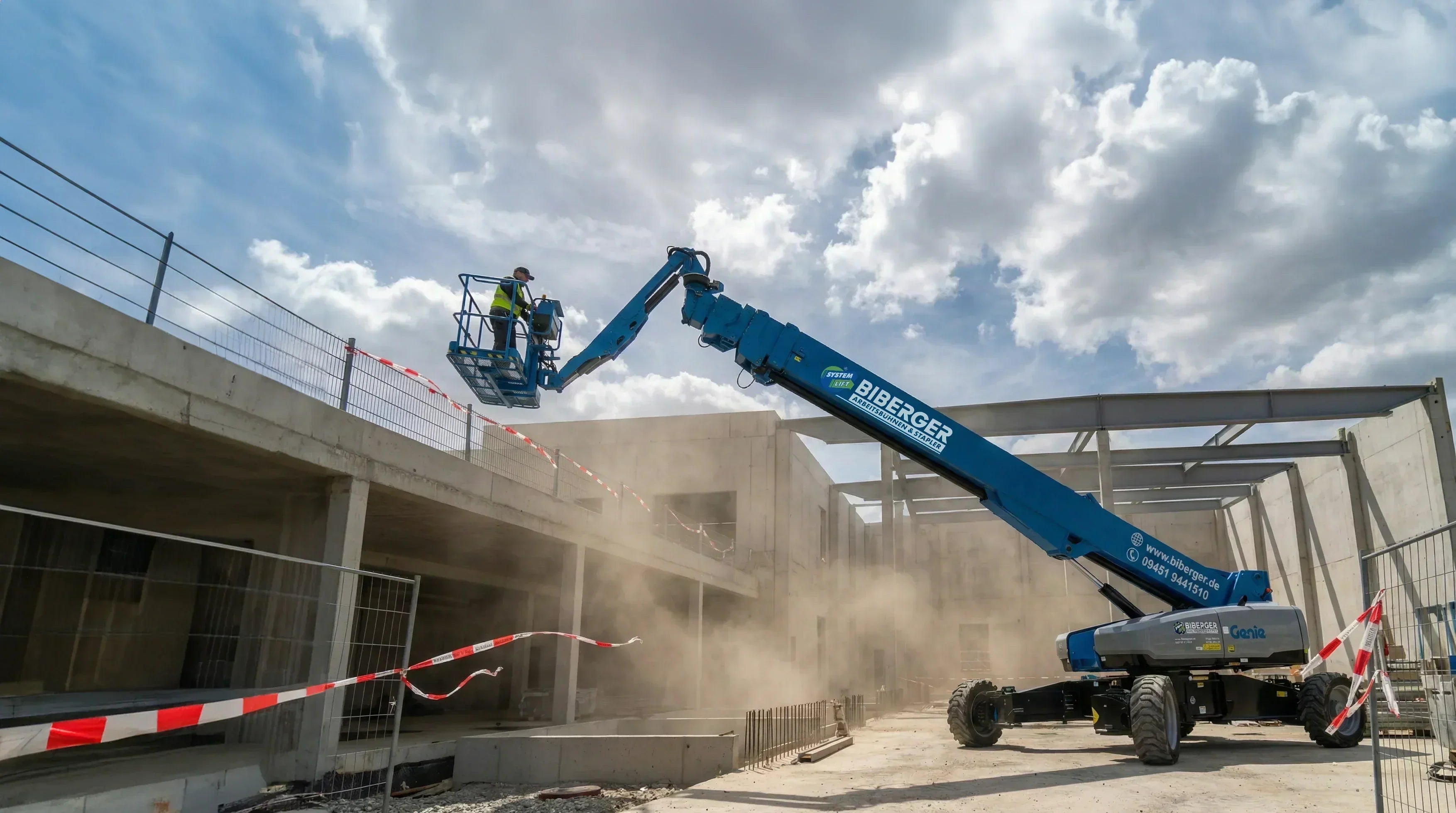
When working in excavations or on slopes, choosing the right work platform is crucial. Articulated boom lifts are particularly well-suited for use on slopes because their reach and flexible booms allow them to reach hard-to-reach areas without driving onto the slope. This increases safety and avoids unnecessary strain on the edges.

Conclusion

The slope angle is a key factor in civil engineering. It influences safety, costs, and space requirements. DIN 4124 provides clear guidelines, which must be supplemented by factors such as soil type, groundwater, and load. Planning too steeply risks collapse; planning too shallow wastes resources.

Our tip: Always calculate slope angles professionally, plan for additional safety measures, and choose the right work platform for working in excavations. This will keep your projects safe, efficient, and cost-effective.

Rectangle_1 - BIBERGER
About the author

Martin Biberger

Managing Director

Martin is the founder and managing director of BIBERGER Arbeitsbühnen & Forklifts.

He is responsible for thetechnical areaTogether with his team, he is responsible for thetechnical purchasingthe machines thatFurther development of the machine inventoryand the smooth operation of over 1,500 BIBERGER rental devices.

From many years of experience he knows theStrengths and weaknesses of all device classes, the possibleAreas of applicationand thetechnical possibilities– always with a view to theDevelopment of the entire industryand future innovations.

Our editorial quality standards

The subject content on biberger.de are editorially created, reviewed, and continuously updated. The basis is our daily work with aerial platforms, telehandlers, and industrial trucks – in rental, sales, operational planning, and technical support.

Each article draws on real-world experience and is editorially reviewed for clarity, accuracy, and practical relevance according to expert criteria. Technical statements are regularly compared against current industry standards and best practices.

The aim of our publications is to make reliable specialist knowledge accessible and to offer guidance to users, decision-makers and industry partners. BIBERGER sees itself as an independent information platform for safe, economical and modern height access technology – well-founded, comprehensible and free from advertising influence.

Leave a comment

Please note, comments need to be approved before they are published.

This site is protected by hCaptcha and the hCaptcha Privacy Policy and Terms of Service apply.

FAQ

How do you calculate the slope angle?

Theslope angledepends on thesoil type, thedepth of the excavation pitand the requirements of theDIN 4124This provides guidelines, e.g.45° for clayor60° for sand and gravel.

Usually the angle is defined as the ratio betweenHeightandhorizontal lengthDepending onstability requirementhe can use geotechnical calculations andstability proofsbe adjusted.

What does a slope angle of 1 to 2 mean?

Aslope angle of 1:2means that theembankmentper1 meter highonehorizontal length of 2 metersThe embankment is thereforeflatterthan with a ratio of 1:1, where height and length are equal.

The larger the second number, theflatteris the slope. This ratio is often used tosecuring of excavationsused tosoil slippageto avoid.

What slope angles are there?

Theslope angledepends on thesoil typeand can have varying steepness. Typical slope angles are:

  • 90° (vertical)– only withrockpossible
  • 60°- forstable soilslike gravel or sand
  • 45°- forcohesive soilslike clay or loam
  • 30° or flatter- forvery soft or wet soils

Theslope anglewill vary depending onconstruction project,safety requirementsand the requirements of theDIN 4124set.

How do you calculate the slope angle of an excavation pit?

Theslope angleoneexcavation pitis determined from the ratio ofheight (H)tohorizontal length (L)the slope. The formula is:

slope angle (α) = arctan(H / L)

Typical slope conditions:

  • 1:1→ 45° (e.g. loam, clay)
  • 1:1.5→ approx. 34°
  • 1:2→ approx. 27° (e.g. sand, gravel)

TheDIN 4124provides guidelines for safeinclinationdepending onsoil typeIf space is limited or the floor is toounstableis, ashoringbe necessary.

Wie steil darf eine Böschung sein?

Wie steil eine Böschung sein darf, hängt stark vom Einsatz ab: Baurechtlich gelten Böschungen meist mit einer Neigung von 1:1,5 bis 1:2 (ca. 33–45°) als stabil, während im Landschaftsbau flachere Neigungen von 1:3 oder flacher üblich sind. Für Fahrzeuge oder Maschinen ist entscheidend, was im Handbuch steht – viele Arbeitsbühnen oder Stapler sind nur für max. 10–15 % Steigung zugelassen.

Relevant topics

View all

Arbeitsbühne Privat mieten – Was ist erlaubt?

Renting a work platform as a private individual – What is allowed?

Aerial work platforms are primarily designed, standardized, and planned for commercial use. Typical applications include facade construction, plant and building technology, and industrial maintenance. Accordingly, equipment selection, insurance models, and rental procedures are geared primarily towards commercial users with trained...

Read more

Anschlagen von Lasten – Anschlagmittel richtig auswählen und sicher einsetzen

Lifting loads – selecting and safely using lifting equipment

Safely attaching loads is one of the most demanding tasks when operating cranes , forklifts , and lifting equipment. Errors almost never occur during the lifting itself, but almost always result from misjudging the load capacity, type of attachment, or...

Read more

Staplerfahrer werden

Become a forklift driver: safely, trained and responsibly

A moment of inattention 7:15 a.m. A forklift driver begins his early shift. Routine. He only gives the forklift a cursory check – time pressure, the truck is waiting. On the third lift, the fork tine snaps at an old...

Read more

CAN-Bus und J1939-Diagnose bei Baumaschinen - BIBERGER

CAN bus and J1939 diagnostics in construction machinery

Modern construction machinery is now highly networked systems. Sensors, control units and safety modules communicate with each other constantly – and this happens via the so-called CAN bus . The CAN bus is essentially the nervous system of every modern...

Read more

Magni Diagnose-Leitfaden: Fehlermeldungen richtig deuten - BIBERGER

Magni Diagnostic Guide: How to correctly interpret error messages

If your Magni telehandler (RTH / HTH series) suddenly displays a warning, it's rarely a total breakdown. Usually, a safety or protective function is being activated. This guide explains the most important error codes, their meaning, and how to react...

Read more

3D-Arm einer Arbeitsbühne

3D arm on aerial work platforms: Technology, advantages and model codes at a glance

The so-called 3D arm – also known as a 3D basket arm , pendulum basket arm , or hybrid jib – is a state-of-the-art feature for aerial work platforms. Its three-axis mobility allows for particularly precise work in hard-to-reach areas....

Read more

Merlo Fehlercodes bei Telehandlern & Bühnen

Merlo error codes for telehandlers & platforms

Modern Merlo telescopic handlers and aerial work platforms feature complex electronic controls. These systems automatically detect malfunctions and display them via error codes. This guide helps you understand each code – including its meaning, cause, and solution. Overview – Merlo...

Read more

JLG Fehlercodes erklärt: Ursachen, Bedeutung & Lösungen - BIBERGER

JLG error codes explained: causes, meaning & solutions

If your JLG aerial work platform suddenly displays an error code or becomes unresponsive, this does not automatically mean it is defective. In most cases, it is due to a safety or protective function . This guide explains what the...

Read more