




 What You Need to Know
Safely attaching loads is one of the most demanding tasks when operating cranes , forklifts , and lifting equipment. Errors almost never occur during the lifting itself, but almost always result from misjudging the load capacity, type of attachment, or angle of inclination.
This guide brings together all the basics , calculations , standards , filing rules and practical recommendations – clearly structured, technically correct and immediately applicable.
Basics Definitions
What are lifting devices?
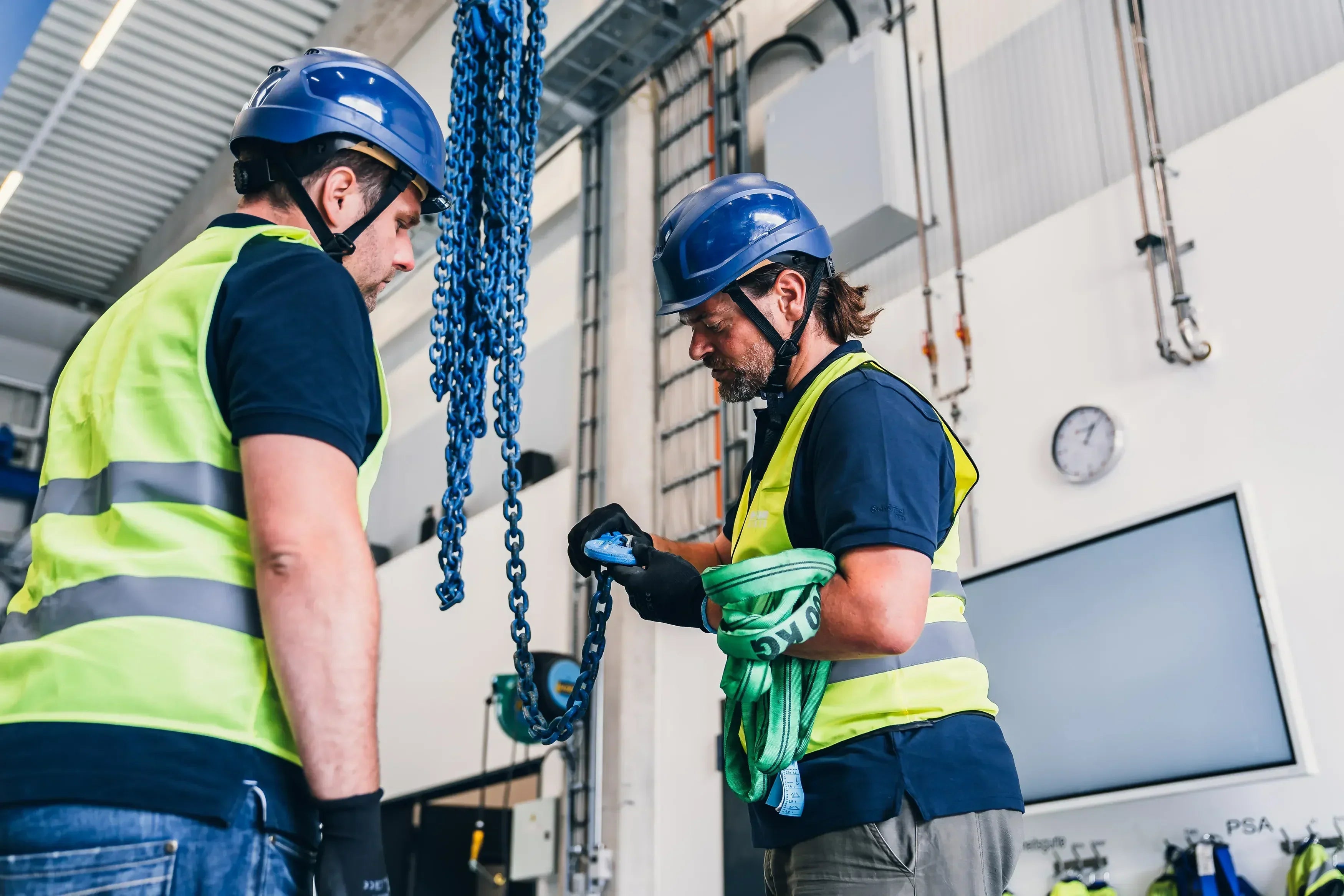
Lifting slings securely connect the load to the lifting arm of a hoisting device . They ensure that forces are applied cleanly and loads can be moved in a controlled manner. The slinger is responsible for the selection, condition, and proper use of the slings.

Key basic concepts at a glance
There are established basic principles for rigging. Load-bearing capacity, angle of inclination, and discard criteria determine whether a rigging operation can be carried out safely. Many accidents result from a lack of knowledge of these factors.
| Expression | Explanation |
|---|---|
| Working Load Limit (WLL) | Maximum permissible load of a lifting device. |
| Operating coefficient | Ratio between minimum breaking strength and WLL. For high-strength lifting equipment, min. 4:1. |
| angle of inclination | Angle between the string and the vertical. The larger the angle, the lower the load-bearing capacity. |
| Ready for dispensing | Condition at which a lifting device may no longer be used. |
| focus | Point at which the load hangs in equilibrium and remains secure. |
Types of lifting equipment
Overview of lifting equipment types
Each lifting sling has a clearly defined area of application. Textile slings are gentle on surfaces , wire ropes are versatile , and chains are extremely robust . The right choice determines safety and cost-effectiveness.
| type | Features | Mission | Special features |
|---|---|---|---|
| Round steel chains | Very robust, heat-resistant, flexible | Heavy, hot, or sharp-edged loads | Quality classes 2–12 |
| Wire ropes | High load capacity, flexible | Construction, Industry | Minimum diameter 8 mm |
| Lifting straps | Gentle, light | Sensitive surfaces | Reduced load-bearing capacity when close to people |
| Round slings | Endless, color-coded | Uneven loads | EN 1492 compliant |
| Shackle/Hook | Stable fasteners | Between load and lifting equipment | DIN EN 13889 |

Overview of typical lifting chain components: eye load hook, suspension link, shackle, and 2-leg and 4-leg slings for different load types and lifting situations.
Marking of lifting equipment
Every lifting device must be permanently, legibly, and unambiguously marked. The marking provides information about load capacity, manufacturer, standard, and operating limits. If the marking is missing, illegible, or damaged, the lifting device must not be used – it is then considered ready for disposal.
The type of marking varies depending on the material: chains have metal pendants, while textiles have sewn-in labels. The requirements are clearly defined in the product standards DIN EN 818, EN 1492, and EN 13414.
| Lifting equipment | Type of marking | Mandatory information | standard |
|---|---|---|---|
| Round steel chains (grade 8) | Metal pendant (red, octagonal) | - Working load limit (WLL) for 0–45° and 45–60° - Nominal thickness of the chain - Number of strands - CE marking - Manufacturer |
DIN EN 818-4/-5 |
| Wire ropes | metal sleeve or pendant | - Working Load Limit (WLL) - Rope diameter - Manufacturer's identification |
DIN EN 13414 |
| Lifting straps | Sewn-in label | - Working Load Limit (WLL) - Material (PES/PA) - Length - Manufacturer - Traceability code - Standard (EN 1492-1) |
DIN EN 1492-1 |
| Round slings | Woven label (color-coded) | - Working Load Limit (WLL) - Material - Manufacturer - Traceability code - Standard (EN 1492-2) |
DIN EN 1492-2 |
| Shackle / Hook | Embossing / Engraving | - Load capacity - Quality class - Manufacturer |
DIN EN 13889 |

Typical load capacity label of a lifting sling: Indication of the permissible WLL for various angles of inclination (e.g., 4,000 kg at 45°, 2,800 kg at 60°). These values apply per leg and must be strictly observed.
What should you do if the label is missing or illegible?
If the marking is illegible, the lifting equipment must no longer be used. It must be immediately discarded and clearly marked as "defective". Use without clear marking violates DGUV Regulation 109-017 and the German Ordinance on Industrial Safety and Health (BetrSichV).
Exception: For single-strand lifting chains, the load capacity specification may be omitted if permanently valid load tables are posted at the place of use.
All lifting equipment placed on the market after 1993 must bear a CE marking. If this marking is missing, the lifting equipment does not comply with the Machinery Directive.
Color coding of round slings – EN 1492
| Color | Load capacity |
|---|---|
| Violet | 1 t |
| Green | 2 t |
| Yellow | 3 t |
| Gray | 4 t |
| Red | 5 t |
| Brown | 6 t |
| Blue | 8 t |
| Orange | 10 t |
Load-bearing capacity calculation
Safety factor operating coefficient
High-strength lifting chains must have a minimum breaking strength that is at least four times their load-bearing capacity. This factor is legally mandated and must not be undercut.
Load-bearing capacity according to number of strands
More strands do not automatically mean greater load-bearing capacity. With asymmetrical loads, often only two strands can bear the load completely.
| strands | Behave | WLL |
|---|---|---|
| 1 | Fully pregnant | 100% |
| 2 | symmetrically supporting | 200% |
| 3 | Often only 2 carrying | 200% |
| 4 | Often only 2 carrying | 200% |
Influence of the angle of inclination
The angle of inclination significantly affects the actual force on the strands. Attaching the rope is prohibited at angles of 60° and above.
| angle | Residual load-bearing capacity | Notice |
|---|---|---|
| 0° | 100% | Optimal |
| 30° | 87% | Normal reduction |
| 45° | 71% | Significantly reduced |
| 60° | 50% | Critical |
| >60° | – | Forbidden |

Note: Ropes and chains permanently installed in load-bearing devices are excluded from this – their angle of inclination is fixed due to their design and has already been taken into account by the manufacturer.
Example calculation
A 5-tonne load with a 2-strand lifting sling (3 ton WLL each) at 45° results in a total capacity of 4.26 tonnes – insufficient. The sling would be overloaded and must not be used.
Reduction in the lacing
During a choker-style rigging operation, the lifting equipment loses approximately 20% of its load-bearing capacity, in addition to the reduction in angle, because the equipment is also subjected to bending stress.
Stop types, tilt angle
Direct stop
The safest and most reliable type of anchor. Ideal for fixed anchor points and symmetrical loads; load-bearing capacity is fully maintained.
Lace-up
The lifting sling is placed around the load. It secures well, but reduces the load-bearing capacity due to friction and bending.
Hanging walk
The riskiest type of rigging. Suitable only for massive, dimensionally stable loads. Not permitted for pipes or profiles.
Chemical compatibility of lifting equipment
In industrial and cleaning environments, lifting equipment frequently comes into contact with oils, acids, or alkalis. Many plastics are sensitive to these substances, which significantly reduces their load-bearing capacity.
| material | Oils | Acids | Lye | remark |
|---|---|---|---|---|
| Polyester (PES) | Good | Bad | Medium | Standard material for lifting straps/round slings |
| Polyamide (PA) | Good | Very bad | Good | Tensile strength, but chemically sensitive |
| Polypropylene (PP) | Medium | Medium | Medium | Cheap, but less robust |
| Steel/Chain | Very good | Medium | Medium | observe corrosion protection |
Technical standards and regulations
| Standard/Rule | Area | Contents |
|---|---|---|
| DGUV Rule 109-017 | Lifting equipment | Duties, dangers, regulations |
| DIN EN 818 | Chains | Quality classes geometry |
| DIN EN 13414 | Wire ropes | Structure, examinations |
| EN 1492 | Textile agent | Round slings lifting straps |
| BetrSichV | Legal basis | Audit obligations |
Inspection Maintenance
Identifying damage – What is critical?
Lifting equipment is subjected to high stress during every use and can develop a wide variety of damage. It is crucial to identify critical damage in time, before failure occurs. Many types of damage can be detected through simple visual and tactile inspection – without any special tools.
Chains
- Elongation: Check link length – more than 5% elongation means discard immediately.
- Deformities: Laterally crushed or bent limbs are a clear exclusion criterion.
- Cracks: Particularly visible at transitions or welds – always critical.
- Corrosion: Deep rust or pitting significantly reduces the load-bearing capacity.
Wire ropes
- Wire breaks: Protruding strands – more than 6 breaks per meter = discard.
- Kinks: "Bird's neck" shape, rope gives way at that point → acutely dangerous.
- Swollen ends: an indication of internal fiber damage.
- Corrosion: White rust, cracks or stains reduce strength.

Textile lifting equipment (lifting straps, round slings)
- Cuts/abrasions: Even small cuts = ready to be discarded.
- Thread pulls: Protruding threads indicate material fatigue.
- Abrasion: Areas that have been worn smooth indicate overloading.
- Discoloration: Indication of heat or chemical exposure.
- Label damaged or missing: Without labeling → do not use.
Shackle / Hook
- Cracks or deformations: Always discard immediately.
- Defective or missing fuses: Not permitted in operation.
Practical tip: If in doubt, mark the lifting equipment, set it aside, and have it inspected by a qualified person. Documenting this with photos will help with later inspections.
Even minor cuts, bent links, or visible cracks are grounds for immediate disqualification. Never continue using damaged lifting equipment – the risk of accidents increases dramatically.
Inspection intervals
A visual inspection is mandatory before each use. In addition, a qualified person must inspect and document the lifting equipment at least once a year.
Out of service – When to stop using
| material | Damage | Border | measure |
|---|---|---|---|
| Chain | Elongation | ≥ 5% | Sorting |
| wire rope | Wire breaks | > 6/m | Sorting |
| Lifting strap | Cuts | Every cut | Sorting |
Safe selection and use
Before striking
Determine the load weight, mark the center of gravity, check the lifting equipment, and prepare edge protection. Mistakes made at this stage cannot be corrected later.
During the attack
Cover the edges, untwist the strands, check the angles, and attach them symmetrically. Reposition if unsure.
During lifting
Test lift, stabilize the load, secure the surroundings. Never stand under the load.
Visual inspection – complete checklist
- Check chain links for elongation
- Check wire ropes for wire breaks
- Check the straps for cuts, abrasions, and discoloration.
- Are the labels legible?
- Hook: Crack test, closure present
- Shackle: Are the bolts complete?
- Edge protection is included?
Training and instruction for slingers
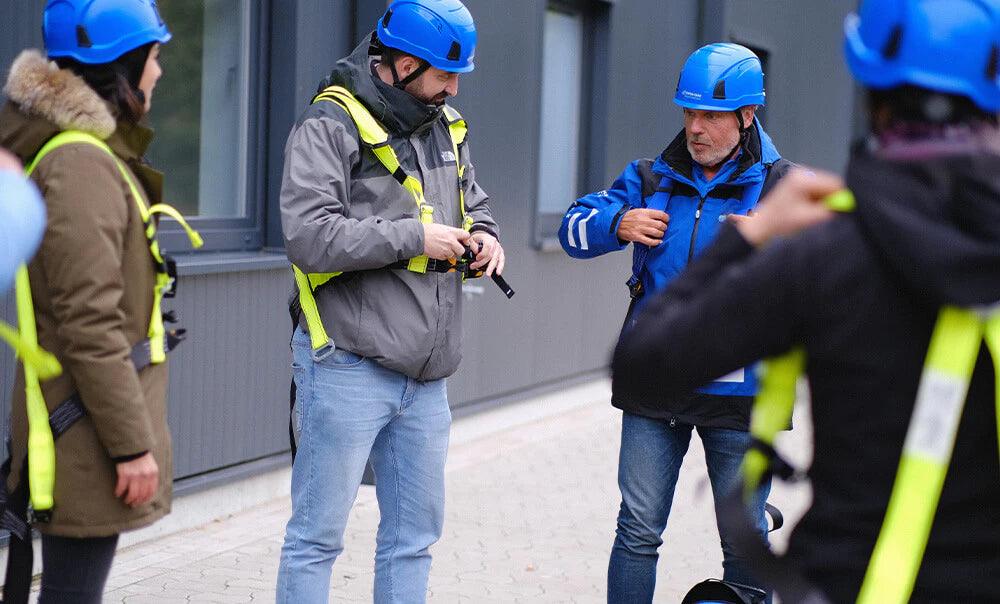
Those who sling loads need not only experience, but above all , thorough and regular training . In practice, most mistakes don't happen intentionally – but because the load-bearing capacity, angle, or condition of the sling is misjudged. This is precisely where sling training comes in.
The course covers the fundamentals of chains, ropes, lifting straps, round slings , and all common types of slings. This includes recognizing damage, correctly measuring angles, handling sharp edges, and typical risk situations on construction sites or in the workplace.
The training is not just a requirement, but a real help in making work easier: Those who can strike the target safely work more relaxed, faster and prevent dangerous situations before they arise.
For SYSTEM-CARD sniper training
Do you want to practice exam questions online? We have provided typical questions for you so you can test your knowledge directly online.
Exam questions: Practicing slinging loads
Qualifications and competence profile of slingers
Safe rigging is a skilled activity. According to DGUV 209-013, riggers must be adequately instructed and qualified . Experience alone is not enough – technical understanding and the ability to correctly assess situations are crucial.
What strikers need to know professionally
- Chain, wire rope and textile technology
- Calculate load-bearing capacities
- Measuring and estimating angles
- Assess load distribution and center of gravity
- Select and check edge protection
- Identify hazards + derive appropriate measures
- Communication with crane operator
- Documentation + auditing obligations
Competency Matrix (Practice-oriented)
| Level | Competency level | Typical tasks |
|---|---|---|
| beginner | Basics are available | Simple symmetrical loads, under supervision |
| Advanced | Accurate in calculation, angle, selection | Asymmetrical loads, edge protection, coordination with crane operator |
| expert | Advanced expertise, risk analysis | Critical loads, trusses, emergency assessment, instruction of others |
Errors, accident risks
| Mistake | Consequence | Avoidance |
|---|---|---|
| Incorrect lifting device | Overload | Use load table |
| No edge protection | Cut, teardown | Use edge protection |
| Too large an angle | Massive loss of load-bearing capacity | Extend strands |
Practical examples of errors (real-life cases)
In practice, the most serious accidents are not caused by material failure, but by incorrect assumptions: wrong angle, underestimated center of gravity, lack of edge protection, or overloading. The following case studies are taken from typical construction site and industrial situations and show how quickly things can become critical.
Case study 1 – Inclination angle misjudged (50° instead of 30°)
A 3-ton load is slung with a two-leg sling. The rigger estimates the angle "visually" at 30°, but it is actually 50°. This reduces the load-bearing capacity by almost 40%. The load begins to swing during lifting, and one leg is briefly overloaded. When lowering the load, the spreader beam slips by 15 cm – a worker is almost trapped.
Lesson: Never estimate angles. Use a protractor or measuring rod.
Case study 2 – Edge not protected → Wire rope breaks
A container is hung with a 12 mm wire rope. A sharp steel edge rests against the upper edge. Without edge protection, a point-contact notch effect occurs. As the crane swings, one wire after another breaks. The rope snaps abruptly, the container falls 80 cm onto a truck bed, severely damaging the vehicle.
Lesson: Any visible or tactile sharp radius → always require edge protection.
Case study 3 – 4-strand sling with asymmetrical load
A welded structure with an unclear center of gravity is lifted using a four-strand sling. Because the load is unevenly distributed, only two strands are actually bearing the weight. The others are hanging loosely. The system is overloaded, even though "four strands" visually suggest safety.
Lesson: Only symmetrical loads activate all strands. Otherwise, calculations always assume two strands.
Case study 4 – Chain with 7% elongation is reused
A 10 mm chain shows 7% elongation during its annual inspection – the limit is 5%. Because "it has held up for the last few years," it continues to be used. While lifting a 2.5-ton component, it breaks in the middle third. The load falls into a cordoned-off area.
Lesson learned: Lengthening above 5% → immediate rejection, no matter how "good it looks".
Emergency scenarios during lifting
Even with good preparation, things can go wrong during the firing process. The crucial factor is that the hitter knows how to react in critical moments – clearly, calmly, and according to the rules.
Emergency 1 – The load begins to tip over
Cause: misjudged center of gravity or strand that is too short on one side.
Immediate measures:
- Crane operator: stop immediately
- Reduce load minimally → End pendulum swing
- Setting new anchor points
- Redefine focus
Emergency 2 – Load suddenly touches down or “slips”
Possible cause: uneven tension, strand jammed, unresolved twist.
Proceed:
- Stop crane movement immediately
- clear the area
- Set the load down again
- Untwist strands, correct angles, and if necessary, choose a different rigging device.
Emergency 3 – Visible damage to the lifting equipment during lifting
Example: Visible wire break, damaged textile strap, deformed chain link.
- Stop movement – do not lift or swing any more loads
- Unload
- Immediately take defective equipment out of service.
- Documentation + notification to a competent person
Emergency 4 – Person in danger zone
Rule: Never continue lifting if people are in the load's shadow.
Process:
- Acoustic stop call
- Fix (hold) the load
- evacuate the danger area
- Continue the process only after approval.
Determine the practical focus
The center of gravity determines whether a load hangs stably. Incorrect assumptions lead to tipping or swaying.
Method 1 – Geometric Center
For symmetrical loads, the center is the first reference point.
Method 2 – Lifting Test
Lift the load 5–10 cm and observe its movement:
- Tilts to the right → Extend the right stop point
- Tilts forward → extend rear strand
Method 3 – Weighing test
For complex components: Gradually lift and adjust the load until it is stable.
Edge protection, protective measures
When edge protection is absolutely necessary
This applies whenever the edge radius is smaller than the diameter or thickness of the lifting device. Textile devices are particularly sensitive in this regard.
Types of edge protection
| type | material | Advantage |
|---|---|---|
| PU protective hose | Polyurethan | Cut-resistant |
| PU edge protection plate | PU 5 mm | Very robust |
| Magnetic angle | Magnet steel | Quick assembly |
Securely attach special loads
Pipes & Profiles
- Hanging prohibited
- Round slings only with edge protection
- The center of gravity is often located outside the geometric center.
Steel sheets / plates
- Suitable for magnetic lifters (refer to EN 13155)
- The surface must be clean and level.
Wire mesh boxes
- Never bang on prison bars
- Only at defined anchor points
Tanks / Containers
- The focus is often shifted.
- Trusses are mandatory
Storage
Proper storage conditions
Store lifting equipment in a dry, UV-protected, and suspended location. Avoid contact with chemicals and heat. Keep test data visible.
Cost-benefit analysis: Chain vs. rope vs. lifting strap
What is the most economical option in the long run?
Chains are expensive but extremely durable. Wire ropes offer excellent value for money. Textile lifting slings are inexpensive but need to be replaced more frequently – especially without edge protection.
| type | acquisition | life | Cost over 10 years |
|---|---|---|---|
| Chain | High | Very long | Small amount |
| wire rope | Medium | Medium | Medium |
| Lifting strap | Low | Short | High |
Magnetic load-handling devices
When is it useful?
Magnetic lifters are an extremely fast solution for steel sheets, profiles, and plates. They can be used without lifting equipment, but their effectiveness is highly dependent on the surface.
| criterion | Evaluation |
|---|---|
| Surface dependency | High |
| standard | EN 13155 |
| Temperature dependence | High |
Modern technologies in action
IoT load sensors
Wireless sensors in shackles, chains, or spreader beams measure tensile forces in real time. Ideal for critical lifting operations or loads with an unknown center of gravity.
Digital test reports
QR codes on the lifting equipment show the inspection status and history. Documentation is automatically saved and is audit-proof.
RFID tracking
RFID tags track inventory levels, usage frequency, and storage locations. Losses and stockouts are significantly reduced.
International Standards
DGUV vs. EN/ISO
Germany operates according to DGUV and DIN standards – very strict rules regarding angles and placement. EN standards are internationally recognized, and ISO is a global standard.
USA – OSHA ASME
In the USA, OSHA and ASME B30.9 apply. Here, textile agents are assessed differently, sometimes with stricter reduction factors.
| region | standard | Special feature |
|---|---|---|
| Germany | DGUV | Strict angle specifications |
| Europe | EN | Harmonised |
| Worldwide | ISO | Internationally valid |
| USA | OSHA/ASME | Textiles tighter, chains looser |
Conclusion – The most important rules
Know the weight, mark the center of gravity, check the angles, use edge protection, and perform a visual inspection. Adhering to these five basic principles drastically reduces the risk of accidents when attaching loads.




Share:
Become a forklift driver: safely, trained and responsibly
Renting a work platform for private use – what is allowed?
Our editorial quality standards
The subject content on biberger.de are editorially created, reviewed, and continuously updated. The basis is our daily work with aerial platforms, telehandlers, and industrial trucks – in rental, sales, operational planning, and technical support.
Each article draws on real-world experience and is editorially reviewed for clarity, accuracy, and practical relevance according to expert criteria. Technical statements are regularly compared against current industry standards and best practices.
The aim of our publications is to make reliable specialist knowledge accessible and to offer guidance to users, decision-makers and industry partners. BIBERGER sees itself as an independent information platform for safe, economical and modern height access technology – well-founded, comprehensible and free from advertising influence.