


 What You Need to Know
In Germany, several relevant training systems for mobile elevating work platform operators exist in practice: the DGUV principle 308-008 as the employers' liability insurance association basis, the SYSTEM-CARD® based on it as an association-organized quality system, and the international IPAF system with the PAL Card .
All three systems are permissible and recognized. The decisive factor for selection is not "better or worse," but rather the area of application , the client's requirements , and above all: how efficiently you organize instruction, assignment, and documentation in daily operations to avoid liability risks.
Brief overview: DGUV 308-008, SYSTEM-CARD® and IPAF
DGUV 308-008 in one sentence
DGUV 308-008 is the German qualification principle according to which operators are trained theoretically and practically. It constitutes the legal minimum standard.
Many providers voluntarily limit the validity of certificates to 5 years, even though the principle itself does not stipulate a time limit. The quality of the training depends heavily on the individual trainer, as there is no central auditing system.
SYSTEM-CARD® in one sentence
SYSTEM-CARD® is the training system of SYSTEM LIFT AG , which fully complies with DGUV principle 308-008 and additionally covers the ISO 18878 standard.
It features TÜV-certified quality management . Over 80 SYSTEM-CARD training centers and more than 110 trainers operate according to uniform standards. It combines compliance with German law with a fixed 5-year validity period and digital solutions (eLearning) for annual refresher training.
IPAF PAL Card in one sentence
IPAF is a globally standardized system. In Germany, the PAL Card is recognized by the employers' liability insurance association as a fully valid certificate of competence according to DGUV 308-008 .
It is primarily the standard in the Anglo-American world and thus functions as a "passport" for international assignments. Due to its clear categorization (e.g., 3a, 3b), it is also often required as a standard by national corporations.
Legal classification: What is mandatory, what is optional?
What you as an employer absolutely must do
Regardless of the training system, independent operation may only be delegated to suitable, instructed and written authorized persons.
A basic qualification (the "certificate"), annual safety training , equipment-specific instruction , and thorough documentation are required.
Quality assurance and liability protection
In the event of an accident, experts often examine not only whether training was provided, but also how it was conducted. While employers must verify the trainer's qualifications for independent DGUV training courses, systems like SYSTEM-CARD® or IPAF guarantee a defined standard through external audits (e.g., TÜV or ISO certification). This relieves the employer of responsibility in the selection process ("selection negligence").
In plain terms, this means that economic savings or personal preferences ("We've known the trainer for a long time") are secondary in liability cases. If the quality of the training isn't up to standard, even cost savings are irrelevant – safety and verifiable standards carry more weight legally.
The most critical difference: The annual instruction
The biggest risk: The "forgotten" repetition
Annual training is legally mandatory (DGUV Regulation 1 / ArbSchG). Many companies fail not because of the initial training, but because of the difficulty of organizing and documenting this annual requirement. A lack of training renders even the best basic training vulnerable in the event of a liability claim.
The solution: In-person vs. eLearning
The systems differ massively in their suitability for everyday use:
- Traditional (DGUV/IPAF): Often, employees have to return to a training room for instruction, or the safety officer has to painstakingly schedule appointments. This costs working time and organizational effort.
- Digital (SYSTEM-CARD®): The system offers integrated eLearning modules (approx. 15-20 min.). The employee completes the training on a PC or tablet, and the system automatically documents it. This saves significant administrative costs and ensures that nothing is overlooked.
Validity in comparison
| feature | DGUV 308-008 (Clean) | SYSTEM-CARD® | IPAF PAL Card |
|---|---|---|---|
| Basic proof | Unlimited nationally (often 5 years, depending on the provider) | 5 years | Card: 5 years / Logbook: Basic training (indefinite) |
| Annual instruction | Mandatory (manual documentation) | Mandatory (eLearning possible) | Mandatory (manual documentation) |
| refreshing | Recommended | After 5 years | After 5 years (for a new card) |
Content and additional qualifications
Theory Practice
All systems cover legal principles, equipment technology (stability, load diagrams), operating limits (wind, ground conditions), and emergency lowering scenarios. The content is largely harmonized by DGUV and ISO standards.
Important: Personal protective equipment against falls (PPE against falls)
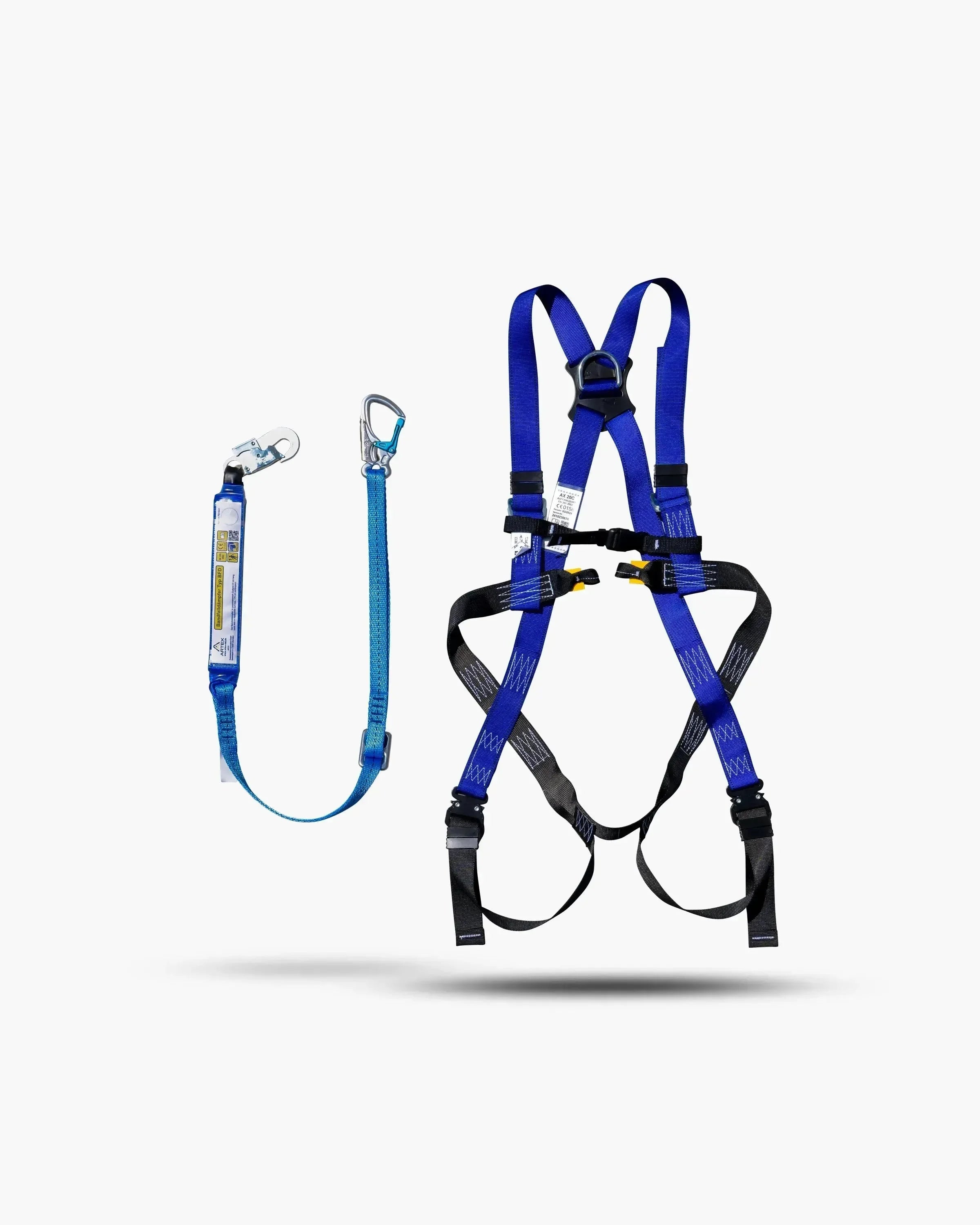
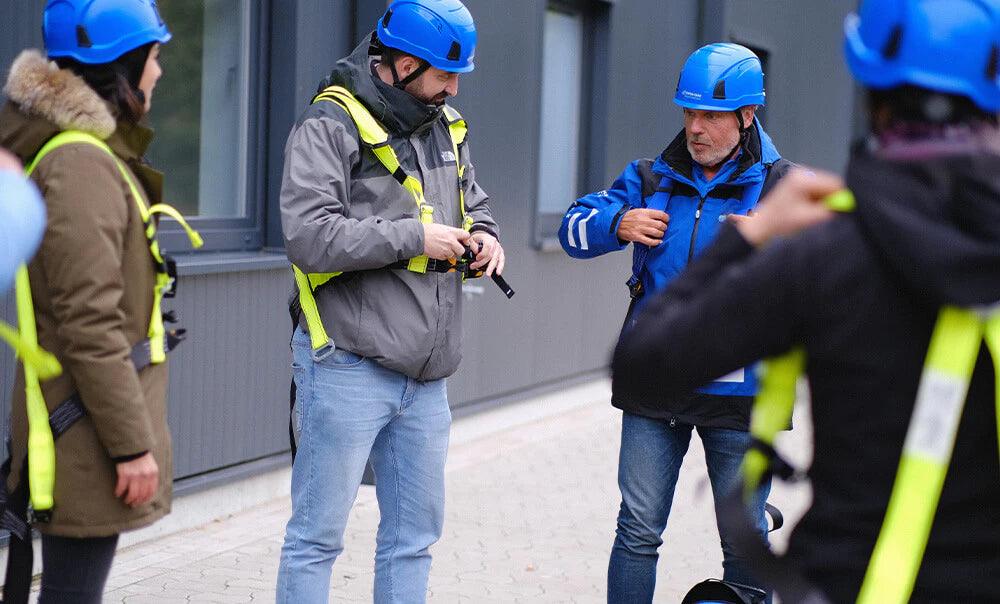
Often forgotten: Personal protective equipment against falls from height (PPE) is mandatory on mobile elevating work platforms (especially telescopic platforms). An operator's license alone usually does not include the necessary practical training in the use and rescue of PPE against falls from height. Professional training providers therefore offer combined modules that directly integrate PPE against falls from height instruction according to DGUV Regulation 112-198.
Economic efficiency: Total Cost of Ownership (TCO)
Many companies only compare the costs of initial training. However, the true costs arise over a five-year period due to lost productivity and the administration of annual training sessions.
Example calculation: Cost per operator over 5 years
Scenario: 1 operator, initial training + 4 annual refresher courses.
| Cost factor | Classical (Presence) | System solution (with eLearning) |
|---|---|---|
| Initial training (approx.) | €250.00 | €300.00 |
| Annual training (course fees) | 4 x €80 = €320.00 | 4x approx. €15.00 ( eLearning ) depending on the price tier |
| Lost work time (4 x 2 hours travel time/course) | approx. €400.00 (labor costs) | approx. €50.00 (4 x 15 min.) |
| Total costs over 5 years | approx. €970.00 | from approximately €410.00 |
Conclusion: Systems with integrated eLearning (such as SYSTEM-CARD®) often have a slightly higher initial investment, but usually pay for themselves in the second year through the elimination of travel time and organizational effort.
Decision aid: In-house or training center?
When is what worthwhile?
- Training Center (External): Ideal for SMEs and companies with up to approximately 50 operators. Advantages: Professional environment, various equipment types available, no internal preparation required, legally compliant documentation provided by the supplier.
- In-house training (at your own company): This is worthwhile for very large groups. Requirements: A suitable training room, appropriate machinery (with valid certification), and sufficient space for driving exercises must be available.
Hybrid model (recommended): Initial training externally at the center (full quality), annual refresher courses digitally via eLearning. This is often the most economical and safest way.
Decision based on scenario
Scenario A: Regional, own equipment, permanent staff
A proper DGUV training course is sufficient. Make sure to use certified providers to avoid variations in quality.
Scenario B: Nationwide, rental equipment, changing construction sites
SYSTEM-CARD® is the "worry-free solution" here. It is recognized throughout Germany, offers TÜV-certified quality, and significantly reduces your bureaucracy through the digital management of annual training requirements.
Scenario C: International projects / especially USA, UK, Australia
IPAF is the standard here. Anyone working across borders (especially in the Anglo-American world) needs the PAL Card as an "entry ticket" for international construction sites.
Implementation plan: How to roll this out smoothly in your company
Step 1: Inventory in 30 minutes
List all individuals who operate stage equipment (or are intended to do so in the future). For each person, record: existing certifications, frequency of use, equipment types, and typical work locations. This will allow you to immediately identify any gaps in qualifications or documentation.
Step 2: Set the standard and define "special cases".
Decide whether you will use DGUV or IPAF as the standard – and for which projects stricter requirements apply. Define clear rules: Which devices may be operated and with what certification? The clearer these rules are, the less chaos will arise when changing construction sites.
Step 3: Establish annual training as a fixed process
Plan the training like mandatory maintenance: recurring, with fixed dates, and documented. Without routine, the topic will always be postponed until "next quarter"—until the first audit or accident. Implement a central (digital) filing system so that documentation is available within minutes.
Step 4: Expiry and deadline monitoring
For IPAF, you need to monitor the expiration of PAL cards. For DGUV, you need at least monitoring of annual training dates and internal assignments. If you don't track this automatically, it's guaranteed to happen too late at some point.
Commissioning documentation: The actual liability protection
The certificate is only the first step. For legally compliant use, you need the minimum set of supporting documents:
- Valid certificate of competence (SYSTEM-CARD®, IPAF or DGUV certificate)
- Proof of last annual training (e.g. eLearning certificate)
- Written authorization by the employer
- Record of device-specific training (on the day of deployment)
Common mistakes in practice: These are the real liability traps
Error 1: "Certificate is there, that's fine"
Without annual training and written authorization, the system is flawed. From the outside, it often looks "okay"—until it's audited. The most frequent weakness isn't the training itself, but the lack of annual documentation.
Error 2: No device training for new models
Even trained operators need instruction if equipment differs significantly (controls, emergency lowering, outriggers, load moment logic). "I already know how" is not a process. Document training sessions concisely but consistently – it's inexpensive and provides protection.
Error 3: Emergency lowering/rescue is not regulated.
Many teams know in theory that an emergency release mechanism exists, but not who does what and when. In a real emergency, a slide doesn't matter; what counts is a practiced procedure. Define roles, rehearse the scenario, and establish it as a company policy.
Conclusion: What really matters
Legal certainty arises from established processes, not just from a card. DGUV is the foundation, IPAF the international specialist, and SYSTEM-CARD® the structured, cost-effective solution for companies seeking legal compliance with minimal administrative effort.
Training courses at BIBERGER
Note: The following section presents the product range of the company BIBERGER.
As a certified training center, BIBERGER offers practical training courses based on DGUV 308-008 and ISO 18878 .
As a partner of SYSTEM LIFT, we utilize the established SYSTEM-CARD® concept . Our customers benefit from:
- Quality and safety: Training provided by experienced full-time trainers in a professional environment.
- Efficiency through digitalization: Initial training in theory and practice with us – your employees complete the annual instruction in a time-saving manner via eLearning.
- Complete service: In addition to the operator's license, we can also integrate PPE training upon request or offer training for forklifts and telescopic handlers.
We would be happy to advise you on whether training at our center or an in-house solution would be more suitable for your company.




Share:
Typical planning mistakes when using aerial work platforms for the first time – and how to avoid them.
Accessing large areas at height: How to plan equipment, logistics and processes without downtime
Our editorial quality standards
The subject content on biberger.de are editorially created, reviewed, and continuously updated. The basis is our daily work with aerial platforms, telehandlers, and industrial trucks – in rental, sales, operational planning, and technical support.
Each article draws on real-world experience and is editorially reviewed for clarity, accuracy, and practical relevance according to expert criteria. Technical statements are regularly compared against current industry standards and best practices.
The aim of our publications is to make reliable specialist knowledge accessible and to offer guidance to users, decision-makers and industry partners. BIBERGER sees itself as an independent information platform for safe, economical and modern height access technology – well-founded, comprehensible and free from advertising influence.