







 What You Need to Know
Introduction
Why errors occur even before deployment
The safe operation of a work platform begins long before the basket lifts off. Mistakes don't happen during the lift itself, but in the preparation: assessing the ground conditions, selecting the right equipment, and coordinating with the team. It is precisely at this stage that the success of an operation is determined – or whether risks arise that can no longer be rectified.
Why structured planning is crucial
This guide shows you the most common planning errors when using a mobile elevating work platform for the first time and explains why they are so often underestimated in practice. You will gain clarity on what really matters, which factors are critical for safety, and why structured preparation is an essential part of your responsibility.
Subsurface analysis errors: Load-bearing capacity is often overestimated.
Optical misjudgments of the ground
Many businesses rely on the visual appearance of the ground – a seemingly solid surface, smooth asphalt, a dense meadow. But you can't determine load-bearing capacity by sight alone; it can only be determined through testing or calculation. Without this, the greatest risk of tipping over and sinking arises.
Point loads and the effect of boom movements
Small support surfaces generate enormous point loads that can overwhelm even solid surfaces. This becomes particularly critical when the stage is designed laterally, transferring up to 80 percent of the load to a single support leg.
Changing conditions during the operation
Underground cavities, frost, rain, or waterlogged soil exacerbate the problem – often unnoticed. Even sun-heated asphalt loses its stability under continuous load.
What this error triggers in practice
Sagging, tipping sideways, or a gradual tilt that only becomes visible at full height. The result is damage, breakdowns, and a high risk of injury.
Everything about soil bearing capacity
Incomplete risk assessment: Dangers remain undetected
Lack of understanding of the operating environment
Often, clear information is lacking regarding traffic routes, crane impacts, power lines or parallel work by other trades – all of which directly affects safety.
Unclear roles and lack of coordination
Even simple questions like "Who is moving around the work area and when?" or "What measures are necessary?" often remain unanswered. This leads to unexpected disruptions and critical situations.
Risk assessment as an active tool
A good risk assessment is not a document to be filed away, but an active planning tool that prepares all subsequent decisions.
Everything about risk assessment
The wrong work platform: Requirements are underestimated.
Misjudgments regarding height and range
Working height, reach, and platform height are frequently confused or incorrectly specified. An unsuitable selection results in the platform not reaching the work area.
Inappropriate load capacity or basket load
If the load is miscalculated, there will be insufficient reserves for materials, tools, or a second person during operation. Overloading is a frequent trigger for safety shutdowns.
Chassis and terrain requirements
Self-propelled platforms are often used on construction sites, even though outriggers are mandatory. Failure to properly equip the platform for uneven terrain is a typical cause of loss of control.
Support and shimming errors: Load distribution is incorrectly planned.
Incorrect or missing washers
Support plates are often chosen too small or not placed in the center. As a result, they tip over, slip out of place, or fail under load.
Insufficient knowledge of ground pressure values
Without calculations, load distribution cannot be reliably planned. Many people improvise on the construction site – and significantly increase the risk.
Dangers from hidden cavities
Undermined or concealed areas such as pipes, shafts or channels lead to the sudden sinking of individual supports.
Inadequate training: Operating errors are inevitable.
Lack of basic knowledge in handling stages
Approximately two-thirds of all serious accidents are caused by operator error. Without thorough training, there is a lack of understanding of the limits of driving, steering, and stability.
Lack of knowledge about emergency systems and limit values
Emergency release devices, torque limiters or tilt sensors are often only "discovered" in an emergency – far too late.
DGUV training as a safety factor
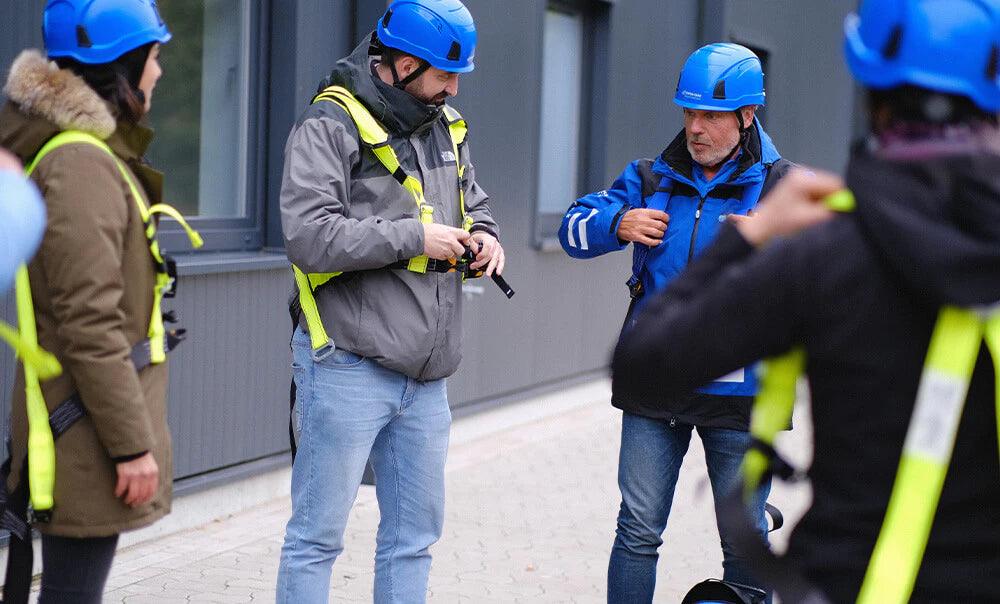
A thorough training course on lifting platforms not only imparts theory, but also the ability to make decisions in real-world applications.
Deficiencies in preparation and functional testing: Technology remains uncontrolled
Blind spots during visual inspection
Brakes, hydraulics, electronics, and emergency stops must be checked daily. However, this routine is frequently skipped.
Typical oversights before starting work
Oil leaks, damaged cables or blocked switches are only noticed during use and then lead to dangerous situations.
Why the exam only takes a few minutes
The visual and functional inspection is brief but crucial. It prevents malfunctions that can quickly become life-threatening at high altitudes.
Online check: visual inspection
Underestimated slope: Physics becomes a risk
Even slight inclines have an impact.
Even slight inclines significantly affect stability and driving behavior. If limit values are exceeded, the stage loses its stability.
Faulty support techniques
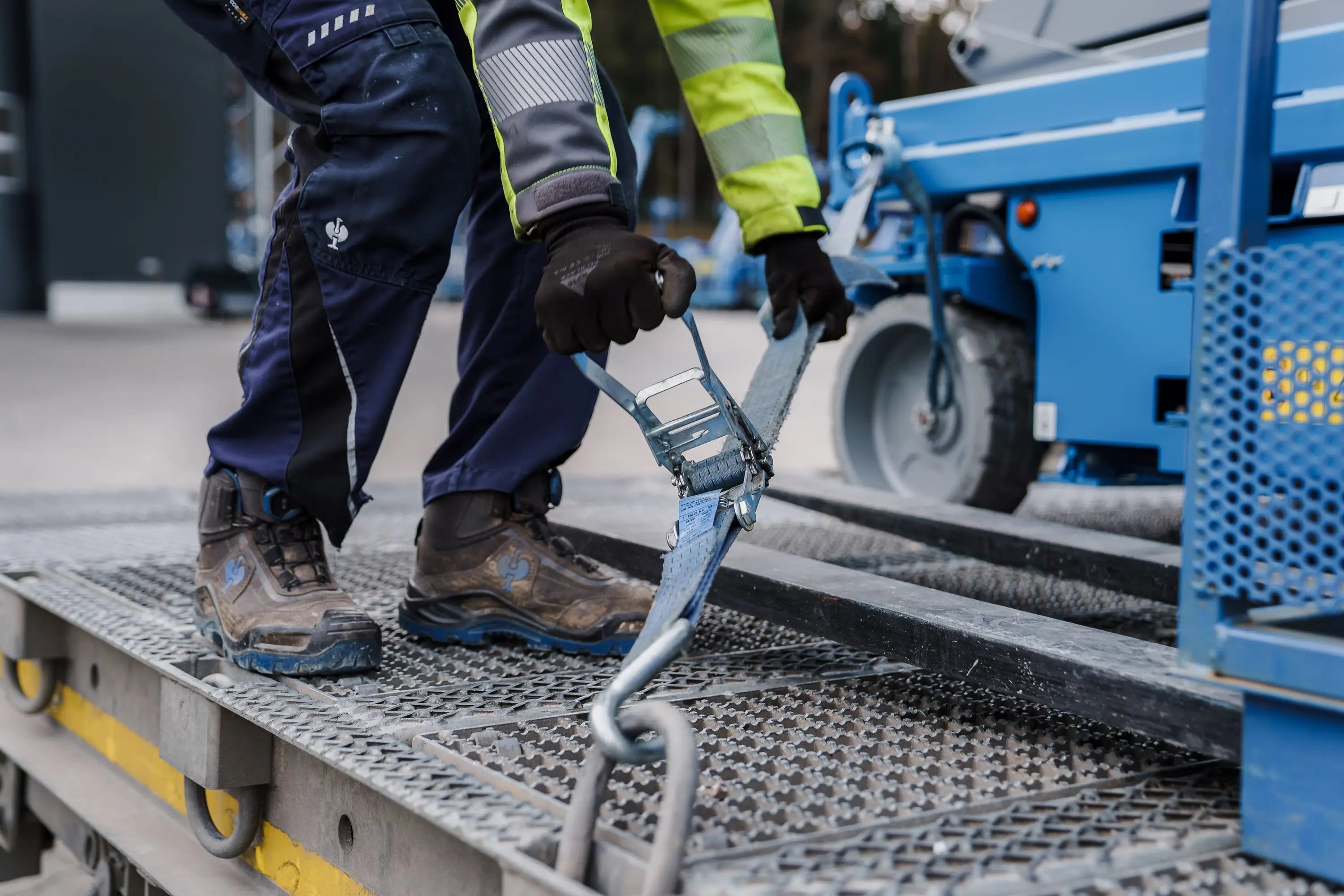
An incorrect sequence or insufficient securing against slipping leads to dangerous shearing and rolling movements.
Influence of weather and subsoil
Icy surfaces or softened ground give way under load and change the inclination values within seconds.
Lack of documentation: Responsibility remains unclear
Why evidence is crucial in emergency situations
Without operating instructions, training, test reports or assignments, it is unclear who bears which responsibility.
Legal consequences for operators
In the event of damage, a lack of documentation can lead to significant liability issues.
Documentation as part of the security concept
It creates traceability and ensures that equipment, people and processes are correctly prepared.
Wind and weather: external influences are ignored
Wind limits and stability
Many stages are only approved for wind speeds up to 12.5 m/s. If this value is exceeded, the stage loses its stability – even without visible swaying.
Influence of rain, frost and sun
Wetness, cold, or softened asphalt alter load-bearing capacity and braking performance. These changes are often gradual.
Planning with weather forecasts
A simple weather check before starting a mission prevents many critical situations during the day.
Power lines: Safety distances are lacking
Dangers from electric arcs
Proximity to high-voltage power lines is one of the most underestimated risk factors. Even small distances are enough to cause an electric arc.
Unclear distances and lack of surveying
Altitude measurements are often estimated rather than verified – a frequent cause of life-threatening situations.
Plan work near power lines in a structured manner
Safety distances must be determined before the start of operations and continuously monitored.
Conclusion: Safe operations require structure – not improvisation.
Why planning is the central security instrument
Most errors during initial deployments are not caused by technical issues, but by a lack of planning. Coordinating the terrain, equipment, surroundings, and personnel early on lays the foundation for safe operation.
Professional work begins before the first stroke
Security is not a matter of chance. It is the result of systematic preparation, clear responsibility, and technical expertise. This is precisely where professional work begins.



Share:
Wind and aerial work platforms: What you absolutely need to know for safe use
DGUV 308-008, SYSTEM-CARD® or IPAF: Which mobile elevating work platform training does your team really need?
Our editorial quality standards
The subject content on biberger.de are editorially created, reviewed, and continuously updated. The basis is our daily work with aerial platforms, telehandlers, and industrial trucks – in rental, sales, operational planning, and technical support.
Each article draws on real-world experience and is editorially reviewed for clarity, accuracy, and practical relevance according to expert criteria. Technical statements are regularly compared against current industry standards and best practices.
The aim of our publications is to make reliable specialist knowledge accessible and to offer guidance to users, decision-makers and industry partners. BIBERGER sees itself as an independent information platform for safe, economical and modern height access technology – well-founded, comprehensible and free from advertising influence.