


 What You Need to Know
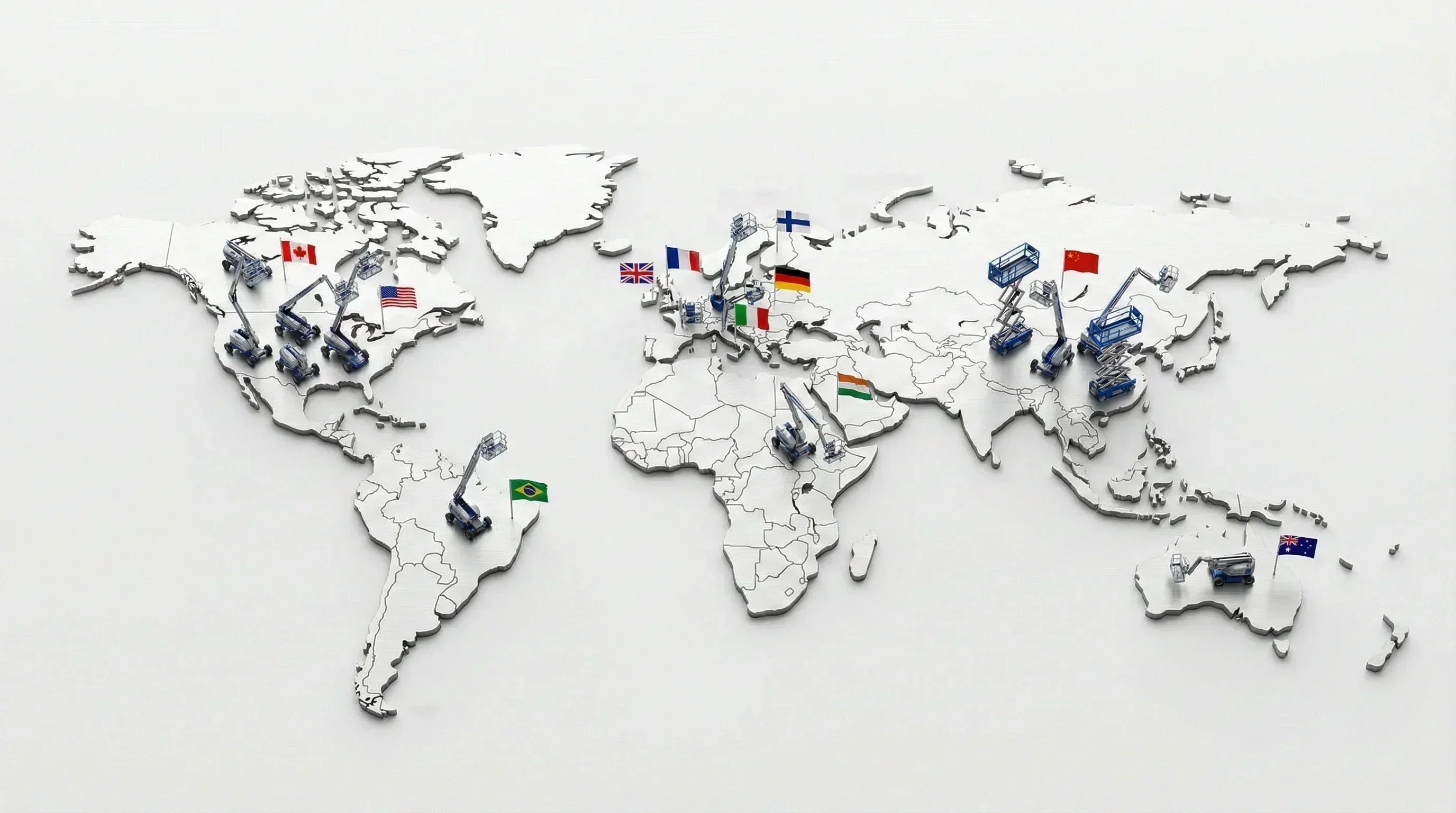
Aerial work platforms are indispensable on almost every construction site and in many industries. However, although the basic technology is similar worldwide, markets differ significantly in terms of regulation, manufacturing landscape, pace of innovation, and typical application profiles. Understanding international developments therefore requires not only technical data but also context. This guide shows you how differently aerial work platforms are used around the world and what factors shape the markets.
Many differences only become apparent in the details: While standards and safety regulations structure the market in Europe, production speed and large fleets dominate in Asia. North America focuses on huge production volumes and robust systems, while Scandinavia sets standards in specialized segments with its fire and rescue technology.
For companies that plan or compare projects internationally, this overview is a valuable tool.
Global characteristics of the aerial work platform markets
Aerial work platforms are internationally recognized as key technology for construction, maintenance, and industry. Nevertheless, markets never develop identically. Depending on the region, standards, infrastructure, economic conditions, and industrial traditions determine which equipment is preferred and how quickly technological innovations are adopted.
In highly regulated markets like Germany or France, standards often dictate which equipment can be used. In high-growth markets like China or Brazil, however, speed is more important: equipment must be available, robust, and capable of reaching high altitudes.
DACH region (Germany, Austria, Switzerland)
Market structure
The DACH region, which we serve, is one of the most strictly regulated markets worldwide. Safety, compliance with standards, and technical documentation are paramount for German aerial work platform rental companies . Equipment requires CE certification and conformity with the Machinery Directive 2006/42/EC and EN 280-1. Annual safety inspections are mandatory and meticulously documented.
In this environment, durable equipment with high-quality components dominates. Users value precise control, high stability, and comprehensive safety features. Equipment fleets consist primarily of diesel-powered machines for outdoor use and electric scissor lifts or mast lifts for indoor applications.
Manufacturer landscape
Several European heavyweights shape the region:
Ruthmann stands for high-performance truck-mounted aerial work platforms and develops models ranging from compact urban solutions to heights exceeding 70 meters. Haulotte is one of the world's leading manufacturers of aerial work platforms and offers virtually all types of equipment.
Teupen specializes in tracked platforms with a compact design, while JCB is growing increasingly in the field of electric scissor lifts.
Training and standards
Operator training in the DACH region follows clearly defined rules: DGUV Principle 308-008, DGUV 208-019, and EU standards specify the required qualifications. The IPAF-PAL card is widely used and internationally recognized.
United Kingdom
Special features of the market
The British market is highly fragmented and characterized by many regional suppliers, each covering specific application areas. Compact truck-mounted platforms between 20 and 25 meters are particularly in demand, as they are ideally suited for urban and versatile applications.
Very high platforms, on the other hand, are less frequently used because Great Britain offers fewer typical applications for extreme working heights. In Southern Europe – for example in Italy – the situation is different: there, telecommunications, wind energy, large industrial plants and historical architecture lead to a significantly higher demand for equipment with a long reach and height.
Manufacturer
Key manufacturers includeNiftylift – known for compact, efficient machines with diesel and 4x4 drive – and Multitel with a wide range of truck and articulated platforms.
Regulatory requirements
The requirements largely follow EN standards, supplemented by the nationally recognized IPAF certification. British culture in access and installation is strongly practice-oriented, with a focus on flexibility and robust applications.
United States of America
Market size and importance
The USA is by far the world's largest market for aerial work platforms. Fleets comprise several hundred thousand units and are highly industrialized, scaled up, and designed for maximum availability. Demand is primarily driven by industries such as oil and gas, large-scale logistics, infrastructure, and industrial plants.
These areas predominantly use robust diesel and off-road vehicles with high payload capacities that must operate reliably under demanding conditions.
Manufacturer
American manufacturers dominate the world market:
JLG is one of the world's leading manufacturers – known for scissor lifts, articulated boom lifts, and telehandlers. Genie (Terex AWP) is also among the world's best, primarily for its telescopic boom lifts and material handling equipment. Snorkel serves both standard and specialized segments, while Versalift specializes in MEWPs with a focus on infrastructure and energy supply.
Standards and training
The US relies on ANSI standards (A92.20, A92.22, A92.24). These differentiate between equipment types and application classes and are more strictly and technically defined than many EU standards. OSHA additionally regulates occupational safety and requires mandatory training for both operators and supervisors.
Canada
Market character
Canada is closely intertwined with the US market, but follows its own standards, such as the CSA standard. Manufacturers like Skyjack dominate the market, particularly with scissor lifts, articulated boom lifts, and telehandlers designed for extreme weather conditions.
Regional characteristics
The Canadian market is technically demanding: devices must function reliably in cold, snowy conditions and on varying surfaces. Electrical devices are gaining in importance, but are used less frequently outdoors than in Central Europe.
Australia
Market conditions
Australia has a medium-sized but technically demanding aerial work platform market. Applications are spread across distant cities, industrial centers, and remote infrastructure projects. Long distances, dusty environments, and high temperatures are commonplace and directly influence the selection and design of the equipment.
Aerial work platforms in these locations must be particularly robust, low-maintenance, and transportable . Long travel distances, rough terrain, and changing work sites demand reliable machines with high off-road capability and clearly predictable service intervals – breakdowns on the road are significantly more critical than in densely populated markets.
Manufacturer and usage
Australia uses a mix of European and North American equipment. Bronto Skylift platforms are used for industrial access at height, while local market players primarily use standard equipment for construction, maintenance, and plant operation.
Scandinavia / Finland
Market characteristics
Scandinavia has a strong tradition in fire and rescue technology. For decades, the region has been considered a development hub for particularly high-performance and specialized access systems. Manufacturers leverage the close interplay between practical requirements, safety culture, and technical standards to develop innovative solutions.
This has led to the development of some of the world's most powerful aerial rescue vehicles in Scandinavia – designed for extreme heights, high stability, and demanding operational scenarios. This specialization continues to shape the market today and makes the region a key driver in the international firefighting and special-purpose vehicle sector.
Manufacturer
Bronto Skylift is known for extreme height access and special platforms reaching heights of over 100 meters. Many of their platforms are used not only in Scandinavia but worldwide – in both municipal and industrial settings.
Main areas of use
Due to weather and geographical conditions, aerial work platforms must withstand the harshest conditions. Users expect high reliability and long service life.
Southern Europe (Italy, France)
Focus on high altitudes
For many years, Italy and France have been among the leading countries in the development and manufacturing of high-performance access equipment. Both markets possess extensive industrial expertise specializing in the design, reach, and efficiency of large work platforms. Manufacturers from these regions set international standards when it comes to working at height and technical precision.
Therefore, aerial work platforms with working heights of approximately 30 to 77 meters are significantly more common in Southern Europe than in many other European markets. They are used for demanding tasks in telecommunications, energy supply, industrial plants, and urban infrastructure, and are considered an important part of regional work practices.
Manufacturer
Haulotte is one of the global technology leaders. Multitel Pagliero develops highly specialized truck-mounted and tracked aerial work platforms. France Elévateur produces equipment for infrastructure, energy supply, and municipalities.
Regulatory framework
Both countries adhere to European EN standards and set similarly high requirements as the DACH region (Germany, Austria, Switzerland). Access equipment is frequently used for demanding maintenance and installation projects.
China and Asia
Growth market
China is currently one of the world's fastest-growing markets for aerial work platforms. Production capacities are increasing continuously, driven by large industrial groups and strong intra-Asian demand. At the same time, more and more manufacturers with broad product ranges are entering international markets, noticeably changing global competition.
The market is characterized by high price dynamics and rapidly increasing quality demands . Many Chinese suppliers develop their equipment specifically for export markets and increasingly meet international standards such as CE, ANSI, or CSA. This not only increases availability but also the technical maturity of the products, making China a key player in global access to altitude.
Manufacturer
Zoomlion offers one of the world's largest product ranges and is active in many export countries. Sinoboom is among the globally relevant manufacturers and supplies high-quality scissor lifts, articulated boom lifts, and telescopic boom lifts.
Market structures
The market is fragmented but experiencing extremely strong growth. Standards vary, as CE, ANSI, or CSA certifications are applied depending on the export country.
Latin America Brazil
Growth through infrastructure
Brazil is currently implementing extensive investment programs that are significantly increasing the demand for modern access equipment. Large infrastructure, energy, and urban development projects are driving a steadily growing demand for reliable work platforms for construction, assembly, and maintenance.
Since domestic production is still relatively small, the machinery used comes predominantly from the USA and Europe . Demand is growing faster than local production, which is why imports play a central role and international manufacturers provide important impetus for the Brazilian market.
challenges
Logistics, transport routes, climatic influences, and regional safety standards vary greatly for users. Maintenance infrastructure is not universally available.
Africa Middle East
Development status
Many African countries are still in the early stages of the structured use of aerial work platforms. The market is developing slowly but is increasingly being stimulated by construction, infrastructure, and energy projects. Since regional production capacities are limited, most equipment is imported internationally , often from European or Asian manufacturers.
Security culture is less established than in Europe, and training and maintenance structures are often still under development. This results in significant differences in the depth of application, documentation, and technical support. At the same time, the region shows long-term potential, as the demand for modern access technology is continuously increasing.
Manufacturer presence
Manufacturers like Haulotte are active and offer suitable equipment for regional requirements. Nevertheless, the market potential remains large in the long term.
Global Technology Trends
Electric and hybrid drives
Electric aerial work platforms are gaining importance worldwide – especially indoors and in emission-sensitive areas. Hybrid platforms combine reach and efficiency.
Digitalization Security
Modern devices offer diagnostic functions, access management, telematics monitoring, and security systems. These technologies enable more efficient operation and less downtime.
International comparison table
The following table summarizes key differences between the most important markets.
| region | Market size / Importance | Main manufacturer | Regulatory standard | Training / Certification | Typical drive type | Rental market characteristics | Insurance / Liability | Maintenance / TÜV requirement | Special features |
|---|---|---|---|---|---|---|---|---|---|
| Germany / Austria / Switzerland (DACH) | Tier 1 – highly developed | Ruthmann, Haulotte, Teupen, JCB | CE marking according to 2006/42/EC, EN 280-1 | IPAF PAL Card, ISO 18878, DGUV 308-008 / 208-019 | Diesel approx. 70%, electric 25%, hybrid 5% | Strongly consolidated | Machinery insurance is standard (partial coverage/comprehensive/breakage protection), roughly €500–3,000 per year. | UVV inspection at least once a year, maintenance approx. €200–500/year, documentation mandatory | Very high regulations and safety standards, rather high prices |
| United Kingdom (England) | Tier 2 – established, fragmented market | Multitel UK, Niftylift, imported JLG/Genie/Haulotte | CE, EN standards, IPAF standards | IPAF PAL card, partly with additional national requirements | Diesel approx. 80%, electric 15%, hybrid 5% | Many regional suppliers, focusing on 20–25 m truck-mounted platforms, price level similar to DACH. | Insurance required, conditions similar to EU standards | At least one inspection per year, tending to be less formally documented than in Germany, Austria, and Switzerland (DACH region). | Strong tradition in firefighting/rescue applications, niche market structure |
| United States (USA) | Tier 1 – world's largest market (500,000+ units) | JLG, Genie (Terex), Snorkel, Versalift, large rental companies like United Rentals | ANSI A92.20 / A92.22 / A92.24, OSHA specifications | ANSI training for Operator Supervisors, national certificates | Diesel approx. 85%, electric 10%, hybrid 5% | Highly consolidated (United Rentals dominates), daily rents roughly US$86–1,500 | Insurance is practically standard; the amount varies greatly depending on the state. | At least once a year, greater responsibility lies with the operator, sometimes less strict than EU regulations. | Huge rental fleets, strong focus on cost efficiency and availability |
| Canada | Tier 2 – established regional market | Skyjack, Sunbelt, JLG/Genie | CSA standards (similar to ANSI) | CSA-compliant training, IPAF widely accepted | Diesel approx. 75%, electric 20%, hybrid 5% | Established rental market, strong ties with the USA, prices similar to the USA | Insurance required, similar to the USA | At least once a year, standard comparable to the USA | Skyjack as an important manufacturing location, harsh climatic conditions |
| Scandinavia / Finland | Tier 2–3 – small, but highly specialized | Bronto Skylift, Jalo Jalo (rental), various EU manufacturers | CE, EN 280-1 | IPAF PAL card, EU standard | Diesel approx. 60%, electric 35%, hybrid 5% | A more compact, consolidated market with a focus on specialized firefighting equipment. | Insurance requirements similar to those in Germany, Austria, and Switzerland (DACH region), sometimes slightly cheaper. | At least once a year, good documentation culture | 112 m Bronto fire service platforms, high innovation and quality orientation |
| Southern Europe (France / Italy) | Tier 1–2 – well-developed, focus on height/range | Haulotte, Multitel Pagliero, France Elévateur and others. | CE, EN 280-1, EU harmonized rules | IPAF + national training models | Diesel approx. 75%, electric 20%, hybrid 5% | Relatively consolidated (e.g., Loxam), many high-performance devices up to ~77 m | Insurance standard EU regulations, comparable to those in Germany, Austria, and Switzerland (DACH). | At least once a year, EU-compliant documentation | Strong specialization in high altitudes, Haulotte as a global key player |
| China / Asia | Tier 1 – rapidly growing wholesale market | Zoomlion, Sinoboom, Horizon Construction Dev., other regional manufacturers | Combination of CE, ANSI, CSA, KC depending on export destination | National training systems, IPAF/ANSI only selectively | Diesel approx. 70%, electric 25%, hybrid 5% | Rapidly growing, often fragmented rental market, aggressive price competition | Insurance varies greatly, sometimes even minimally. | Maintenance and testing standards vary, not consistently at EU level. | Cost advantages, large fleets, quality highly dependent on manufacturer, increasing exports |
| Latin America / Brazil | Tier 3 – Growth market with great potential | Mostly imported US/EU equipment, local rental companies | Locally adapted combination of ANSI/CE-like rules | Inconsistent; IPAF/ANSI is more common in larger projects. | Diesel approx. 90%, electric 5%, hybrid 5% | Fragmented, demand driven by infrastructure programs (e.g. PAC in Brazil) | Insurance obligations are inconsistent and highly dependent on the country. | Maintenance infrastructure is limited, standards are less strict. | High growth potential for Western suppliers; logistics service is crucial. |
| Australia | Tier 3 – smaller but established market | Bronto Skylift (deployment), Summit Tower Hire, international rental companies (e.g. United Rentals) | National standards, often based on ANSI/CE | National courses, widely recognized by IPAF/ANSI | Diesel approx. 80%, electric 15%, hybrid 5% | Regional providers + increasing consolidation by international corporations | Insurance required under Australian law | Regular inspections (at least once a year), documentation required. | Long distances, hot climate; logistics and robustness are particularly important. |
| Africa / Middle East | Tier 4 – severely underdeveloped market | Haulotte Africa, various imported devices | Very heterogeneous, often only basic requirements | There are hardly any uniform standards; training is mostly project-based. | Diesel approx. 95%, electric/hybrid hardly represented | Less developed rental market, primarily used in large projects with international companies | Insurance requirements vary greatly depending on the country and project. | Poorly regulated, limited workshop and service infrastructure | Significant need for improvement in safety, training, and service; great long-term potential. |
Conclusion: What does the international comparison mean for practical application?
Whether in Europe, the USA, or China – the market for aerial work platforms is in flux worldwide. Understanding international differences allows for better risk assessment and the selection of the right technology for each project. Manufacturers are increasingly developing global platforms, while regional requirements continue to create significant variations.
For users, this means: Thinking outside the box is worthwhile. New technologies, alternative drive systems, and international safety standards are shaping the future of the industry – and opening up new opportunities to work more efficiently, safely, and sustainably.




Share:
Renting a work platform for private use – what is allowed?
Wind and aerial work platforms: What you absolutely need to know for safe use
Our editorial quality standards
The subject content on biberger.de are editorially created, reviewed, and continuously updated. The basis is our daily work with aerial platforms, telehandlers, and industrial trucks – in rental, sales, operational planning, and technical support.
Each article draws on real-world experience and is editorially reviewed for clarity, accuracy, and practical relevance according to expert criteria. Technical statements are regularly compared against current industry standards and best practices.
The aim of our publications is to make reliable specialist knowledge accessible and to offer guidance to users, decision-makers and industry partners. BIBERGER sees itself as an independent information platform for safe, economical and modern height access technology – well-founded, comprehensible and free from advertising influence.