


Reading now: Restraint systems on work platforms: standards, forces, anchor points
Zusammenfassung Summary

Restraint systems prevent people from falling from work baskets or exposed areas. They may only be attached to specially designed anchor points, which must have different minimum load-bearing capacities depending on the type of system. According to DIN EN 280, restraint systems must have a load-bearing capacity of at least 3 kN, while fall arrest systems must meet significantly higher requirements – at least 6 kN, and even ≥ 7.5 kN according to EN 795.

Key elements include standard-compliant lanyards, regular inspections by qualified personnel, and properly conducted training. This article uses a practical example to demonstrate why the correct use of PPE is crucial – and how the whiplash effect, pendulum motion, and fall hazards can be reliably avoided with the right system.

Zusammenfassung Summary

Restraint systems prevent people from falling from work baskets or exposed areas. They may only be attached to specially designed anchor points, which must have different minimum load-bearing capacities depending on the type of system. According to DIN EN 280, restraint systems must have a load-bearing capacity of at least 3 kN, while fall arrest systems must meet significantly higher requirements – at least 6 kN, and even ≥ 7.5 kN according to EN 795.

Key elements include standard-compliant lanyards, regular inspections by qualified personnel, and properly conducted training. This article uses a practical example to demonstrate why the correct use of PPE is crucial – and how the whiplash effect, pendulum motion, and fall hazards can be reliably avoided with the right system.

Restraint systems are mandatory when working at heights. They secure the operator in the platform and prevent them from leaning too far out or falling. The key factors are where the anchorage is, which standards apply, and the actual forces at work. Here you'll find all the relevant facts for working safely on mobile elevating work platforms.

Basics: Comparison of restraint and fall arrest systems

A fall restraint system ensures that the person remains within the safety zone of the work basket . It prevents a fall from occurring. A fall arrest system only engages when a fall occurs – at which point the harness, rope, and anchor point must absorb enormous forces.

The standards set clear requirements: Restraint systems must be attached to anchor points with a load-bearing capacity of at least 3 kN . According to DIN EN 795, fall arrest systems require 6 to 7.5 kN . The two systems must not be confused or interchanged.

Standards and regulations at a glance

DIN EN 280:2016-04 applies to aerial work platforms . It specifies fixed anchor points in the work basket with a minimum load capacity of 3 kN – exclusively for restraint systems. These anchor points are firmly integrated into the basket floor or structure and clearly marked. Attachment is permitted only here. Other components such as railings or control panels are not permitted as anchor points.

DIN EN 795 applies to fall arrest systems. Depending on the type (e.g., Class A for fixed anchor points), it specifies a load-bearing capacity of at least 6 kN to 7.5 kN. The German Industrial Safety Ordinance and the Personal Protective Equipment Use Ordinance supplement these requirements with risk assessment, training, and inspection requirements.

Anchor points and their load-bearing capacity

System type standard Load capacity use
restraint system EN 280 ≥ 3 kN Prevents leaning out or falling out
Fall arrest system (classic) EN 795 ≥ 6 kN Catches falls, high arresting forces
EN 795 Class A EN 795 ≥ 7.5 kN Fixed anchor devices

Manufacturer and model information of anchor points

Manufacturer Model Type (EN 795) Load capacity
Skylotec GmbH Securant® Permanent Anchor Type A 12 kN static in all directions
RUD X-Gounted® PSAgA Single Point Type A 12 kN static (4-fold safety factor)
McBULL® Anchor point 3150 kg 3.15 kN (Grade 8; for lifting processes)
Tractel grapple hoist PA (single anchor point) Type A up to 12 kN (depending on series)
PSA-INOX-STAR M12 L:18 mm / L:50 mm Type A 12 kN (stainless steel)
WS Group ABS Lock III (concrete) Type A 22 kN static

System components and application

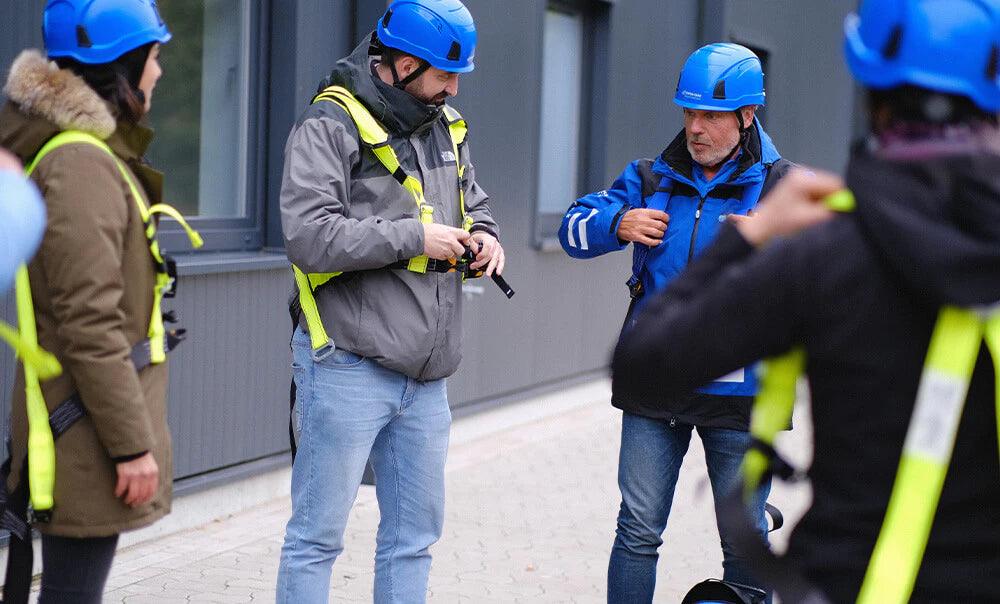
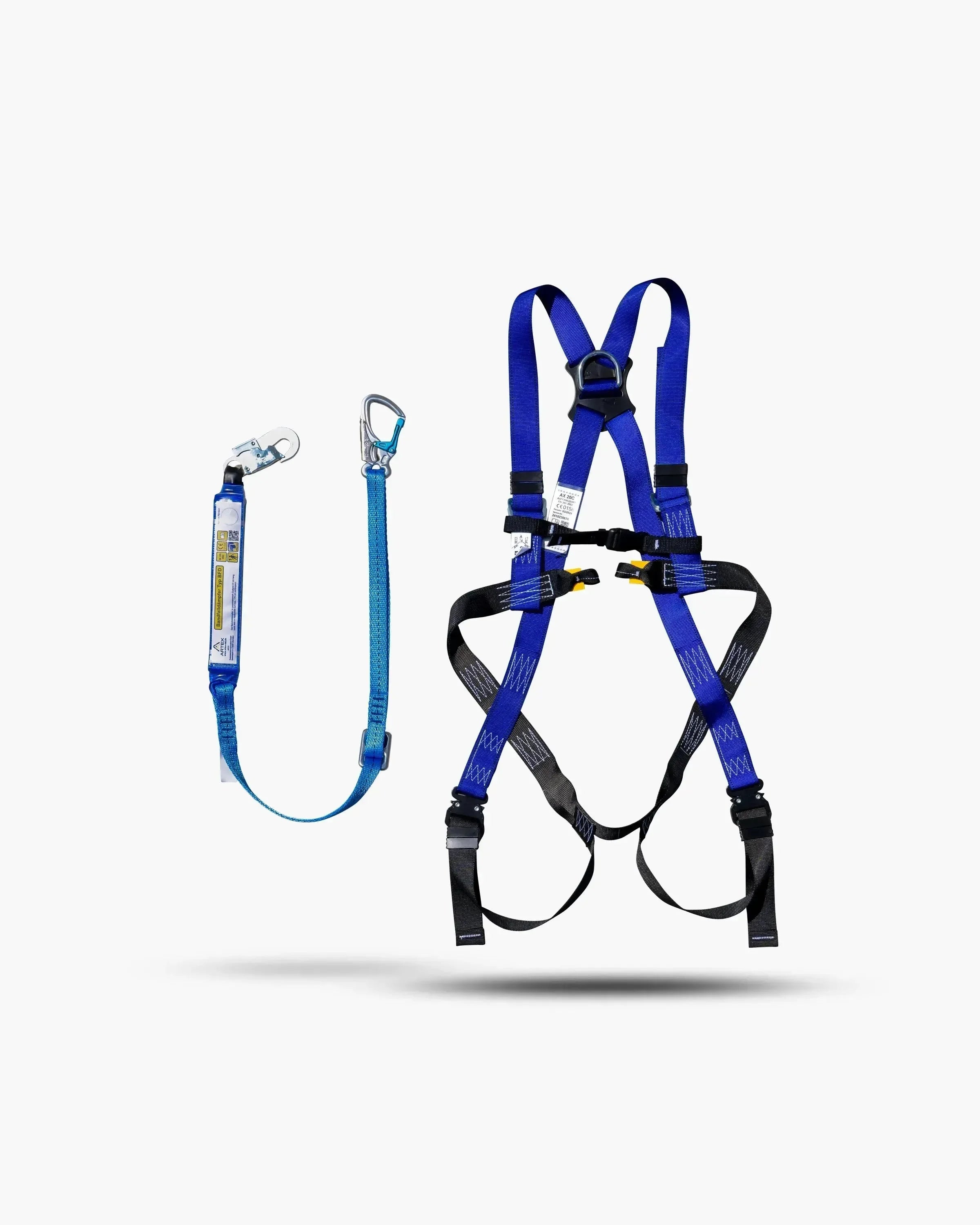
A complete restraint system consists of a full body harness (EN 361), a lanyard (EN 354), and, if necessary, an energy absorber (EN 355). The lanyard must be a maximum of 1.80 m long to limit freedom of movement. Guided fall arresters according to EN 360 automatically adjust the rope length and reduce the whiplash effect. Helmets with chin straps (EN 12492) provide additional protection against head injuries.

Impact forces and whip effect

Extreme forces are exerted when arresting a fall. The maximum impact force can be calculated simply as follows:

 F max = (m × g × h) / s + (m × g)

with:

  • m = total mass (person + equipment) in kg
  • g = acceleration due to gravity 9.81 m/s²
  • h = drop height in m
  • s = Stroking distance of the shock absorber in m

Example calculation

Example: m = 100 kg, s = 1.5 m, g = 9.81 m/s²

Head h (m) Fmax (N)
1.0 1 635 N
2.0 2 289 N
3.0 2 943 N

The values ​​show that even at low fall heights, several kilonewtons are effective. Therefore, tested anchor points with a load capacity of at least 12 kN and a sufficiently long damping path are crucial for safety.

Practical example: Correct stop prevents accident

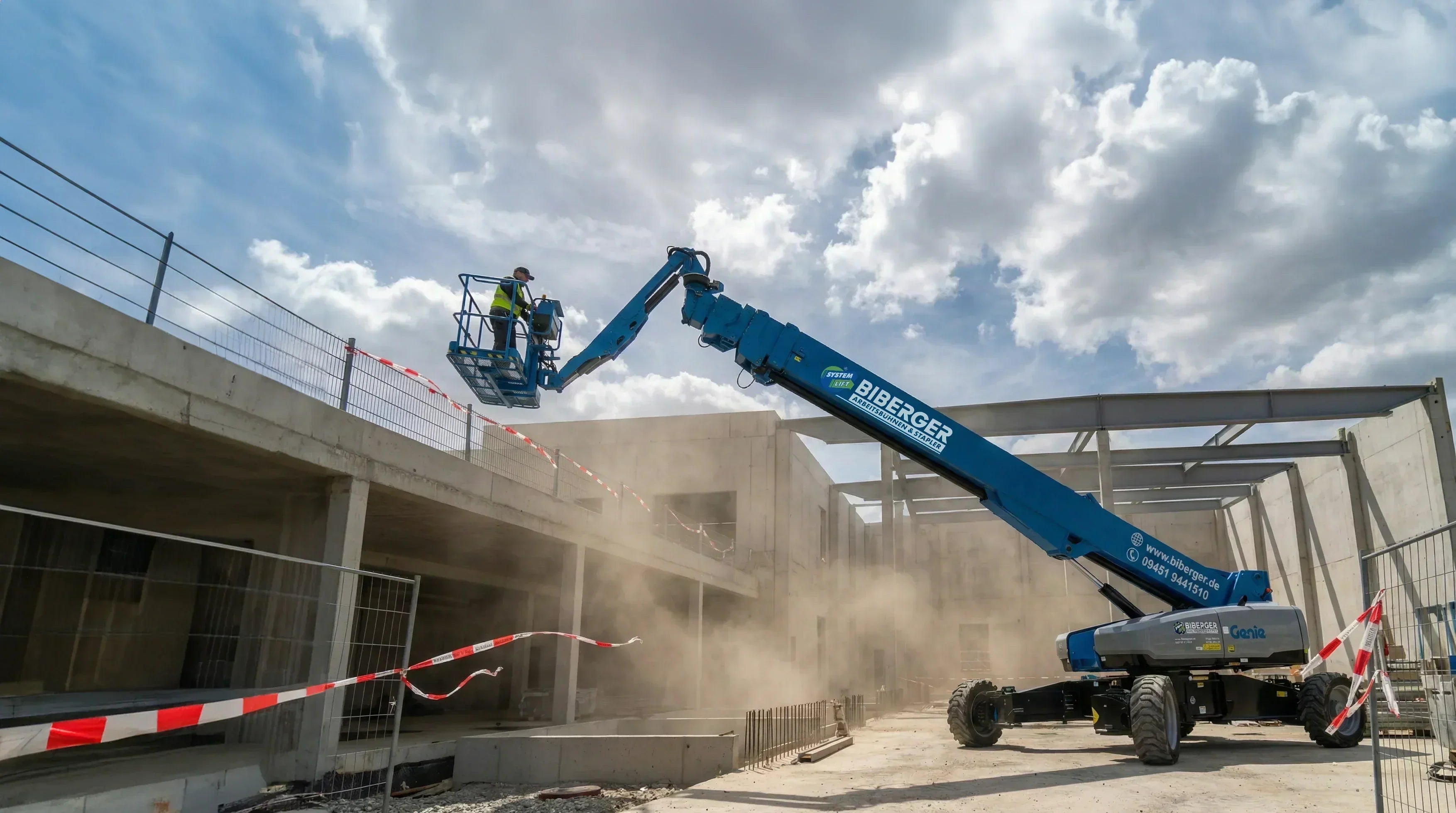
A mechanic was working on a 20-meter articulated work platform on the facade of a building. As the boom swung back, the cage struck a piping system, causing the operator to stumble. Thanks to his correctly worn restraint system – harness EN 361, lanyard EN 354, and anchor point in the cage (3 kN according to EN 280) – he remained safely in the platform. Without this restraint, he would have fallen approximately eight meters. This example demonstrates that even brief moments of inattention can have serious consequences – and how important correctly used personal protective equipment (PPE) is in everyday practice.

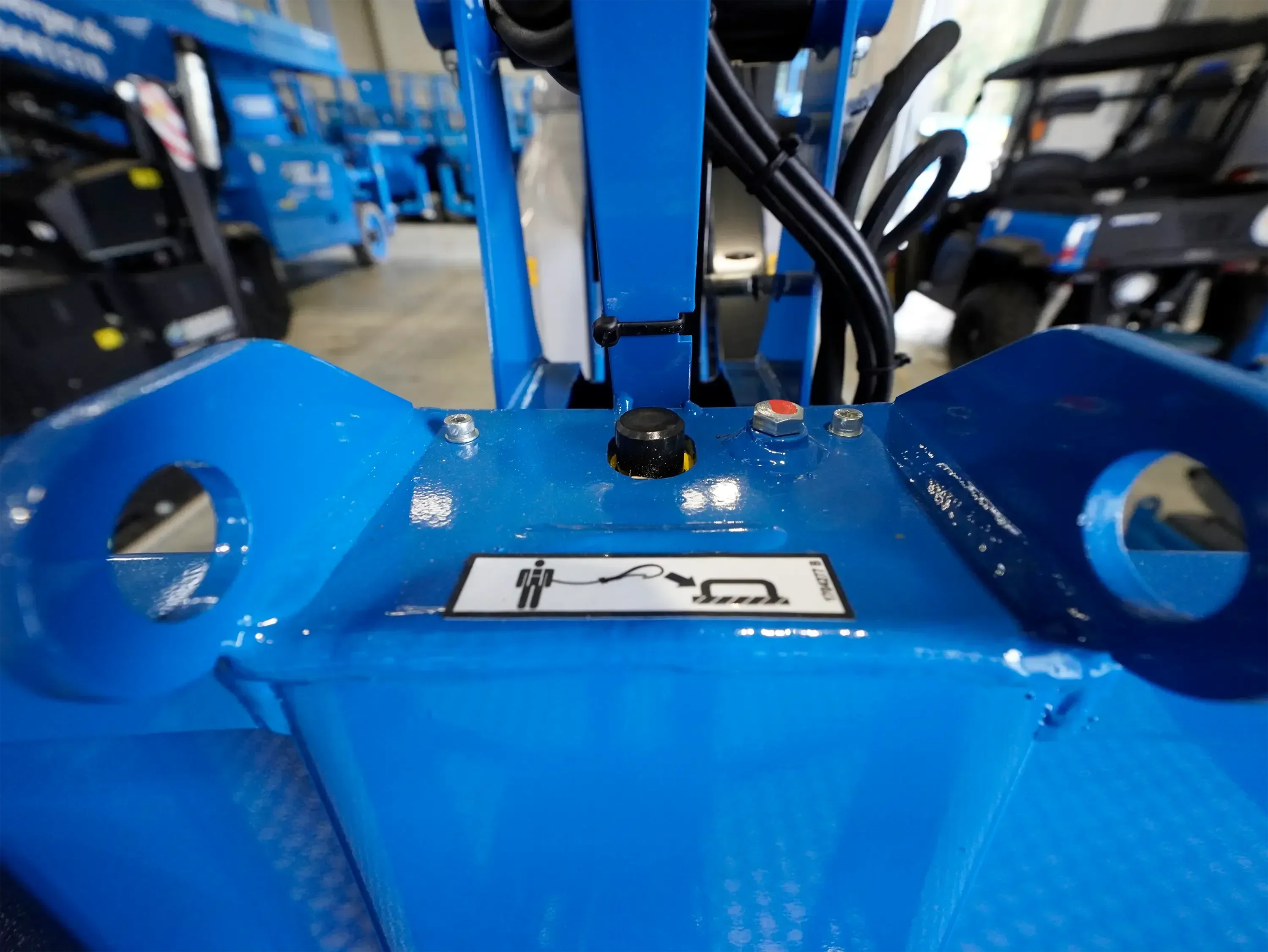
Anchor point PSAgA work platform

Anchorage points in the work platform's work basket are usually clearly marked. PPE may only be attached here: one person or one piece of PPE per anchorage point.

PSAgA anchor point of a mobile elevating work platform

Duties, examinations and instruction

Employers are required to conduct a risk assessment and provide appropriate restraint systems. All fall protection PPE must be tested before use and inspected at least once a year by a qualified person. All employees operating mobile elevating work platforms must receive practical training at least once a year—including anchoring, rescue, and emergency lowering.

Conclusion

Restraint systems on work platforms save lives – provided they are properly selected, correctly installed, and regularly inspected. The anchor points in the work basket are permanently integrated and designed to withstand at least 3 kN. Fall arrest systems are subject to significantly higher values, up to 7.5 kN. What's crucial is a clear separation of the two systems, proper training, and the awareness that safety is not an add-on, but rather a part of daily work.

Rectangle_1 - BIBERGER
Your contact for used machines

Martin Biberger

Managing Director

Our editorial quality standards

The subject content on biberger.de are editorially created, reviewed, and continuously updated. The basis is our daily work with aerial platforms, telehandlers, and industrial trucks – in rental, sales, operational planning, and technical support.

Each article draws on real-world experience and is editorially reviewed for clarity, accuracy, and practical relevance according to expert criteria. Technical statements are regularly compared against current industry standards and best practices.

The aim of our publications is to make reliable specialist knowledge accessible and to offer guidance to users, decision-makers and industry partners. BIBERGER sees itself as an independent information platform for safe, economical and modern height access technology – well-founded, comprehensible and free from advertising influence.

Leave a comment

Please note, comments need to be approved before they are published.

This site is protected by hCaptcha and the hCaptcha Privacy Policy and Terms of Service apply.

FAQ

How many kN must an anchor point withstand?

It depends on the system: For restraint systems,at least 3 kN, for fall arrest systemsat least 6 kN to 7.5 kNrequired – depending on the standard.

Where should the anchor point be located?

The anchor point must be firmly and clearly marked – ideallyabove head height and as perpendicular as possible to the belt eyeletto avoid swinging movements. On work platforms, only theprovided eyelets in the work basketbe struck.

What is an anchor point in fall protection?

An anchor point is thefixed connection between human and security systemIt absorbs the forces that occur during a fall and mustproven to be sustainable and compliant with standards– depending on the application with at least 3 kN, 6 kN or 7.5 kN.

What is an anchor point according to EN 795?

An anchor point according to EN 795 is acertified attachment option for personal protective equipment against falls from a height (PPE)Depending on the typeat least 6 kN to 12 kNand is used either permanently installed (Type A) or mobile – e.g. as a lifting beam or lifting rope.

What regulations apply to anchor points for fall protection?

Important regulations are theDIN EN 280(at least 3 kN for restraint systems), theDIN EN 795(at least 6–7.5 kN for fall arrest systems) and theIndustrial Safety OrdinanceThey regulate how anchor points must be constructed, tested, and used – always adapted to the safety system used.

What is the anchor point for fall protection?

The anchor point is the point where the safety system is attached – for example, a ring, an eyelet, or a stop rail. It must be firmly mounted, easily accessible, andtested for the forces occurringDepending on the type of system, different minimum requirements apply – for example, 3 kN for restraint systems or 6–7.5 kN for fall arrest systems.

What minimum strength should an anchor point in PPE have?

This depends on the system used:Restraint systemsrequire anchor points withat least 3 kN,Catch systemsneedat least 6 kN, better7.5 kN– Depending on the standard (e.g., DIN EN 795). Strength must be verifiably tested and documented.

What can be used as an anchor point?

Onlytested, sustainable and clearly marked pointswhich are approved for fall protection – e.g. permanently installed eyelets, eyebolts or certified anchor devices according to EN 795. Components such as railings, ladders or scaffolding maynotused unless expressly approved for this purpose.

Relevant topics

View all

Arbeitsbühne Privat mieten – Was ist erlaubt?

Renting a work platform as a private individual – What is allowed?

Aerial work platforms are primarily designed, standardized, and planned for commercial use. Typical applications include facade construction, plant and building technology, and industrial maintenance. Accordingly, equipment selection, insurance models, and rental procedures are geared primarily towards commercial users with trained...

Read more

Anschlagen von Lasten – Anschlagmittel richtig auswählen und sicher einsetzen

Lifting loads – selecting and safely using lifting equipment

Safely attaching loads is one of the most demanding tasks when operating cranes , forklifts , and lifting equipment. Errors almost never occur during the lifting itself, but almost always result from misjudging the load capacity, type of attachment, or...

Read more

Staplerfahrer werden

Become a forklift driver: safely, trained and responsibly

A moment of inattention 7:15 a.m. A forklift driver begins his early shift. Routine. He only gives the forklift a cursory check – time pressure, the truck is waiting. On the third lift, the fork tine snaps at an old...

Read more

CAN-Bus und J1939-Diagnose bei Baumaschinen - BIBERGER

CAN bus and J1939 diagnostics in construction machinery

Modern construction machinery is now highly networked systems. Sensors, control units and safety modules communicate with each other constantly – and this happens via the so-called CAN bus . The CAN bus is essentially the nervous system of every modern...

Read more

Magni Diagnose-Leitfaden: Fehlermeldungen richtig deuten - BIBERGER

Magni Diagnostic Guide: How to correctly interpret error messages

If your Magni telehandler (RTH / HTH series) suddenly displays a warning, it's rarely a total breakdown. Usually, a safety or protective function is being activated. This guide explains the most important error codes, their meaning, and how to react...

Read more

3D-Arm einer Arbeitsbühne

3D arm on aerial work platforms: Technology, advantages and model codes at a glance

The so-called 3D arm – also known as a 3D basket arm , pendulum basket arm , or hybrid jib – is a state-of-the-art feature for aerial work platforms. Its three-axis mobility allows for particularly precise work in hard-to-reach areas....

Read more

Merlo Fehlercodes bei Telehandlern & Bühnen

Merlo error codes for telehandlers & platforms

Modern Merlo telescopic handlers and aerial work platforms feature complex electronic controls. These systems automatically detect malfunctions and display them via error codes. This guide helps you understand each code – including its meaning, cause, and solution. Overview – Merlo...

Read more

JLG Fehlercodes erklärt: Ursachen, Bedeutung & Lösungen - BIBERGER

JLG error codes explained: causes, meaning & solutions

If your JLG aerial work platform suddenly displays an error code or becomes unresponsive, this does not automatically mean it is defective. In most cases, it is due to a safety or protective function . This guide explains what the...

Read more