


 What You Need to Know
Anyone who wants to operate a forklift or other industrial truck in-house needs a valid industrial truck license – also known as a forklift license. This qualification is legally required and proves your expertise in the safe handling of forklifts.
In this guide (as of 2026), you will learn everything about forklift operator training, the different levels of forklift licenses, costs, legal requirements, and annual instruction. Whether you're a beginner or a professional, here you'll find all the essential information about the driving permit.
Why this training saves lives
Forklift accidents may seem "trivial" at first glance – in reality, they are often serious, happen quickly, and affect more than just the driver. According to DGUV statistics, there were around 18,000 reportable workplace accidents involving industrial trucks in 2024. In over 7,000 cases, people were hit, crushed, or run over – almost half of all accidents. In addition, several fatal accidents were registered in this area. For comparison: In 2024, the DGUV recorded a total of around 712,000 reportable workplace accidents – industrial trucks thus account for a small but particularly serious proportion.
This shows why qualification is more than "paper": It trains precisely the situations that escalate in practice – narrow aisles, poor visibility, stress, speed, load behavior, and other persons in the operating area. Many serious accidents are not caused by a lack of skill in "stacking," but by excessive speed, blocked vision (e.g., load in front of the nose), missing markings, or incorrect behavior at intersections. This is precisely why instruction, training, and documentation are not optional, but a core component of legal certainty.
Why the industrial truck license is mandatory
Legal basis at a glance
The industrial truck license is legally required. The basis for this is formed by:
- DGUV Regulation 68
- DGUV Principle 308-001
- § 12 Occupational Safety and Health Act (ArbSchG)
- § 12 Industrial Safety Ordinance (BetrSichV)
Only those who have successfully completed the training according to DGUV Principle 308-001, are regularly instructed, and are authorized in writing by the employer according to DGUV Regulation 68 are permitted to operate an industrial truck in the workplace.
What are the consequences of non-compliance?
Anyone driving a forklift or telehandler without a valid industrial truck license or without annual instruction risks fines, exclusion from insurance coverage, and personal liability in the event of damage.
Which forklifts can be driven with an industrial truck license?
Tiered model according to DGUV Principle 308-001 (Levels 1–3)
The training is divided into three levels. Depending on the level, you may operate different types of forklifts.
| Level | Designation | Permitted Equipment | Note |
|---|---|---|---|
| Level 1 | Basic Training | Counterbalance forklifts / Industrial counterbalance trucks | General training – basis for all further levels (Levels 2 and 3) according to DGUV 308-001. |
| Level 2 | Additional Training | Reach trucks, telehandlers, container handlers | Mandatory for special load conditions |
| Level 3 | On-site Instruction | Specific equipment in operational use | Mandatory before each use |
Important: Pedestrian-controlled industrial trucks ("pallets jacks") are a special case
Not every industrial truck automatically requires full forklift license training according to Levels 1–3. For purely pedestrian-controlled industrial trucks (e.g., electric pallet jacks, electric high-lift trucks, side loaders), DGUV Principle 308-001 does not formally apply.
In practice, however, occupational accident insurance institutions still recommend documented theoretical and practical instruction, a written driving authorization, and, for regular use, a separate driving permit for pedestrian-controlled industrial trucks.
But: As soon as a device has a foldable driver's platform or drives faster than 6 km/h, an obligation to train may arise again. Accidents also happen here – just differently: Crushing, running over feet, getting trapped on shelves or loading ramps are typical scenarios.
Validity and annual instruction
How long is the forklift license valid?
The industrial truck license is valid indefinitely. However, you are only permitted to drive if you complete documented safety instruction at least once a year in accordance with DGUV Regulation 1 and § 12 ArbSchG.
Obligation for annual instruction
According to DGUV Regulation 1 and § 12 ArbSchG, annual safety instruction is mandatory.
It includes, among other things, the following contents:
- Current legal regulations
- Operating instructions for the vehicle
- Accident prevention and driving physics
- Stability and driving behavior
- PPE and emergency measures
- Load securing and visual inspection
- Behavior in case of danger and liability
Contents of the forklift operator training
Theoretical training
The theory covers all legal and technical fundamentals:
- DGUV rules and regulations
- Driving physics and stability
- Load capacities and visual inspections
- Traffic rules in the workplace
- Working with attachments
- Recognizing dangerous situations
Practical training
In the practical part, you will learn the safe handling of the forklift:
- Control checks and daily inspections
- Stacking, starting, maneuvering
- Working in confined spaces
- Load pickup and transport
How long does the training take?
The duration of the training depends on group size, prior experience, and equipment type. As a guideline: Basic qualification (Level 1) typically comprises at least 20 to 32 learning units (one learning unit = 45 minutes) and is often completed in 1 to 3 days in practice.
- Common practice: 2 days as a compact standard (theory + practice + exams)
- For small groups/prior knowledge: sometimes faster, but content and exams must be fully covered
- For complex operations: additional training and instruction extend the overall qualification
Important: Content and exams must be completed in full.
Prerequisites: Who can participate?
To participate in forklift license training, you must meet the following requirements:
- At least 18 years old
- Official ID or registration certificate
- Basic knowledge of German or the language of instruction
- Physically fit for the practical operation of industrial trucks
Physical suitability: What does that mean specifically?
Physical suitability is not a "nice-to-have," but a central component of safe operation. Employers may only employ persons who are suitable – practically this means: vision, hearing, reaction time and mobility must be such that a forklift can be operated safely in the workplace.
In practice, suitability is often checked through an occupational medical examination. Typical contents are:
- Visual acuity (e.g., adequate recognition of persons, markings, fork tips)
- Color vision (important for signals/markings, depending on the operation)
- Hearing (warning signals, reversing alarms, surroundings)
- Reaction and resilience (stress situations, braking distance, evasive action)
- Mobility (shoulder check, safe mounting and dismounting)
Who pays? Usually the employer, because it is part of the operational requirements. Important: Diagnoses such as diabetes are not automatically an exclusion criterion – the decisive factor is whether safe operation is possible in the specific use case.
Difference: Forklift license, driving authorization, instruction
Only with all three elements are you legally authorized to drive. This overview shows what each is:
| Document | Function | Issuer | Validity | Consequence if missing |
|---|---|---|---|---|
| Forklift License | Proves completed training according to DGUV 308-001 | Training provider (e.g., TÜV, DEKRA) | Unlimited (with annual instruction) | No qualification proven → deployment inadmissible |
| Driving Authorization | Authorization by employer to operate industrial trucks | Employer | Until revoked / end of assignment | Driving ban despite license |
| Instruction | Updating of knowledge – mandatory according to DGUV Regulation 1 | Competent person or training partner | 12 months (for apprentices: 6 months) | Driving authorization practically immediately revoked (until instruction is caught up and documented) |
| Operational Instruction (Level 3) | Device- and task-specific instruction in the workplace (e.g., routes, loads, attachments) | Employer / competent person | Device-/task-specific | Not authorized for this specific device/task |
Industrial truck license examination: Theory and practice
Theory exam at a glance
The examination for future forklift operators consists of approximately 30 multiple-choice questions in the form of forklift license exam questions. Topics: accident prevention, load behavior, traffic routes, PPE.
Test your knowledge online now
Practical exam
Here, the instructor evaluates:
- Safe and correct driving
- Safe handling of loads
- Stability when lifting and lowering
- Storing and retrieving under supervision
- Sense of responsibility
Upon passing, you will receive the official industrial truck license as proof of your qualification.
5 common exam mistakes – and how to avoid them
- Missing visual inspection → checklist to be used beforehand
- Driving too fast on the course
- Load incorrectly picked up or lost
- No shoulder check when reversing
- Ignoring traffic signs in the workplace
Forklift Driving Learning Path
What does the industrial truck license cost?
Average costs
- Standard license (2-day course): approx. €250–350
- Level 2 additional training: +€100–200
- Annual instruction: from approx. €50 on-site, online sometimes as low as €25–45
Who bears the costs for the qualification?
In many cases – especially in the transport and logistics sector – the employer pays. For self-initiative or retraining, the Federal Employment Agency or education vouchers may also be applicable.
Insurance and Liability: The often underestimated point
Insurance coverage
In the event of an accident, the insurance company (and, in occupational safety, also the professional association) will carefully examine whether qualifications and organization in the company were adequate. If mandatory components such as instruction, training, or documentation are missing, this can have massive consequences – up to disputes over benefits and recourse claims. It is not only crucial that training has taken place, but also that the training is verifiable.
In practical terms, this means: Instruction without a participant list, date, content, and signatures is often "non-existent" in an emergency. This is precisely why thorough documentation is a real safety and liability brake – not bureaucracy.
Employer liability
Employers bear the primary responsibility: they must ensure that only suitable, qualified, and authorized persons drive – including organizing instruction, training, traffic routes, and operating instructions. In the event of violations, fines are possible; in the case of personal injury, criminal consequences (e.g., negligence) may also arise.
Forklift driver liability
Forklift drivers also bear responsibility: anyone who acts with gross negligence, ignores safety rules, "cuts corners" under time pressure, or drives despite lacking the necessary prerequisites risks personal consequences. In the event of damage, questions quickly arise such as: Was the instruction up-to-date? Was the order given? Was the training completed? Was the visual inspection performed?
Third parties and visitors
Many serious accidents don't involve the driver, but third parties: colleagues, external companies, visitors, customers, or pedestrians in warehouse areas. Here, markings, clear rules, sightlines, speed limits, and reverse safety concepts are crucial. Even the best driving practice is of little use if the company doesn't provide a safe environment.
Registration and Providers
Where can you register?
Training courses are offered by TÜV, DEKRA, and SYSTEM-CARD Partners, among others. BIBERGER also offers training directly at your location or in-house.
On-site Training
For multiple employees, in-house training is recommended – time-saving, efficient, and cost-effective. BIBERGER offers volume discounts for 5 or more participants.
After the Forklift License Exam
What to do if you lose your forklift license?
If you lose your forklift license, it's not initially a legal problem – but without proof, you usually won't be allowed to drive in the workplace. Important: There is no central register for forklift licenses in Germany and Austria. Authorities therefore cannot issue replacements.
First step: Contact the training center where you completed your training (e.g., TÜV, DEKRA, SYSTEM LIFT, or a training provider). Many providers archive participant data for several years and can issue a duplicate of the license for a processing fee.
If that's not possible:
- The former employer often has a copy in the personnel file
- If no records exist, the training must be completed again
Important for practice: Even with a valid forklift license, you are only allowed to drive if you also have a written driving authorization from your employer, current annual instruction, and operational instruction on the specific equipment. Without these three components, its use is not legally permissible.
When driving authorizations or instructions "expire": typical scenarios
Many problems arise not when passing the exam, but later in everyday life. These cases are typical – and should be resolved properly:
- Change of workplace within the company: New Level 3 instruction (routes, rules, loads, hazard points) is required.
- Change of company: The old driving authorization is automatically invalid. A new employer must issue a new authorization.
- Instruction older than 12 months: Until the instruction is completed, the driving authorization is practically no longer legally sound.
- Change of equipment (different forklift type/attachment): Additional training or instruction may be necessary – depending on the risk and equipment.
- Accident or near-miss: Additional training/instruction may be ordered.
- Long absence: After 6+ months, a refresher is at least strongly recommended, even if no formal new exam is necessary.
International Validity
A forklift license is not a "globally valid driver's license." In the EU, a qualification can be partially recognized – however, a company may still require additional proof, instruction, or training in the operational language. The deciding factor is always: Occupational safety law applies nationally, and the employer must provide proper authorization.
Conversely, foreign certificates are often not automatically sufficient in Germany because content, examination standards, and documentation vary greatly. For full legal certainty, in practice, a new training/examination or at least a recognized qualification according to German standards is often the cleanest way – especially with foreign language risks and liability issues.
Special Features: Pallet trucks, Narrow Aisle, Telescopic
The more specialized the equipment, the more likely it is that Level 1 alone is not enough. Typical examples:
- Reach trucks / warehouse equipment: often Level 2 required
- Narrow-aisle forklifts: special training due to guidance system, height, and rescue concept
- Telescopic forklifts: often additional qualification; for all-terrain telescopic forklifts, special principles apply
- Working at greater heights: higher requirements for stability, travel path, rescue, and fall protection concept
PPE and Vehicle Equipment (brief and practical)
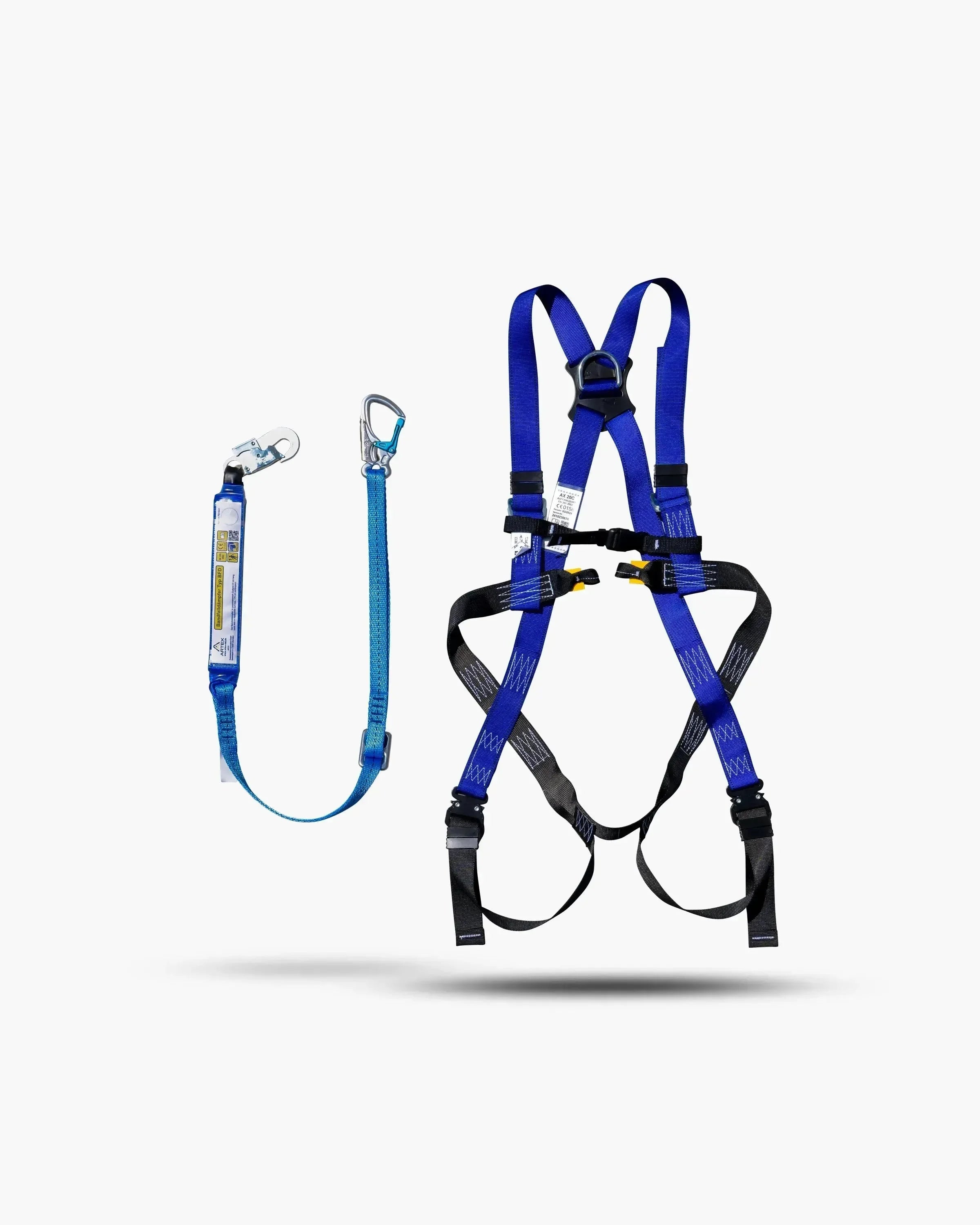
In operation, PPE and vehicle condition are safety factors. Depending on the application, safety shoes and high-visibility clothing are practically always included, a helmet may be mandatory depending on the environment. On the forklift itself, safety devices such as a seat belt, load backrest, and functioning warning systems are crucial – and must be considered in visual inspection and maintenance.
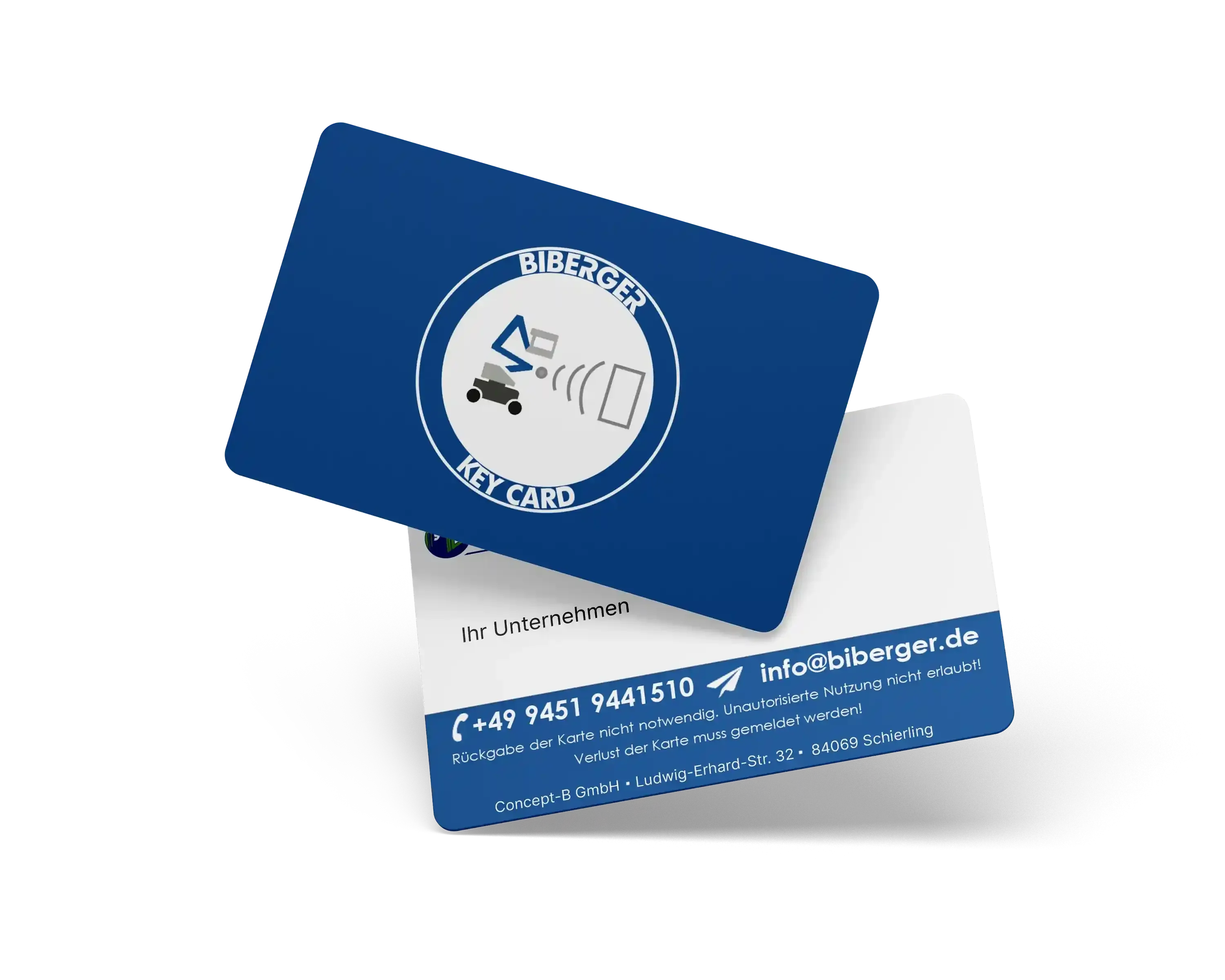
System-Card Concept for Companies
With the SYSTEM-CARD from BIBERGER, you can plan, manage, and document training nationwide – legally compliant and DGUV-compliant.
Checklist for Employers (Quick Check)
- Valid license checked and documented for each driver
- Annual instruction planned, carried out, signed (participant list!)
- Written driving authorizations available and current
- Equipment/application instruction (Level 3) documented for each area
- Physical suitability/fitness for duty checked (occupational medical, if required)
- Traffic routes, markings, intersections, sightlines in the warehouse checked
- Operating instructions understandable and accessible
- Maintenance/inspection of forklifts current (incl. safety-relevant equipment)
- Near-misses evaluated and measures implemented
Conclusion
The industrial truck license is mandatory – but also a career boost. With solid training, annual instruction, and a valid driving authorization, you are on the safe side. Get informed, register, and get started now!
Visit the SYSTEM-CARD Training Center to view dates for a theoretical and practical exam.




Share:
Working height vs. platform height: What's the difference?
All information about the Genie SX 180 telescopic boom lift – extremely high, extremely efficient
Our editorial quality standards
The subject content on biberger.de are editorially created, reviewed, and continuously updated. The basis is our daily work with aerial platforms, telehandlers, and industrial trucks – in rental, sales, operational planning, and technical support.
Each article draws on real-world experience and is editorially reviewed for clarity, accuracy, and practical relevance according to expert criteria. Technical statements are regularly compared against current industry standards and best practices.
The aim of our publications is to make reliable specialist knowledge accessible and to offer guidance to users, decision-makers and industry partners. BIBERGER sees itself as an independent information platform for safe, economical and modern height access technology – well-founded, comprehensible and free from advertising influence.