


 What You Need to Know
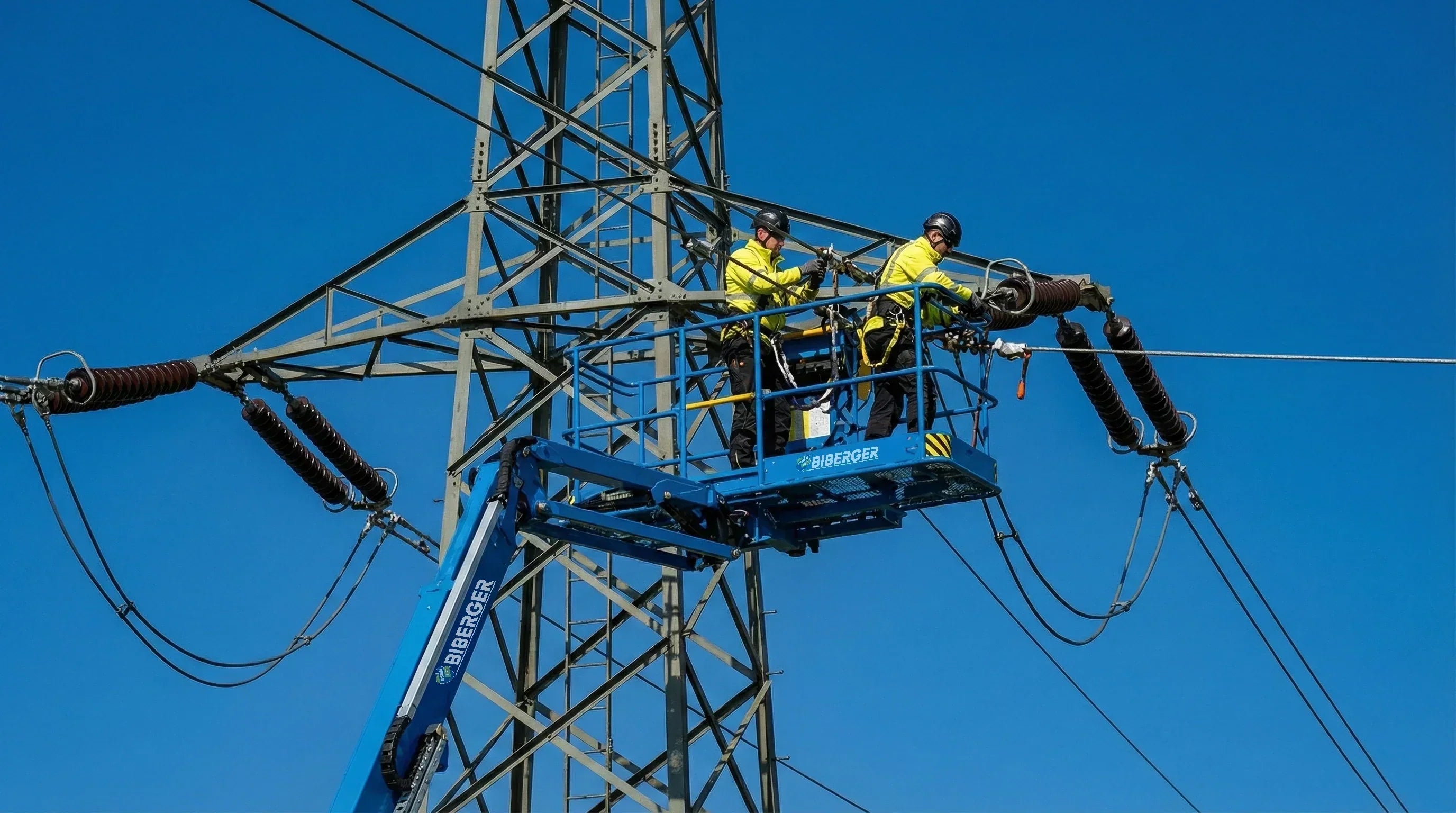
Working with aerial work platforms near power lines is among the most dangerous jobs imaginable. Electric shocks, arcing, and step voltages can become life-threatening in seconds. Standard aerial work platforms are expressly not approved for work on live power lines – they may only be used for work in close proximity , provided the applicable minimum distances are maintained.
This guide is aimed at companies, safety officers, and operators. It clearly explains which distances apply, which rules are binding, and how operations can be planned and carried out safely.
Key messages: What every operator and user needs to know
The most important principles must be clear even before operational planning begins. They form the basis for every risk assessment.
- Standard work platforms are NOT approved for work on live electrical components. They may only be used if the minimum distance to live parts is maintained.
- Minimum distances according to DIN VDE 0105-100 are mandatory: 1 m / 3 m / 4 m / 5 m depending on the voltage level.
- Network operators must be informed before work begins. Any work is prohibited without authorization.
- Annual safety inspections are legally required. A missing inspection sticker will lead to a construction stoppage.
- Operators must be trained and have written authorization. If the authorization is lacking, the business owner is personally liable.
Legal framework: What must be strictly adhered to
For work near electrical lines, clear legal and regulatory requirements apply. These define responsibilities, inspection obligations, and the necessary technical and organizational safety measures.
Laws and regulations
They form the binding framework for every company:
- Occupational Health and Safety Act – Risk assessment is mandatory
- German Ordinance on Industrial Safety and Health (BetrSichV) – safe provision, testing obligations, documentation
- Product Safety Act – CE conformity of the machine
DGUV regulations
They describe the safe operation in detail:
- DGUV Information 208-019 – Selection, Operation, Maintenance, Qualification
- DGUV Rule 103-011 – only for qualified electricians when working on live circuits
- DGUV Principle 308-008 – Training and Appointment of Operators
- DGUV Principle 308-002 – Inspections and Expertise
Standards
They define technical safety requirements and safety distances:
- DIN EN 280 – Construction and safety requirements for work platforms
- DIN VDE 0105-100 – Approach zones and minimum distances (mandatory!)
- TRBS 2121 – Fall prevention and selection of suitable work equipment
In addition, the network operators' line protection instructions apply. These are binding and often stricter than general regulations.
Minimum distances to power lines: The central safety rule
The following values of DIN VDE 0105-100 must be strictly adhered to. They apply to all work platforms and all conductive components.
| Nominal voltage | Minimum distance (DV) for work platforms |
|---|---|
| up to 1 kV | 1.0 m |
| >1 kV to 110 kV | 3.0 m |
| >110 kV to 220 kV | 4.0 m |
| >220 kV to 380 kV | 5.0 m |
| unknown | at least 5.0 m |
The distances apply horizontally, vertically, and diagonally . Any conductive component – basket, boom, tools, and even people – serves as a reference point.
International organizations such as IPAF often recommend even greater distances – sometimes 9 to 15 meters for pylon and cable route work.
What is allowed – and what is not
Allowed
- Working near power lines while adhering to the IT zone
- Work carried out in coordination with the network operator
- Operations within the protected zone require written authorization from the operator.
Not allowed
- Working under voltage with standard aerial work platforms
- Falling below the minimum distances without activation/covering
- Use stages as cranes (attach loads to the basket)
- Improvised baskets on forklifts, wheel loaders or telescopic handlers
Planning and organization: Proceed safely, step by step.
Preliminary planning
Before a stage is ordered, the following points must be clarified:
- Obtain information about the power line (voltage, location, operator)
- Risk assessment with a focus on "electrical hazards"
- Consider alternative methods (e.g., scaffolding, crane)
- Consider the rescue plan (topic: step voltage)
Coordination with the network operator
- Please notify us of the start of work at least 5 working days in advance.
- Request on-site instruction from the operator.
- Define protective measures: unlocking, barriers, height restrictions
- Ensure written approval before work begins.
Stage selection
- Choose the type based on range, surface, and available space.
- Review annual audit and current audit report
- Use only trained and duly authorized operators.
Safe operation: Checklist for the construction site
Before deployment
- Daily visual and functional inspection documented
- The subsoil is load-bearing, and the supports are correctly positioned.
- Safety distance marked/blocked off on the floor
- Work and traffic area secured
During the operation
- Minimum distances consistently maintained
- Guides are used when visibility is limited.
- No protruding metal parts or long tool carriers
- No overload – adhere to basket load limits
- Stop work immediately in case of thunderstorms or strong winds.
Forbidden
- Getting out of the basket
- Driving with the stage raised and without clear visibility
- Working without a second person during high-risk operations
Emergency procedures in case of contact or dangerous approach
If contact occurs or an arc flash is imminent, correct behavior determines life and death.
- Stay in the basket – never jump out!
- Do not move or lower the stage.
- Isolate the surrounding area by at least 10 meters .
- Immediately alert the fire department and network operators.
- Only initiate rescue after approval by the operator.
- Only in case of fire danger: Leave with a closed leg jump (hop away)
Maintenance and inspection: What is legally required
workday
- Visual and functional inspection (hydraulics, supports, railings, emergency stop)
Yearly
- UVV inspection according to DGUV 308-002 by a qualified person
- Test report and test sticker must be available
Extraordinary
- After accidents
- After renovations or unusual loads
Isolated stages
They require additional insulation tests according to the manufacturer's instructions.
Typical mistakes and causes of accidents – and how to avoid them
Experiences from DGUV, BG BAU and IPAF repeatedly show the same patterns.
Typical mistakes
- No or incomplete risk assessment
- Wrong stage type, underestimated reach
- Missing inspection sticker
- Insufficient support on soft/unclear ground
- Operators without training or written authorization
Most common types of accidents
- Fatal electrical accidents caused by falling below the DV zone
- Collisions with overhead lines during swiveling
- Stage tipping over due to incorrect operation or poor support
- Fall from the basket due to unexpected movement
Conclusion: Safety is achieved through planning, knowledge, and clear rules.
Working near power lines requires discipline, clear procedures, and the right equipment. Minimum distances, network operator approval, and certified work platforms are not optional – they are vital. Employers, safety officers, and operators share responsibility for safe and legally compliant operations.
Those who are prepared work safely.




Share:
How often should you clean construction equipment such as forklifts and work platforms?
Outdoor work platforms & forklifts: Which machines for off-road use?
Our editorial quality standards
The subject content on biberger.de are editorially created, reviewed, and continuously updated. The basis is our daily work with aerial platforms, telehandlers, and industrial trucks – in rental, sales, operational planning, and technical support.
Each article draws on real-world experience and is editorially reviewed for clarity, accuracy, and practical relevance according to expert criteria. Technical statements are regularly compared against current industry standards and best practices.
The aim of our publications is to make reliable specialist knowledge accessible and to offer guidance to users, decision-makers and industry partners. BIBERGER sees itself as an independent information platform for safe, economical and modern height access technology – well-founded, comprehensible and free from advertising influence.