


 What You Need to Know
Unpaved terrain is not an exception – it's commonplace in many industries: from maintenance in gravel pits to assembly and industrial operations on conveyor systems, and construction in wind or solar farms. This is precisely where, in practice, what works and what simply looks good on paper diverges.
This article shows you which machines are truly helpful on loose ground, gravel, clay, lawns or slopes – and what needs to be considered when selecting, transporting and using them.
What challenges does unpaved terrain present?
Not viable , not level, not predictable.
Industrial operations off-road are characterized by two things: a lack of infrastructure and high demands . Usually, several of these factors combine:
- Loose or wet ground , often with ruts, dips or puddles
- Gradients and edges , e.g. on embankments, depressions, ramps
- Lack of access roads , e.g., if access is only possible via low loader.
- Dusty or muddy conditions that change daily depending on the weather.
- Limited space , for example between silos, conveyor belts or stockpiles
-
Working near power grids and transformer stations , often with varying terrain and limited access for transport vehicles
Standard machines – whether platforms or forklifts – are often overwhelmed here. Not because of the technology, but because they are not prepared for the specific conditions.
Which machines work on unpaved ground?
All-terrain work platforms
- Telescopic platforms with all-wheel drive and oscillating axle: A robust solution for long reaches, especially horizontally. High ground clearance, powerful drive, excellent off-road capability.
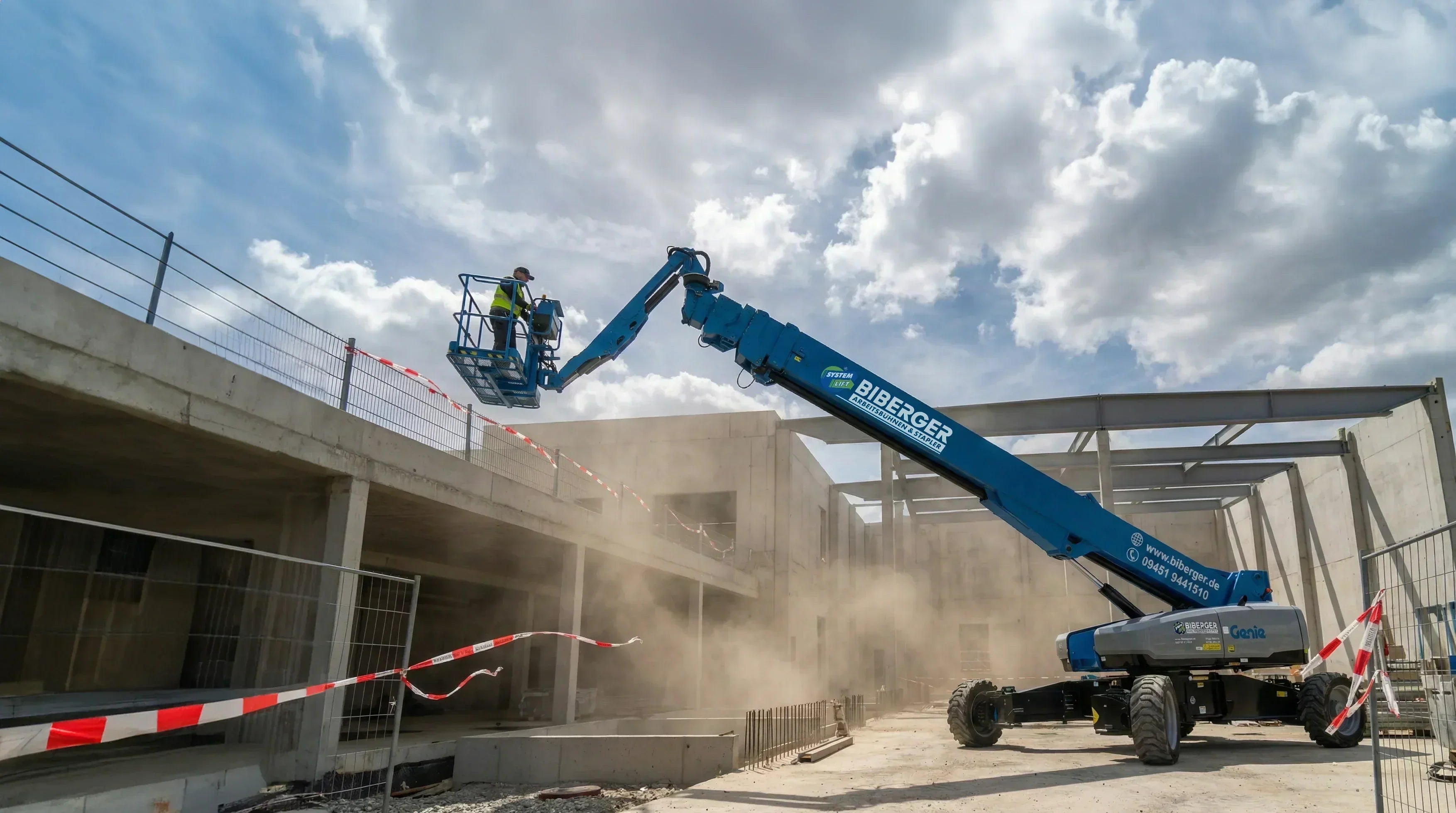
- Articulated telescopic platforms with diesel or hybrid engines: Ideal for confined work sites, e.g., under pipe bridges or between structures. Their compact design is advantageous in tight construction areas.
- Tracked platforms: The solution for low ground pressure . They can handle gravel, wet clay, or grass. They can compensate for uneven terrain – important on slight slopes.
Rough terrain forklifts and telescopic handlers
- Telescopic handlers (rigid or rotating): Especially proven on bulk material surfaces or for material transport in plant construction. High lifting heights, long reach – even over obstacles.
-
Rough terrain forklifts with pneumatic tires and a high wheelbase: Significantly more stable than industrial forklifts , often with all-wheel drive and differential lock.
They can also be used reliably on uneven, partially loose or only partially load-bearing surfaces.
Important: Always choose the machine based on the worst point of access and placement area – not on the ideal view in sunlight.
What is often underestimated in practice?
The delivery
Many operations fail before they even begin – because low loaders can't unload or there's not enough room to maneuver. Check beforehand:
- Turning circle and maneuvering area for vans
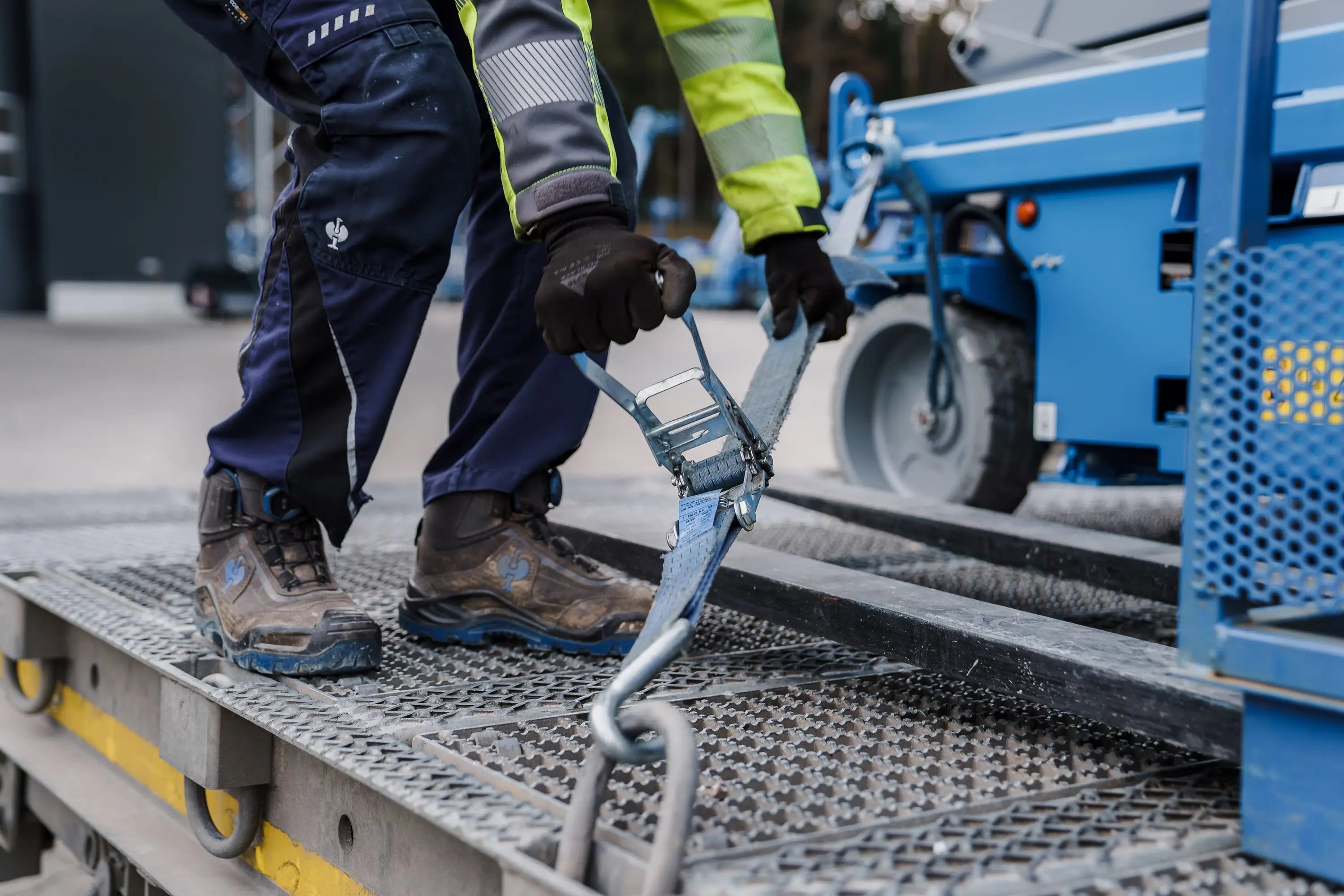
- Ramp incline during unloading (especially critical with articulated platforms)
- Load-bearing capacity of access roads (water-bound surfaces or gravel with weak points)

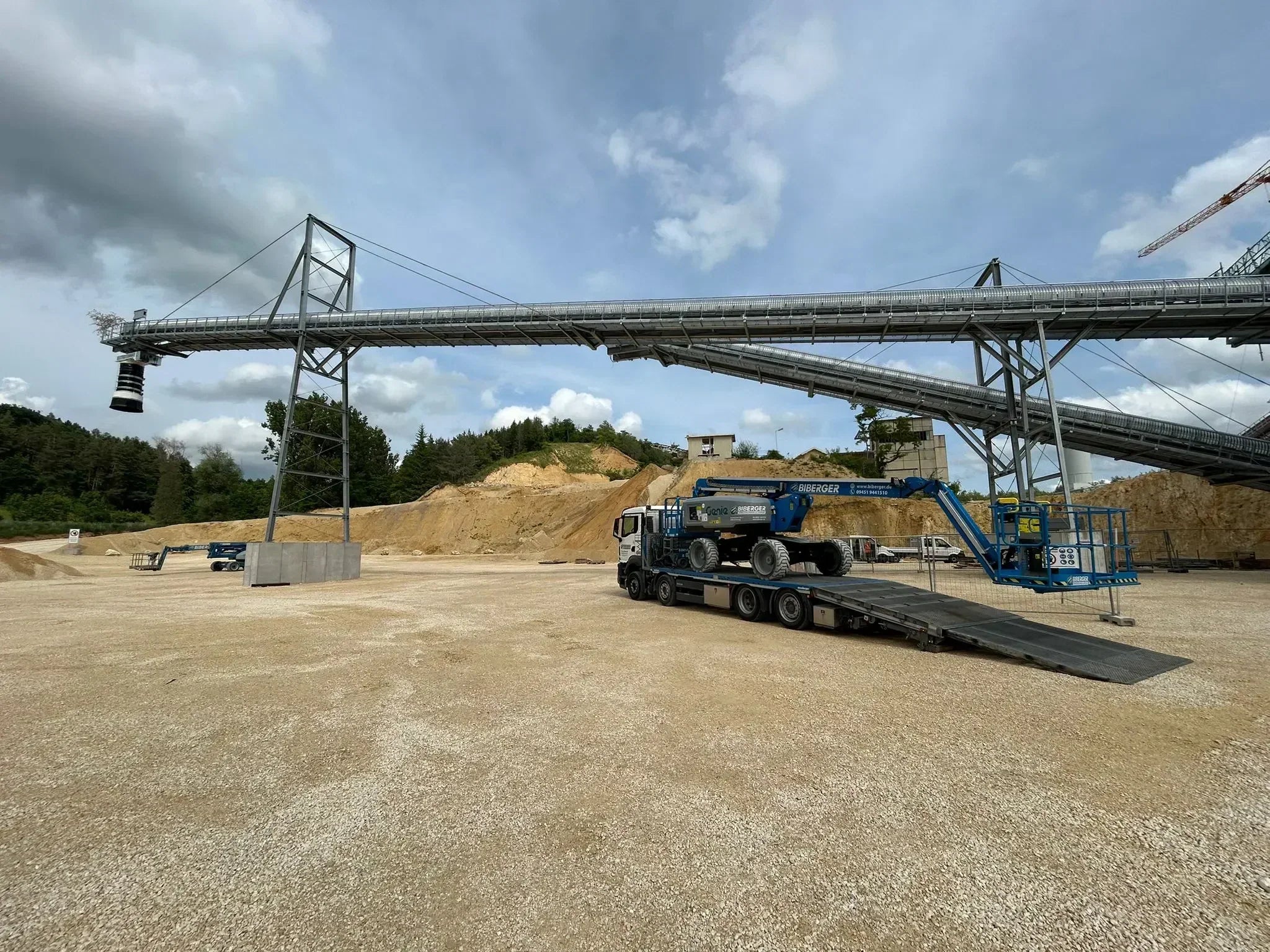
Precise delivery to the gravel plant: All-terrain articulated telescopic platform from BIBERGER on a low loader – ready for use under demanding conditions.
The installation area
Not every seemingly "large area" is actually usable. Important:
- Check support width and basket reach
- Mark uneven areas or depressions
- If necessary, plan for support plates (even for self-propelled vehicles).
What factors determine operational readiness?
- Ground pressure: The larger the contact area of the machine, the better the weight is distributed.
- Steering behavior and drive: All-wheel drive alone is not enough – a powerful, sensitive hydrostatic drive is essential.
- Machine weight: Too heavy = sinking. Too light = unstable during lifting operations. Finding the right balance is crucial.
- Lateral reach: On soft ground, it's better to work with greater reach instead of constantly repositioning.
Safety: What you need to pay attention to on loose ground
Terrain poses a risk. Not because of the machine – but because of the surroundings. Therefore:
- Never set it up without visual and functional checks – especially on gravel, grass or embankments.
- Load distribution through plates, even with "only one wheel".
- Slow down basket swivel and boom movement – instability due to rebound.
- Take wind into account – especially with large platforms or banner work.
- No driving movements with the boom extended on unstable ground.
The role of the landlord: More than just delivery
A good landlord …
- Checks access, weight and soil load-bearing capacity in advance
- recommends the right device – not just the largest one
- provides boards, ramps and instruction
- Delivers on time – even to construction sites in the forest, quarry or solar park
Tip: A landlord who truly understands the terrain and machine behavior can identify potential risks before they occur on the construction site.
Conclusion: Anyone working in the field needs the right equipment.
Unpaved ground is not an excuse – it's a requirement. And that requirement can be easily met if you:
- realistically assess the operating conditions
- Select machines based on their place of use – not wishful thinking.
- working with a landlord who knows your neighborhood
The more difficult the terrain, the better the preparation needs to be.
Because in the end, it doesn't matter whether the stage is high enough – but whether it gets there safely at all.




Share:
Work platforms and power lines: Minimum distances and rules
Spider work platforms and mini cranes on the roof: When they are used
Our editorial quality standards
The subject content on biberger.de are editorially created, reviewed, and continuously updated. The basis is our daily work with aerial platforms, telehandlers, and industrial trucks – in rental, sales, operational planning, and technical support.
Each article draws on real-world experience and is editorially reviewed for clarity, accuracy, and practical relevance according to expert criteria. Technical statements are regularly compared against current industry standards and best practices.
The aim of our publications is to make reliable specialist knowledge accessible and to offer guidance to users, decision-makers and industry partners. BIBERGER sees itself as an independent information platform for safe, economical and modern height access technology – well-founded, comprehensible and free from advertising influence.