

Reading now: Scissor lifts in shell construction: Why they are so in demand on construction sites
Zusammenfassung Summary

Scissor lifts are not only practical in shell construction – they are often the key to efficient work at lofty heights.Thanks to their high load capacity, continuous platform, and compact dimensions, they enable assembly, installation, and finishing work even under time pressure. They offer decisive advantages over scaffolding or telescopic solutions, particularly in tight shell structures, on sensitive floors, or when multiple trades are working in parallel.

What is often overlooked: The right selection and preparation makes the difference.Ground load, charging cycles, platform details, and the appropriate drive system (electric or hybrid) must be tailored to the application. Planning the platform as a team member rather than as a stopgap solution saves valuable time and ensures construction progress – especially for sensitive or tightly scheduled projects.

Zusammenfassung Summary

Scissor lifts are not only practical in shell construction – they are often the key to efficient work at lofty heights.Thanks to their high load capacity, continuous platform, and compact dimensions, they enable assembly, installation, and finishing work even under time pressure. They offer decisive advantages over scaffolding or telescopic solutions, particularly in tight shell structures, on sensitive floors, or when multiple trades are working in parallel.

What is often overlooked: The right selection and preparation makes the difference.Ground load, charging cycles, platform details, and the appropriate drive system (electric or hybrid) must be tailored to the application. Planning the platform as a team member rather than as a stopgap solution saves valuable time and ensures construction progress – especially for sensitive or tightly scheduled projects.

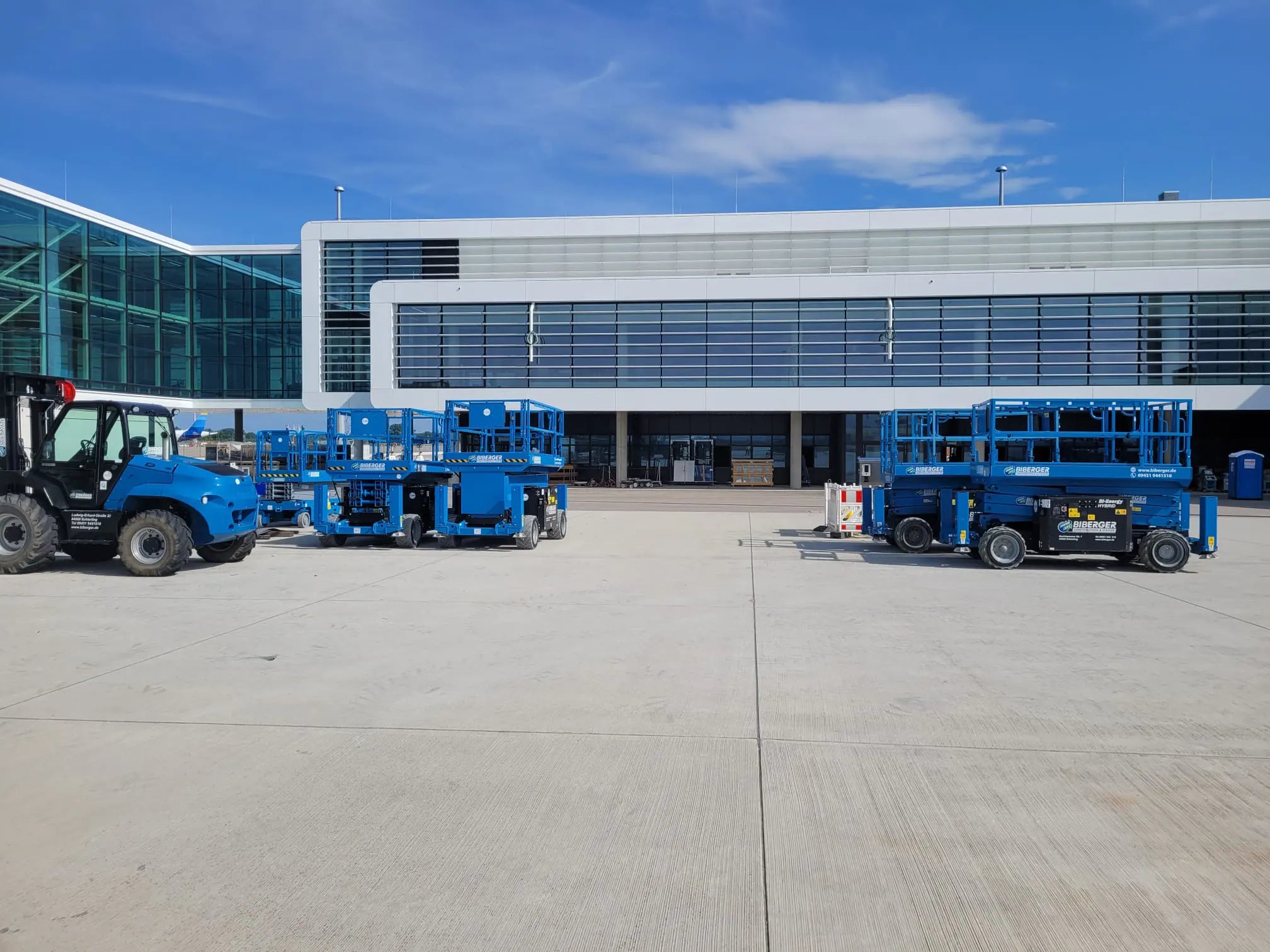
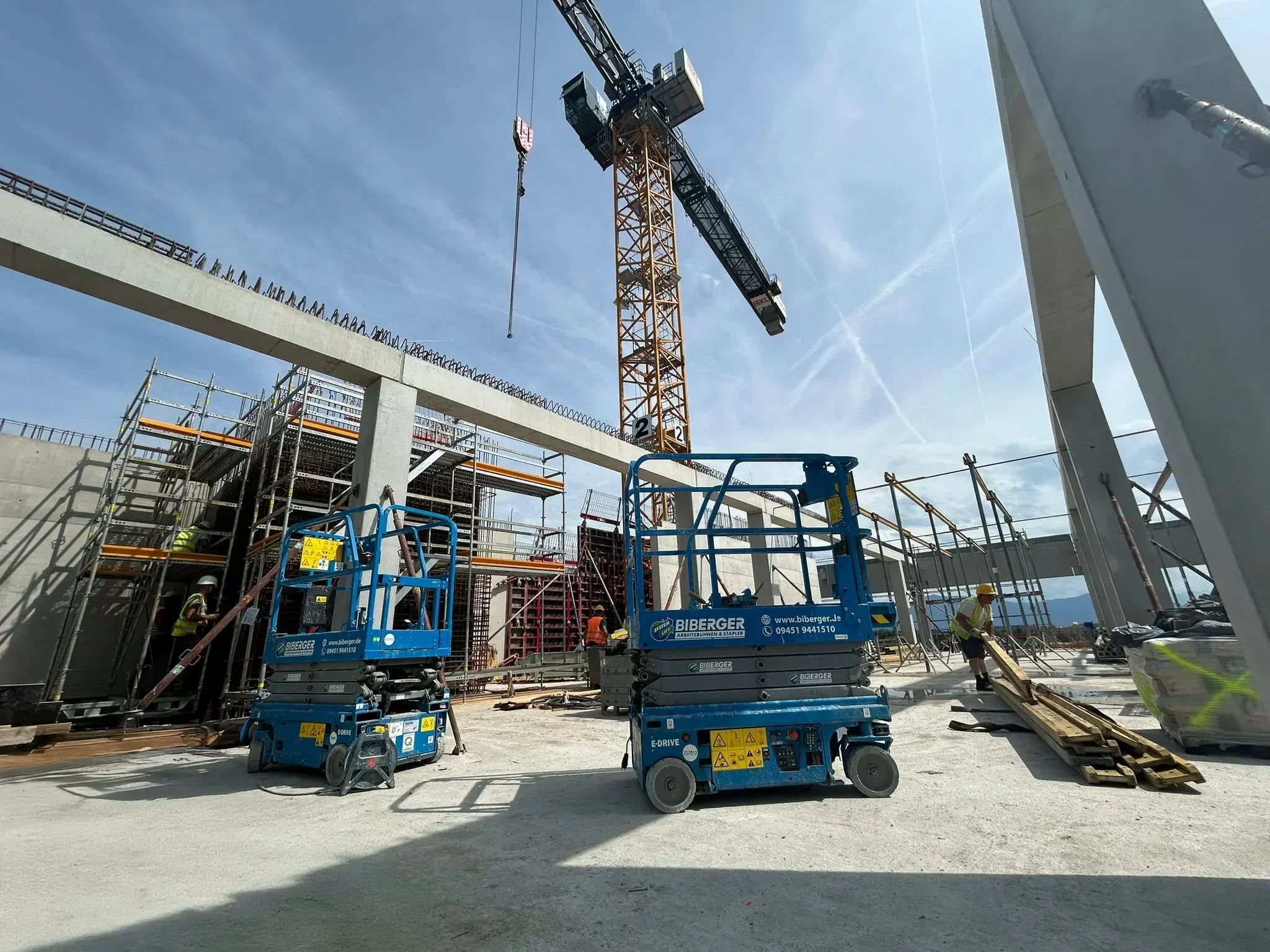
Scissor lifts are often considered the basic platform on every construction site – but they are highly specialized for precisely what matters on shell construction sites : fast, robust, and uncomplicated. They offer advantages where other access technologies, such as scaffolding , reach their limits:

  • Load capacity up to 500 kg and more , ideal for tools, materials and two people
  • Height access up to over 34 meters , without complex support
  • Electric or hybrid drive , particularly suitable for semi-open or closed halls

Especially during the shell construction phase, the ground, access roads, and weather conditions change daily. Scissor lifts provide a stable constant in the chaos – if chosen correctly.

What are the requirements for the shell construction of stages?

Load capacity and platform size

In shell construction, it's rare for just one person to be at height – often two people work together, carrying toolboxes, cables, pipes, or assembly materials. Scissor lifts offer consistent load-bearing capacity across the entire platform – something not always possible with other work platforms .

In addition, many platforms can be extended sideways using a so-called platform extension – this saves moving and noticeably increases efficiency.

Maneuverability despite size

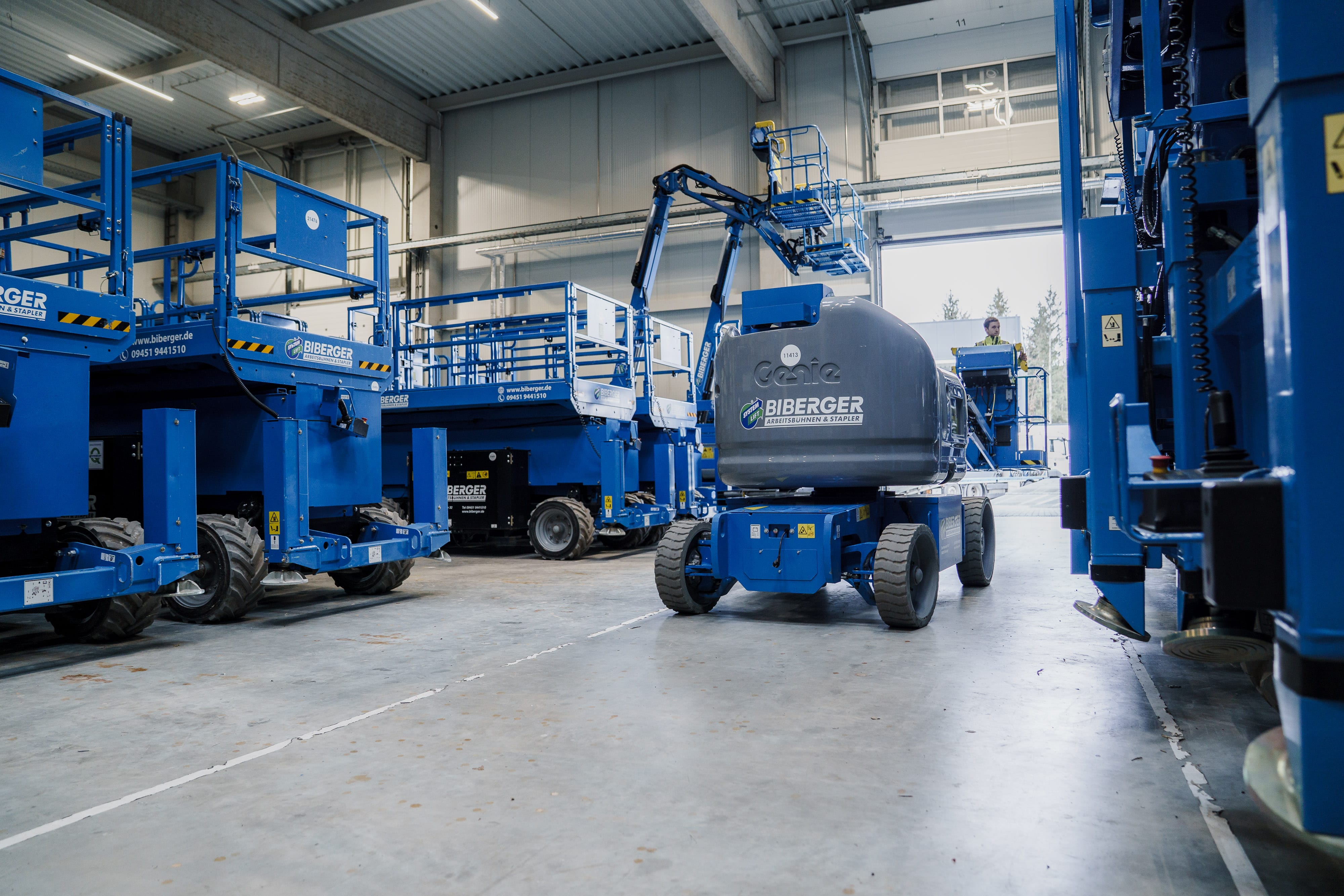
Not every large platform will fit through every shell. Especially in new buildings with temporary partition walls or restricted access, dimensions must be precisely coordinated. Modern scissor lifts are so compact that they can even fit through shell gates up to 2 m high – a real practical advantage .

Where scissor lifts are particularly strong

Installation work on ceiling and wall

  • Light, ventilation, piping, TGA – everything that hangs from the ceiling needs safe access
  • Continuous platform without bends or joints ensures continuous work

Installations under time pressure

  • Thanks to quick assembly, easy operation and minimal training requirements, scissor lifts are ideal when several trades share space and time slots
  • A reliable solution, especially for short-term assignments – for example, when other trades are delayed

Working on sensitive ground

Many people think of rough gravel when they think of a shell construction. But often the ground is already poured or prepared – and a platform with low ground pressure is crucial. Electric scissor lifts with non-marking tires and minimal point loads are clearly advantageous here.

Easy to use – even for changing teams

Forward, backward, up, down – that's often all it takes. Scissor lifts are considered particularly user-friendly because they're intuitive to control. This is a real advantage for changing teams on the construction site: little training time, no complex controls , no surprises.

Even temporary helpers or subcontractors can get up and running quickly (assuming they have been trained) – ideal when construction work requires a quick turnaround and not every operator is a professional. Simplicity here means a quick start, fewer errors, and greater safety .

What is often underestimated – and causes problems later

Permissible floor load

The platform fits through the gate, but the floor won't hold it. There's only one thing to help here: check in advance where the platform will travel and where it will be positioned. This is especially critical in freshly laid screed or basement areas.

Power supply and charging cycles

The battery was empty, the charging stopped —and the entire schedule was delayed. Solution: Organize chargers on-site, use break times for intermediate charging, and keep track of charging cycles.

Indoor emissions

Hybrid devices can also generate emissions – for example, when the platform automatically switches to diesel. This can be a problem in shell buildings with dense structures or when working with screed and finishing work. Purely electric scissor lifts are the safe choice here.

Practical tips: How to get the best out of it

  • Plan the stage like a team member – early, not “when it’s time”
  • Check dimensions and weights not only on paper , but on site – especially gates, edges, ramps
  • Pay attention to the platform equipment : sockets, pull-out, sensors – everything that promotes productivity
  • Talk to the rental company about the exact purpose – they often know machines that are better suited than the “standard model”

Conclusion: Scissor lifts are not gap fillers – they are real productivity boosters

What may seem simple at first glance is actually one of the most powerful machines on a construction site . Scissor lifts combine safety, load capacity, and accessibility – and provide speed precisely where other systems slow down. Those who don't just "include" them in their plans, but use them purposefully , save time, reduce risks, and significantly increase efficiency.

Because in the end, what you don’t reach at the top stays at the bottom.

Rectangle_1 - BIBERGER
About the author

Martin Biberger

Managing Director

Martin is the founder and managing director of BIBERGER Arbeitsbühnen & Forklifts.

He is responsible for thetechnical areaTogether with his team, he is responsible for thetechnical purchasingthe machines thatFurther development of the machine inventoryand the smooth operation of over 1,500 BIBERGER rental devices.

From many years of experience he knows theStrengths and weaknesses of all device classes, the possibleAreas of applicationand thetechnical possibilities– always with a view to theDevelopment of the entire industryand future innovations.

Our editorial quality standards

The subject content on biberger.de are editorially created, reviewed, and continuously updated. The basis is our daily work with aerial platforms, telehandlers, and industrial trucks – in rental, sales, operational planning, and technical support.

Each article draws on real-world experience and is editorially reviewed for clarity, accuracy, and practical relevance according to expert criteria. Technical statements are regularly compared against current industry standards and best practices.

The aim of our publications is to make reliable specialist knowledge accessible and to offer guidance to users, decision-makers and industry partners. BIBERGER sees itself as an independent information platform for safe, economical and modern height access technology – well-founded, comprehensible and free from advertising influence.

Leave a comment

Please note, comments need to be approved before they are published.

This site is protected by hCaptcha and the hCaptcha Privacy Policy and Terms of Service apply.

FAQ

How far can a scissor lift extend?

The maximum working height of scissor lifts is, depending on the model, between6 and over 34 meters. The stageextended vertically upwards, without side projection. Not only the height is crucial, but also thePlatform size and load capacity, which usually remains stable with increasing altitude.

Precise information depends on the specific stage type – electric indoor models usually have shorter ranges than diesel-powered outdoor devices.

Kann man mit einer Scherenbühne Material heben?

Ja – Scherenbühnen sind sogar ideal für das Heben von Material. Die meisten Modelle bieten eine hohe Traglast von 300 bis über 500 kg, teilweise auch mehr. Damit lassen sich Werkzeug, Baustoffe, Montagezubehör oder Leitungen problemlos mit nach oben nehmen.

Wichtig: Das Material darf gleichmäßig verteilt sein, da die Plattform in der Regel keine Punktlasten verträgt. Auch sollten Personen und Material gemeinsam das zulässige Gewicht nicht überschreiten. Für reinen Materialtransport ohne Bedienpersonal sind andere Geräte wie Teleskoplader besser geeignet – Scherenbühnen sind primär für das Arbeiten mit Last gedacht, nicht als reiner Aufzug.

Does a scissor lift have to be on level ground?

Yes – a level, stable surface is mandatory.Many scissor lifts can be used on uneven grounddon't even drive outor only up to a certain height.

This is for safety reasons: The stage movesvertically upwards, without lateral compensation. Even slight slopes can jeopardize stability. Modern devices haveInclination sensorswhich automatically block the lift if the floor is not level enough.

Conclusion:Always check before use:Is the floor load-bearing, stable and level?Help in case of doubtBase plates or floor coveringsto create a safe standing area.

What is the concept of a scissor lift?

The basic principle of a scissor lift isa vertical lift via a scissor frame– hence the name. Several metal struts arranged crosswise (the so-called “scissors”) are moved apart hydraulically or electrically andlift the platform upwards.

In contrast to articulated or telescopic platforms, the platformonly vertical, not sideways. This makes themparticularly stable, durable and easy to use.

How far can a scissor lift travel?

Scissor lifts areself-driving, but within their driving rangehighly dependent on use:

Within the work area:

Modern models canproceed independentlyas long as the platform is retracted. The range depends on the battery level or the tank (for diesel models) – usuallyseveral hours of drivingeasily possible.

With the platform extended:

Many scissor lifts can benot or only to a limited extentwhen they are extended. This depends on the model and the safety clearances – for someno movementallowed with raised platform, others allowminor shuntingon flat ground.

Transport over longer distances:

Scissor lifts are not designed for long distances (e.g. between construction sites or hall areas).Transport by low loader or trailer– because speed and propulsion are only sufficient for slow movements on the operational site.

In short:

Yes, a scissor lift can move – but only within its area of operation.Long distances are not intended, and caution or a complete standstill is required when the platform is extended.

When do you use a scissor lift?

A scissor lift is always used whenWorking at heighton alarge, stable platformmust be carried out – ideallyvertically upwards, without a large lateral reach. Typical application scenarios are:

Interior fittings & technical building equipment (TGA):

  • Installation of ventilation, electrical, sprinkler systems
  • Ceiling mounting in halls, warehouses or shopping centers

Shell & prefabricated construction:

  • Work on ceilings or beams
  • Material transport at work level during construction

Maintenance & Repair:

  • Repairs in production halls or logistics centers
  • Cleaning and service of high-altitude facilities

Industry & Event Technology:

  • Stage construction, lighting and sound technology
  • Construction of temporary installations in halls

The scissor lift is particularly suitable when…

  1. Load capacity is required: several people + material
  2. low emissions are important (e.g. with electric drive indoors)
  3. straight, level ground is available
  4. high repeatability is required (e.g. in series assembly)

Relevant topics

View all

Wind und Arbeitsbühnen: Was Du für einen sicheren Einsatz unbedingt wissen musst

Wind and aerial work platforms: What you absolutely need to know for safe use

Key problem: Why wind loads are so often underestimated Wind load is one of the most underestimated risks when using aerial work platforms. At ground level, wind force 6, with 12.5 m/s or around 45 km/h, often seems relatively harmless....

Read more

Arbeitsbühnenmärkte weltweit KI generiert

Aerial work platforms worldwide: An international comparison of markets, manufacturers & costs

Aerial work platforms are indispensable on almost every construction site and in many industries. However, although the basic technology is similar worldwide, markets differ significantly in terms of regulation, manufacturing landscape, pace of innovation, and typical application profiles. Understanding international...

Read more

Arbeitsbühne Privat mieten – Was ist erlaubt?

Renting a work platform as a private individual – What is allowed?

Aerial work platforms are primarily designed, standardized, and planned for commercial use. Typical applications include facade construction, plant and building technology, and industrial maintenance. Accordingly, equipment selection, insurance models, and rental procedures are geared primarily towards commercial users with trained...

Read more

Anschlagen von Lasten – Anschlagmittel richtig auswählen und sicher einsetzen

Lifting loads – selecting and safely using lifting equipment

Safely attaching loads is one of the most demanding tasks when operating cranes , forklifts , and lifting equipment. Errors almost never occur during the lifting itself, but almost always result from misjudging the load capacity, type of attachment, or...

Read more

Staplerfahrer werden

Become a forklift driver: safely, trained and responsibly

A moment of inattention 7:15 a.m. A forklift driver begins his early shift. Routine. He only gives the forklift a cursory check – time pressure, the truck is waiting. On the third lift, the fork tine snaps at an old...

Read more

CAN-Bus und J1939-Diagnose bei Baumaschinen - BIBERGER

CAN bus and J1939 diagnostics in construction machinery

Modern construction machinery is now highly networked systems. Sensors, control units and safety modules communicate with each other constantly – and this happens via the so-called CAN bus . The CAN bus is essentially the nervous system of every modern...

Read more

Magni Diagnose-Leitfaden: Fehlermeldungen richtig deuten - BIBERGER

Magni Diagnostic Guide: How to correctly interpret error messages

If your Magni telehandler (RTH / HTH series) suddenly displays a warning, it's rarely a total breakdown. Usually, a safety or protective function is being activated. This guide explains the most important error codes, their meaning, and how to react...

Read more

3D-Arm einer Arbeitsbühne

3D arm on aerial work platforms: Technology, advantages and model codes at a glance

The so-called 3D arm – also known as a 3D basket arm , pendulum basket arm , or hybrid jib – is a state-of-the-art feature for aerial work platforms. Its three-axis mobility allows for particularly precise work in hard-to-reach areas....

Read more