



 What You Need to Know
Anyone who uses an electric aerial work platform sooner or later asks themselves the same question: How long does the battery actually last?
The answer is not that simple, because many operators confuse two different things: the runtime of a battery per charge and its lifespan over several years.
While runtime describes how long an aerial work platform can be operated on one battery charge, lifespan refers to the period until the battery needs to be replaced due to aging.
Both values depend on numerous factors – from the battery type and operating conditions to charging behavior.
In this article, you will learn what runtimes are realistic in practice, how long batteries typically last, and what measures can significantly extend their lifespan.
Runtime and Lifespan: The Most Important Difference
Many users use both terms synonymously. Technically, however, they describe two completely different properties.
What does battery runtime mean?
Runtime describes how long an aerial work platform can be operated on a full battery charge.
It indicates how long the platform can drive, lift, and work before it needs to be recharged.
What does battery lifespan mean?
Lifespan describes the period until the battery significantly loses performance or needs to be replaced due to aging.
For example, a battery can last eight hours per charge and still need to be replaced after four years.
Confusing the two terms often leads to false expectations about the actual performance of an aerial work platform.
How long does an aerial work platform last per battery charge?
The runtime depends heavily on the type of machine, battery capacity, and operating conditions.
Therefore, a general statement for all aerial work platforms is not possible.
Typical Runtimes in Practice
- Scissor lifts: often about 8 to 10 hours in normal use
- Mast booms: often a full workday
- Articulated boom lifts: dependent on driving time and lifting movements
- Telescopic boom lifts: highly dependent on working height and application profile
These values are only guidelines. The actual runtime can be significantly higher or lower depending on usage.
Why two identical platforms can run for different durations
Even identically constructed machines can achieve completely different runtimes in daily use.
A platform that is mostly stationary and only occasionally lifted consumes significantly less energy than a machine that is constantly driven, lifted, and lowered.
Therefore, the type of use is often more important than the pure battery capacity.
What factors influence battery runtime?
Battery runtime is determined by numerous influences. Some of these can hardly be influenced, others can.
Battery Type
The battery type used has a great influence on performance, charging behavior, and lifespan.
Modern lithium-ion systems often offer a higher usable capacity and more charging cycles than classic lead-acid batteries.
Working Height and Lifting Movements
Every lifting operation requires energy. The more frequently the platform is raised and lowered, the faster the charge level drops.
High working heights also increase energy demand.
Driving Portion
Machines that are constantly driven consume significantly more energy than platforms that primarily work at a fixed location.
Particularly long driving distances can noticeably reduce the runtime.
Surface
Smooth hall floors put significantly less strain on the drive than uneven outdoor surfaces.
Slopes, gravel, or poor ground conditions further increase energy consumption.
Weight of the Load
The higher the load in the work basket, the more the battery and drive are strained.
Tools, material, and people increase the total weight and thus the energy demand.
Why Cold Significantly Reduces Battery Performance
Temperature is one of the most important influencing factors on battery performance.
Particularly low temperatures can significantly reduce the usable capacity.
What happens in the cold?
As temperatures drop, the chemical processes within the battery slow down.
The result:
- lower capacity
- less range
- higher internal resistance
- longer charging times
This is why many users report significantly shorter operating times in winter.
Can heat also cause damage?
Yes. High temperatures briefly improve performance, but at the same time accelerate battery aging.
Persistent heat can significantly shorten the lifespan.
How long does an aerial work platform battery last overall?
In addition to the runtime per charge, many operators are interested in the long-term lifespan.
There are significant differences between the various battery technologies here.
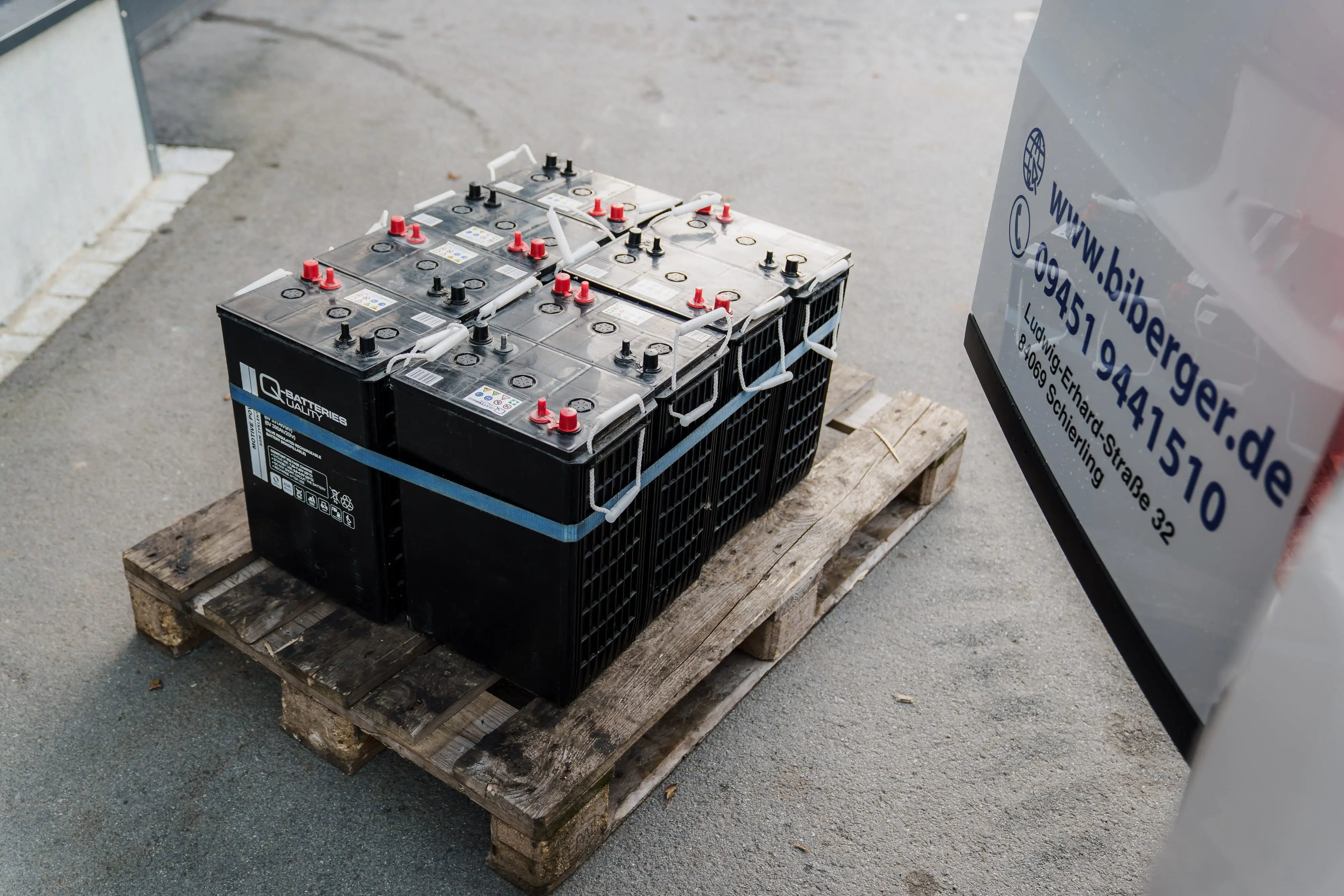
Lead-Acid Batteries
With good care, classic lead-acid batteries often achieve a lifespan of approximately three to five years.
However, the actual lifespan depends heavily on use and maintenance.
Lithium-Ion Batteries
Lithium-ion systems often achieve significantly more charging cycles and can be used for many years longer with professional use.
In practice, lifespans of well over five years are not uncommon.
Why Maintenance is Crucial
Two identical batteries can age completely differently.
While one battery may need to be replaced after only a few years, another with the same technology can last significantly longer.
The difference often lies in the charging behavior and operating conditions.
How to Recognize an Aging Battery
Batteries usually lose their performance gradually.
Typical signs include:
- noticeably shorter runtimes
- more frequent recharging
- slower lifting
- voltage drops under load
- unusually long charging times
- machine warning messages
If several of these symptoms occur simultaneously, the battery should be checked.
Lead-Acid or Lithium-Ion: Which Lasts Longer?
The question of the better technology cannot be answered generally. Both systems have advantages and disadvantages.
Lead-Acid Batteries
- lower acquisition costs
- proven technology
- higher maintenance effort
- lower cycle count
Lithium-Ion Batteries
- more charging cycles
- faster charging times
- lower maintenance effort
- higher acquisition costs
Especially with daily use, lithium-ion systems can be economically attractive in the long term.
How to Extend Battery Lifespan
With a few measures, battery lifespan can often be significantly increased.
Avoid Deep Discharge
A complete discharge unnecessarily stresses any battery and should be avoided if possible.
Use the Right Charger
Charger and battery must match. Incorrect chargers can damage the battery.
Charge Regularly
Aerial work platforms should not be left for long periods with a nearly empty battery.
Avoid Extreme Temperatures
Heat and extreme cold accelerate aging processes and reduce performance.
Check Contacts
Clean and undamaged contacts ensure reliable energy transfer.
Perform Regular Maintenance
Maintenance helps to identify problems early and prevent consequential damage.
Common Mistakes When Charging Aerial Work Platforms
Many battery problems do not arise from defects, but from improper use.
Leaving Uncharged for Too Long
A long period of inactivity with a low charge level can permanently damage the battery.
Using Unsuitable Chargers
Incorrect chargers can extend charging times and stress the battery.
Permanent Full Load
Operating the platform regularly at its load limit increases energy demand and accelerates wear.
Ignoring Temperature
Especially in winter, reduced battery performance should be considered when planning operations.
When should a battery be replaced?
Replacement becomes sensible when the runtime no longer reliably enables daily use or performance significantly decreases.
Further indications may include:
- frequent failures
- significant capacity losses
- disproportionately long charging times
- recurring error messages
At the latest then, the battery should be professionally checked.
Conclusion: Battery runtime depends more on use than on the machine
How long an aerial work platform battery lasts cannot be answered with a fixed number. Battery type, usage, temperature, load, and charging behavior are decisive.
While many electric aerial work platforms can handle a full workday on one charge, long-term lifespan primarily depends on care and operating conditions.
By charging batteries correctly, avoiding extreme temperatures, and paying attention to the first signs of aging, you can significantly improve both runtime and lifespan.




Share:
Blind Spots on Telehandlers: How to Avoid Dangerous Shunting Accidents
Our editorial quality standards
The subject content on biberger.de are editorially created, reviewed, and continuously updated. The basis is our daily work with aerial platforms, telehandlers, and industrial trucks – in rental, sales, operational planning, and technical support.
Each article draws on real-world experience and is editorially reviewed for clarity, accuracy, and practical relevance according to expert criteria. Technical statements are regularly compared against current industry standards and best practices.
The aim of our publications is to make reliable specialist knowledge accessible and to offer guidance to users, decision-makers and industry partners. BIBERGER sees itself as an independent information platform for safe, economical and modern height access technology – well-founded, comprehensible and free from advertising influence.