


 What You Need to Know
What large-scale advertising is really about
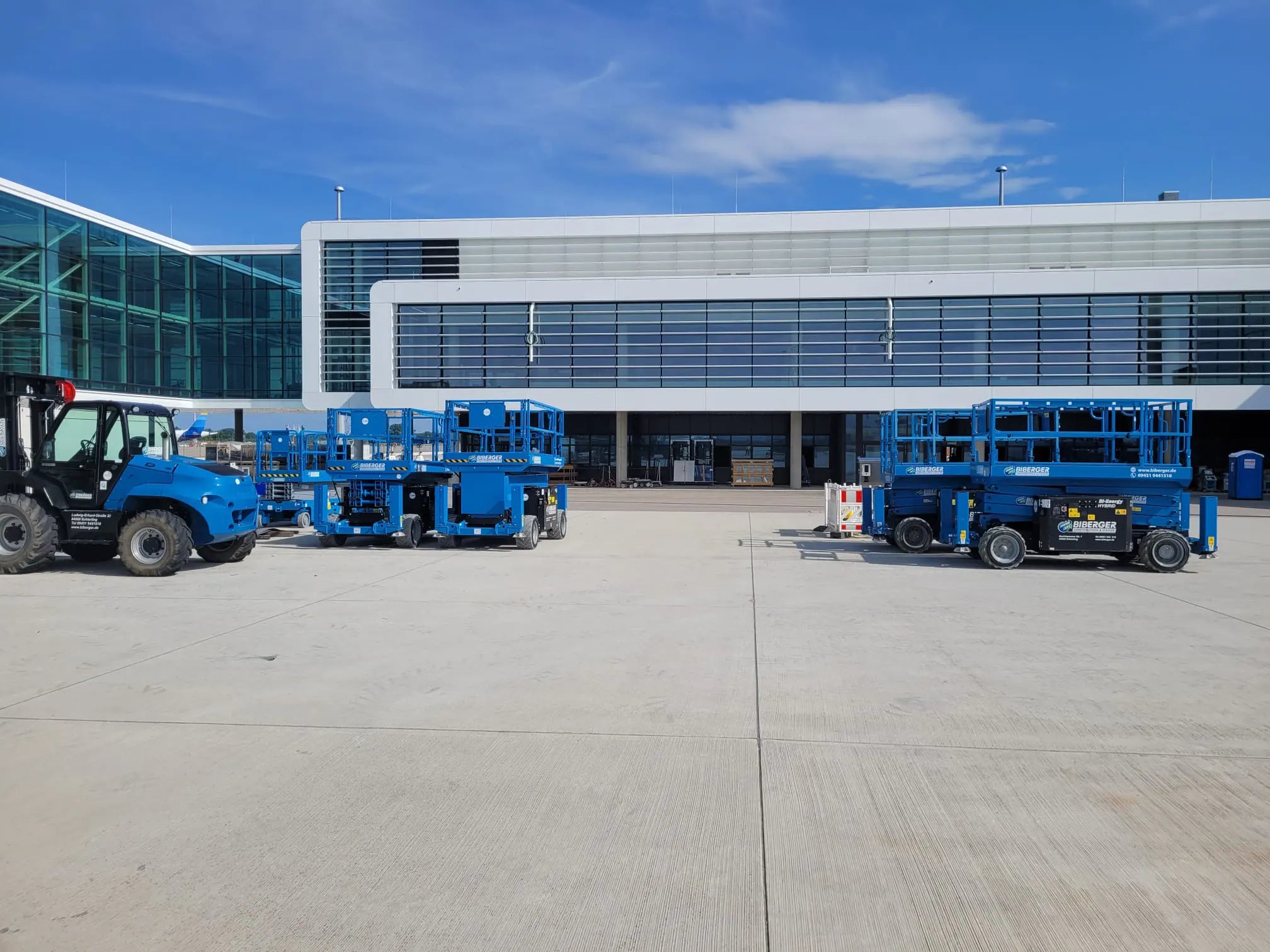
On large forecourts and long facades, you don't lose time at height, but on the ground. Repositioning, waiting times for transport, incorrect equipment width, restricted areas – all of that eats up hours.
The key question is not "How high?", but: How do you get the device to each point, how often do you have to reposition it, and who is blocking whom?
The most common misconception: "One device is enough"
Why an all-rounder is usually more expensive
A device that "can do everything" often gets in the way in practice. It's either too big for peripheral areas, too slow to implement, or inefficient when working in parallel.
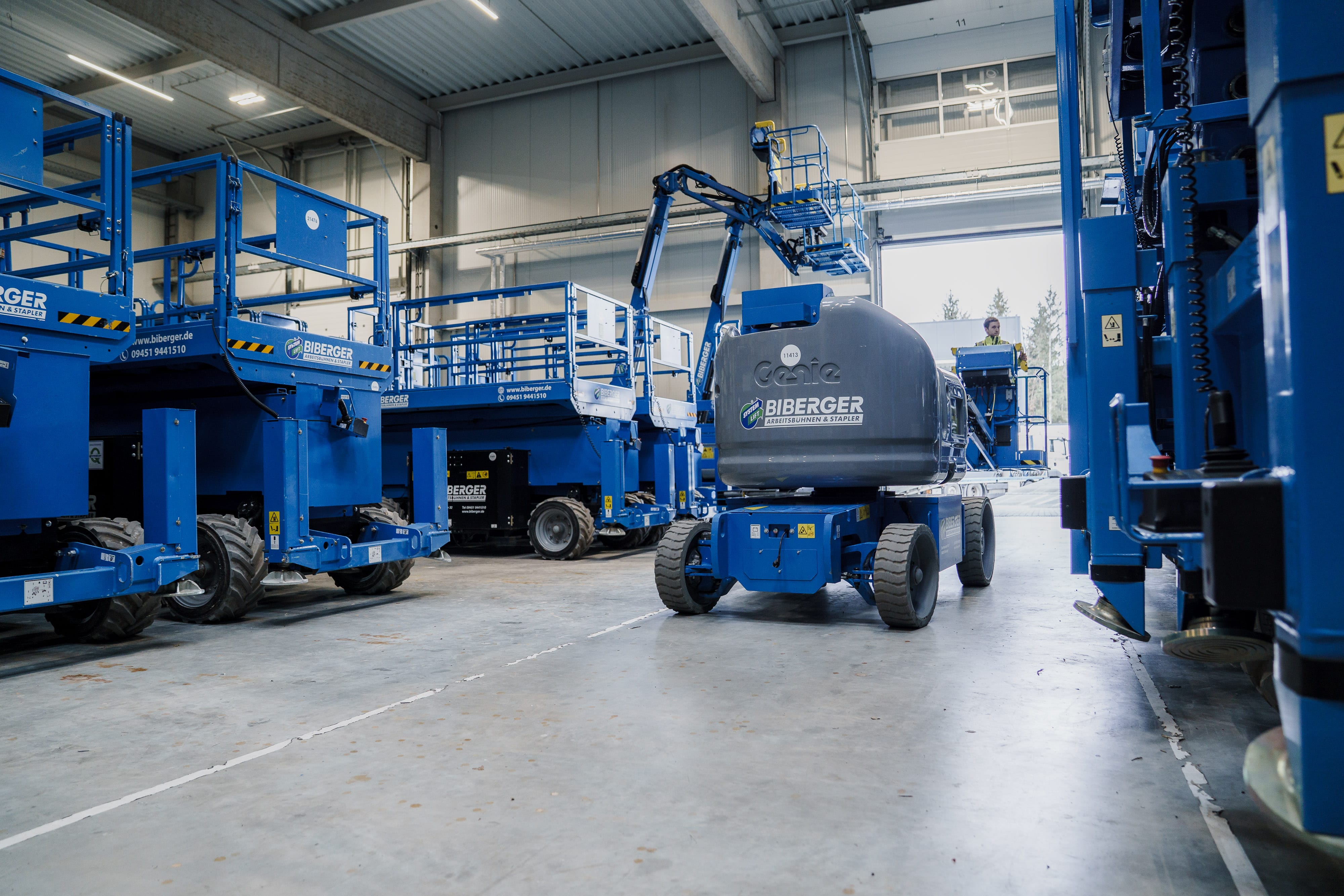
On large areas, it works better to think in terms of roles: area performance (scissors), reach (boom), material flow (forklift/telescopic), zone work (compact).
When you really need multiple devices
Splitting the workload is worthwhile whenever two trades require simultaneous access to heights or the distance between work points is large. Otherwise, one piece of equipment will be "wandering" all day instead of working.
A rule of thumb from experience: If you have to move more often than every 60-90 minutes, the setup is not right.
Equipment selection based on construction site logic, not data sheet romance.
Scissor lift: When area and tempo are crucial
Scissor lifts deliver high area coverage: quiet, fast up/down, minimal play, well-suited for linear work (facades, hall walls, substructures). The advantage comes from speed, not from "reach".
What's important here is not the maximum height, but: platform size, actual load capacity, driving speed off-road and how often you need to reposition.
Articulated/telescopic platform: When you need to go around obstacles
When roof overhangs, canopies, supports, or cordoned-off areas are in the way, you need reach and geometry. A boom stage is useful in these situations – but it doesn't replace usable space.
The mistake is planning articulated telescopic platforms as the "standard" for facade work, even though the work is actually linear. This slows down the process.
Telescopic handlers/forklifts: The underestimated time waster is material.
On large sites, projects often fail due to material movement: pallets, railings, glass elements, tools, cables, ballast. If materials don't keep flowing, the height remains stagnant.
Plan the material flow separately: Who brings what where, within which time windows, and where is the buffer zone?
What you need to check beforehand at the deployment site
Zones & restricted areas: Where are you actually allowed to drive?
Large areas appear open, but rarely are: escape routes, fire protection zones, access roads, security areas, passageways, delivery corridors. These zones determine the type of equipment and its positioning.
If you only realize these limitations once you're there, you'll have to change your plans – and end up paying twice.
Soil & slope: Not "load-bearing", but "passable"
The question is: Can you drive, brake, and steer the device smoothly – even over joints, channels, manhole covers, transitions, and slopes?
On concrete slabs, the transitions and edges are usually the problem, not the surface area itself. This determines the appropriate tires and whether a particular machine is suitable.
Access & passage: Width trumps height
In large areas, the bottleneck often occurs at one point: a gate, ramp, passageway, bollard, or barrier. If you can't get through there, the rest of the area is irrelevant.
Therefore, first determine the bottleneck, then the height. Not the other way around.
Implementation without chaos: How to keep the beat
Use "working windows" instead of spontaneous maneuvering.
When multiple teams are working together, you need clear time windows: when will tasks be implemented, when will materials be replenished, and when is the zone clear. Otherwise, equipment will block each other.
This is not overengineering, but rather the difference between one device that works and one device that gets in the way.
Define buffer zone: Do not place material directly at the work site.
Having materials directly at the work area sounds good, but it creates bottlenecks. A buffer zone from which materials can be smoothly pulled is better.
This keeps traffic routes clear and reduces stage downtime.
Typical mistakes we see constantly in practice
Mistake 1: Altitude requirement without a reserve for the actual situation
If the planning specifies " 6-8 meters is sufficient," there's often insufficient leeway due to work position, component type, or because you can't directly access the wall. The result: the device doesn't quite fit, and you have to improvise.
Reserve is not only created by meters, but also by device logic: platform, range, footprint.
Mistake 2: One device for indoor and outdoor use without a clear priority
A device that works perfectly indoors is often too slow or too sensitive outdoors. Conversely, an outdoor device is often impractical or undesirable indoors.
If both are needed, plan for two roles – or decide clearly where the focus lies.
Mistake 3: Material flow is done "on the side".
If no one is responsible, materials are left unfinished, the stage waits, and the day is ruined. This happens faster than any technical malfunction.
Having a forklift/telephoto operator as a fixed part of the plan usually saves more than the next stage upgrade.
This is how we discuss large-scale projects at BIBERGER.
We first clarify bottlenecks (access, zones, floor space, relocation), then equipment combination, then logistics. This way you get a setup that runs smoothly and doesn't just fit "on paper".
If you provide us with the deployment location and the working axes, we will suggest a distribution of equipment according to roles: area coverage, reach, material flow, and peripheral areas.




Share:
DGUV 308-008, SYSTEM-CARD® or IPAF: Which mobile elevating work platform training does your team really need?
How safe is a rented aerial work platform, actually?
Our editorial quality standards
The subject content on biberger.de are editorially created, reviewed, and continuously updated. The basis is our daily work with aerial platforms, telehandlers, and industrial trucks – in rental, sales, operational planning, and technical support.
Each article draws on real-world experience and is editorially reviewed for clarity, accuracy, and practical relevance according to expert criteria. Technical statements are regularly compared against current industry standards and best practices.
The aim of our publications is to make reliable specialist knowledge accessible and to offer guidance to users, decision-makers and industry partners. BIBERGER sees itself as an independent information platform for safe, economical and modern height access technology – well-founded, comprehensible and free from advertising influence.