Reading now: Working height simply explained – definition, examples, areas of application
Zusammenfassung What You Need to Know

TheWorking heightIt determines comfort, efficiency, and safety. In the kitchen, it determines whether work is carried out ergonomically; on a construction site, it determines whether a facade can be reached. For ladders and scaffolding, the following applies: working height = standing height + approximately 2 m.

In everyday life as well as in industry, working height is crucial.Kitchens, workshops, offices, logistics, and medical facilities use them for ergonomic processes. In height access technology, it is calculated as a platform height plus 2 m – with typical ranges from 6–8 m to over 40 m, and in special cases even over 100 m.

Zusammenfassung What You Need to Know

TheWorking heightIt determines comfort, efficiency, and safety. In the kitchen, it determines whether work is carried out ergonomically; on a construction site, it determines whether a facade can be reached. For ladders and scaffolding, the following applies: working height = standing height + approximately 2 m.

In everyday life as well as in industry, working height is crucial.Kitchens, workshops, offices, logistics, and medical facilities use them for ergonomic processes. In height access technology, it is calculated as a platform height plus 2 m – with typical ranges from 6–8 m to over 40 m, and in special cases even over 100 m.

Working height sounds simple – but it isn't. Depending on the location, it can determine comfort, efficiency, or even safety. In the kitchen, working height determines whether you can comfortably chop vegetables or whether your back hurts after ten minutes. On a construction site, working height determines whether you can reach the facade in one go – or whether you lose valuable time with the wrong platform.

What does working height actually mean?

The definition is quickly explained: Working height describes the area in which you can practically work.

For work platforms , it's calculated from the platform height plus approximately two meters of reach. For furniture or workbenches, it's a matter of centimeters and ergonomics. In other words: the same word, but different meaning.

Here we explain the difference between working height and platform height in detail.

Z40/23N RJ Rentals - BIBERGER

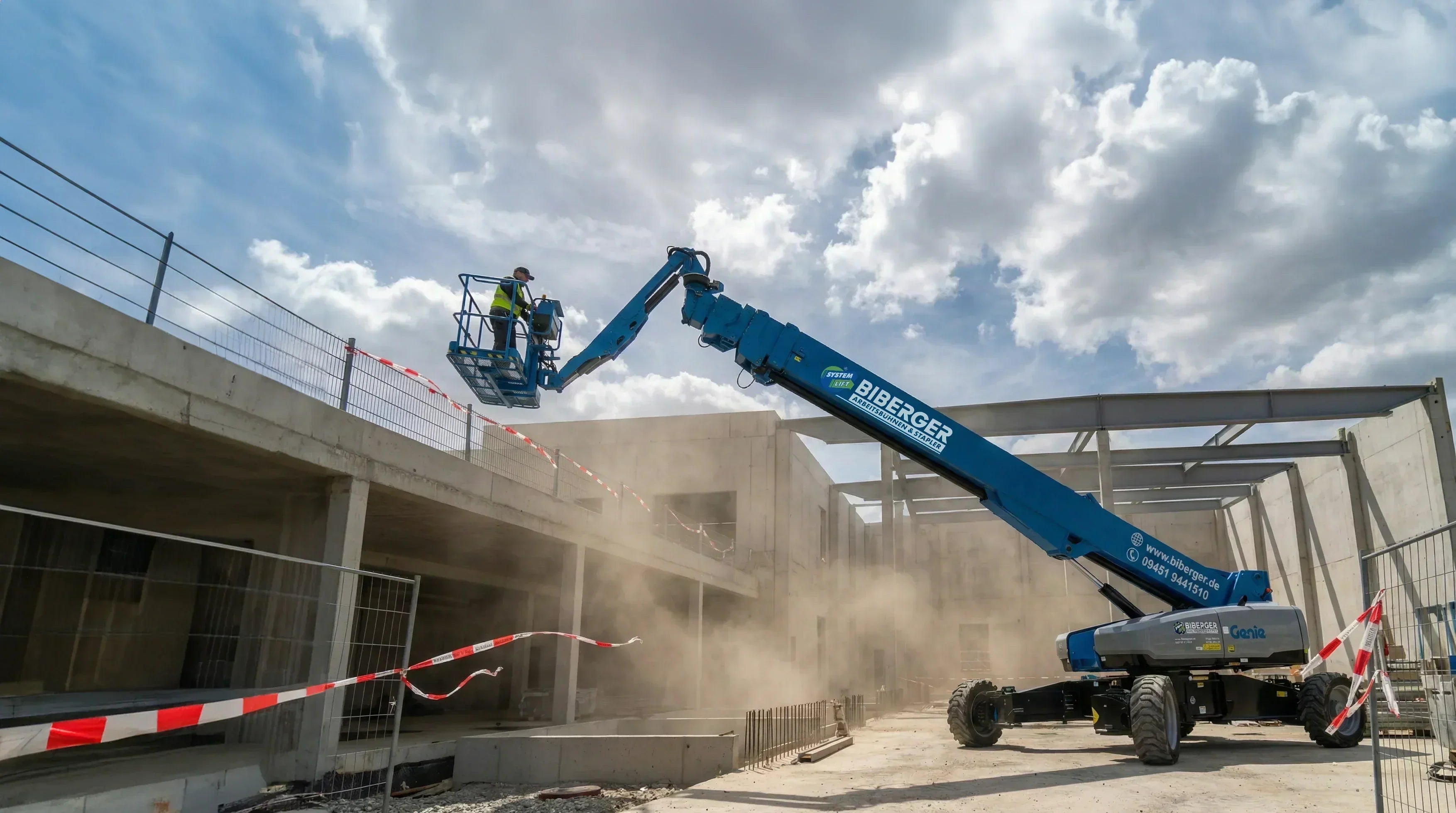
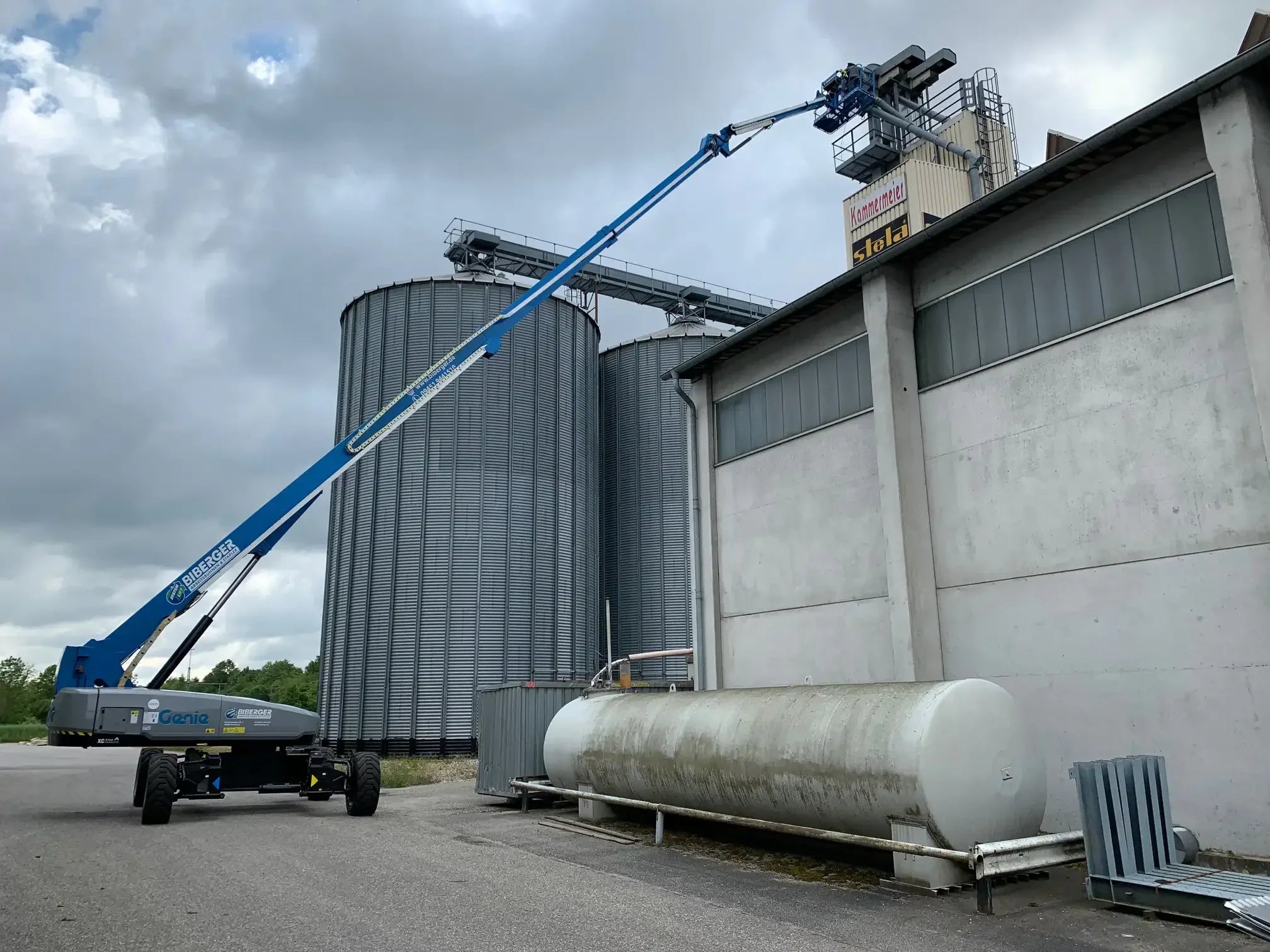
Here you can see the working area with indication of the working height of a small articulated telescopic platform .

Working height on work platforms – the decisive factor

In height access technology, working height is the most important metric of all . It determines whether your project is running or stalled. A platform with an 8-meter platform height has a working height of around 10 meters. It sounds trivial, but it makes the difference between reaching the ceiling or not.

Practical examples

Interior work in an 8-meter-high hall? A scissor lift with a working height of 6-8 meters is sufficient. Facade work on a 20-meter- high office building? You won't even get close without a telescopic boom lift. And for industrial facilities with pipes or overhangs, you need articulated boom lifts – because working height without reach is useless.

Working height in everyday life

Working height plays a role not only on construction sites. It also determines many aspects of everyday life: Kitchen countertops are usually between 85 and 95 cm, and workbenches are tailored to body size and use. Even in the office, table heights are chosen to protect shoulders and wrists. Working height = ergonomics = health.

Working height in industry

Whether it's an assembly line, machine operator, or packaging station – in industry, working heights are precisely tailored to processes. Even a few centimeters can determine whether employees can work efficiently and without damaging their backs.

Working height in warehouse & logistics

Shelf heights, conveyor systems, and picking stations are designed to ensure goods can be moved quickly and safely. An incorrect working height directly leads to lost time and a higher risk of injury.

Working height in the office

Office workstations require desks and monitors at the appropriate height. Adjustable tables and chairs ensure that people of different heights can work optimally.

Working height in the medical field

In operating rooms, on treatment chairs or examination tables, the correct working height is crucial for the precision and ergonomics of the specialist staff – and thus also for the safety of the patients.

Working height in the catering industry

Kitchen work surfaces, counters, and buffet stations must be designed to allow chefs and service staff to work quickly, ergonomically, and hygienically. Here, too, the following applies: incorrect height = unnecessary strain.

Ladder, scaffolding or stage – which one is right for you?

The rule of thumb for ladders and scaffolding is: working height = standing height + 2 meters. So, if you climb to three meters, you're effectively working at five meters. This sounds practical, but it's risky: the higher you go, the more unstable you become . That's why work platforms have long been standard—safe, flexible, and quickly ready for use.

Find out which is better for your project: work platform vs. scaffolding .

Which devices for which working heights?

  • 6–8 m: Compact scissor lifts or mast lifts, ideal for warehouses and halls
  • 10–16 m: Articulated telescopes for working over obstacles
  • 20–30 m: Telescopic platforms for construction & industry
  • 40+ m: Special equipment for infrastructure and large-scale projects

How to calculate the correct working height

Just remember: platform height + 2 meters = working height . But: plan for a reserve! If you're working on a 12-meter facade, a 12-meter platform isn't enough. Tools, materials, freedom of movement – ​​all of this requires clearance.

Working height and ergonomics – small scale, big impact

The same applies to kitchens and workshops: The right height saves energy and stress. A workstation that's too low leads to back pain, while one that's too high leads to tension. Therefore, working height should never be left to chance – whether in industry or in the home.

BIBERGER – your partner for every working height

Whether you're working on a 6-meter warehouse or a 40-meter facade project, you'll always find the right solution in our rental fleet of over 1,000 pieces of equipment . We offer practical advice: Which platform is truly suited to your application? What working height is sufficient? And where is it worth having backup? With BIBERGER, you get technology that not only reaches high but also fits the bill.

Benjamin_Biberger_f09df03b-780b-4e03-8991-ca3f20113b29 - BIBERGER
About the author

Benjamin Biberger

Managing Director

Benjamin is the founder and managing director of BIBERGER Arbeitsbühnen & Forklifts.

He is responsible for thecommercial and administrative areasof the company and, together with his team, ensures theOptimization of operational processesand theoptimal customer supportin their projects.

Through his many years of experience in the areas of organization andProject managementIt provides a stable foundation – in its own daily business, in sustainableFurther development of processesas well as in theCollaboration with partners and customers.

Our editorial quality standards

The subject content on biberger.de are editorially created, reviewed, and continuously updated. The basis is our daily work with aerial platforms, telehandlers, and industrial trucks – in rental, sales, operational planning, and technical support.

Each article draws on real-world experience and is editorially reviewed for clarity, accuracy, and practical relevance according to expert criteria. Technical statements are regularly compared against current industry standards and best practices.

The aim of our publications is to make reliable specialist knowledge accessible and to offer guidance to users, decision-makers and industry partners. BIBERGER sees itself as an independent information platform for safe, economical and modern height access technology – well-founded, comprehensible and free from advertising influence.

Leave a comment

Please note, comments need to be approved before they are published.

This site is protected by hCaptcha and the hCaptcha Privacy Policy and Terms of Service apply.

FAQ

What is the maximum working height for ladders?

Themaximum working height for laddersis usually6 to 7 meters. TheStand heighton the ladder plus the averageBody height of about 2 metersFor work at greater heights,Work platforms or scaffoldingas a safer alternative.

What is the maximum working height of a scaffold?

Themaximum working height for scaffoldingis usuallyup to 12 meters indoorsandup to 8 meters outdoors, without additional static proof. With specialFacade or system scaffoldingHowever, significantly greater heights can be achieved if aprofessional support and acceptanceoccurs.

What is the maximum working height of a work platform?

Themaximum working height of work platformsDepending on the design, it is between6 and over 100 metersScissor lifts usually reachup to 28 m, telescopic or articulated telescopic platforms up to58 m, and specialTruck or crawler work platformsevenover 100 m.

What is the optimal working height in the kitchen?

Theoptimal working height in the kitchenis usually between85 and 95 cm. It is based on theHeight: Ideally, the worktop should be about10–15 cm below the bent elbowend. This is how you workergonomic, gentle on back and joints.

What working height is optimal for which body size?

The optimalWorking heightdepends on theHeightAs a rule of thumb, the work surface should be10–15 cm below the elbowFor people who are 160 cm tall, approximately 85–90 cm is ideal; for people who are 170 cm tall, a height of 90–95 cm is recommended; and for people who are 180 cm tall, the optimal working height is 95–100 cm. This allows you to work ergonomically, comfortably, and with less strain on your back.

What is the working height of ladders?

TheWorking height of a ladderdescribes the height that a person can safely reach with outstretched arm. As a rule, theStand height(the last safe position on the ladder) aboutAdd 2 metersExample: If you stand at 3 m, the working height is approximately 5 m.

What is the working height of a scaffold?

TheWorking height of a scaffoldresults from the standing height plus approximately2 meter reach height. If the platform is at 8 m, the working height is around10 m.

What working height does a workbench have?

TheWorking height of a workbenchis usually between85 and 95 cmIt can be adjusted depending on body size and intended use (e.g., precise work, heavy hammering, or assembly) – ideally, the forearms should rest at a 90° angle.

What working height is permissible for a leaning ladder?

AtLean-to laddersis a working height ofup to approx. 7 metersFor commercial use, according to occupational health and safety guidelines, laddersonly for short-term workandnot as a permanent jobThe actual permissible working height depends onLadder length, standing height and safe angle of attackaway.

Relevant topics

View all

DGUV 308-008, SYSTEM-CARD® oder IPAF: Welche Hubarbeitsbühnen-Schulung braucht dein Team wirklich?

DGUV 308-008, SYSTEM-CARD® or IPAF: Which mobile elevating work platform training does your team really need?

In Germany, several relevant training systems for mobile elevating work platform operators exist in practice: the DGUV principle 308-008 as the employers' liability insurance association basis, the SYSTEM-CARD® based on it as an association-organized quality system, and the international IPAF...

Read more

Typische Planungsfehler beim ersten Einsatz von Arbeitsbühnen – und wie du sie vermeidest - BIBERGER

Typical planning mistakes when using aerial work platforms for the first time – and how to avoid them.

Introduction Why errors occur even before deployment The safe operation of a work platform begins long before the basket lifts off. Mistakes don't happen during the lift itself, but in the preparation: assessing the ground conditions, selecting the right equipment,...

Read more

Wind und Arbeitsbühnen: Was Du für einen sicheren Einsatz unbedingt wissen musst - BIBERGER

Wind and aerial work platforms: What you absolutely need to know for safe use

Key problem: Why wind loads are so often underestimated Wind load is one of the most underestimated risks when using aerial work platforms. At ground level, wind force 6, with 12.5 m/s or around 45 km/h, often seems relatively harmless....

Read more

Arbeitsbühnen weltweit: Der internationale Vergleich von Märkten, Herstellern & Kosten - BIBERGER

Aerial work platforms worldwide: An international comparison of markets, manufacturers & costs

Aerial work platforms are indispensable on almost every construction site and in many industries. However, although the basic technology is similar worldwide, markets differ significantly in terms of regulation, manufacturing landscape, pace of innovation, and typical application profiles. Understanding international...

Read more

Arbeitsbühne Privat mieten – Was ist erlaubt? - BIBERGER

Renting a work platform for private use – what is allowed?

Aerial work platforms are primarily designed, standardized, and planned for commercial use. Typical applications include facade construction, plant and building technology, and industrial maintenance. Accordingly, equipment selection, insurance models, and rental procedures are geared primarily towards commercial users with trained...

Read more

Anschlagen von Lasten – Anschlagmittel richtig auswählen und sicher einsetzen - BIBERGER

Lifting loads – selecting and safely using lifting equipment

Safely attaching loads is one of the most demanding tasks when operating cranes , forklifts , and lifting equipment. Errors almost never occur during the lifting itself, but almost always result from misjudging the load capacity, type of attachment, or...

Read more

Staplerfahrer werden

Become a forklift driver: safely, trained and responsibly

A moment of inattention 7:15 a.m. A forklift driver begins his early shift. Routine. He only gives the forklift a cursory check – time pressure, the truck is waiting. On the third lift, the fork tine snaps at an old...

Read more

CAN-Bus und J1939-Diagnose bei Baumaschinen - BIBERGER

CAN bus and J1939 diagnostics in construction machinery

Modern construction machinery is now highly networked systems. Sensors, control units and safety modules communicate with each other constantly – and this happens via the so-called CAN bus . The CAN bus is essentially the nervous system of every modern...

Read more