





 What You Need to Know
The load center of gravity is a key issue in industrial trucks. Whether it's a forklift, telehandler, or aerial work platform, it determines safety, load capacity, and stability . Understanding it helps you work more efficiently and reduce risks.
What does load center mean?
The load center of gravity is the point at which the weight of a load is evenly distributed. For industrial trucks, it is measured in millimeters from the back of the forks or the center of the vehicle. It determines whether a load can be picked up and moved safely.
Why is the load center so important?
A machine tipping over isn't just caused by excessive weight—it can also tip over if the center of gravity shifts too far forward or to the side. Load capacity only applies when the load center is defined.
Load center of gravity for forklifts
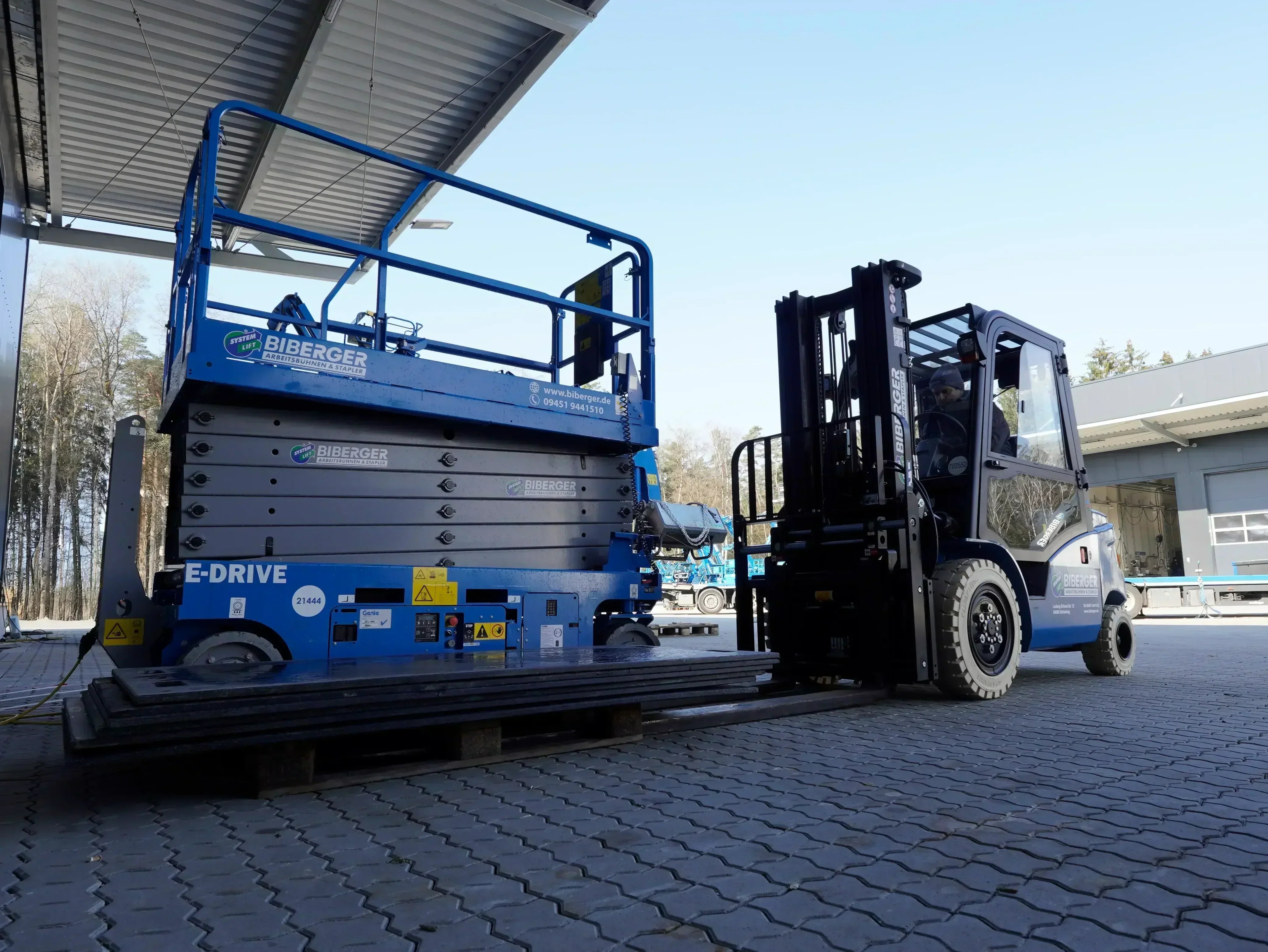
For forklift trucks, a load center of 500 mm is used as standard.
- If the center of gravity is within these 500 mm → full load capacity can be used.
- If it moves forward → load capacity drops drastically.
Example calculation
| Pallet depth | Focus | Forklift load capacity (2,000 kg @ 500 mm) |
|---|---|---|
| 1,000 mm | 500 mm | 2,000 kg |
| 1,200 mm | 600 mm | ~1,600 kg |
| 1,600 mm | 800 mm | ~1,200 kg |
Rule of thumb: The further forward the load protrudes, the less can be lifted.
Load center of gravity for telehandlers
With telehandlers, the center of gravity moves further forward with each extension of the arm . With lateral extension or rotation (roto), it shifts further.
Understanding the load diagram
A load diagram shows how load capacity changes with height and radius.
- X-axis = projection in m
- Y-axis = load capacity in kg
- Curve = maximum load capacity depending on arm position
Load center of gravity for work platforms
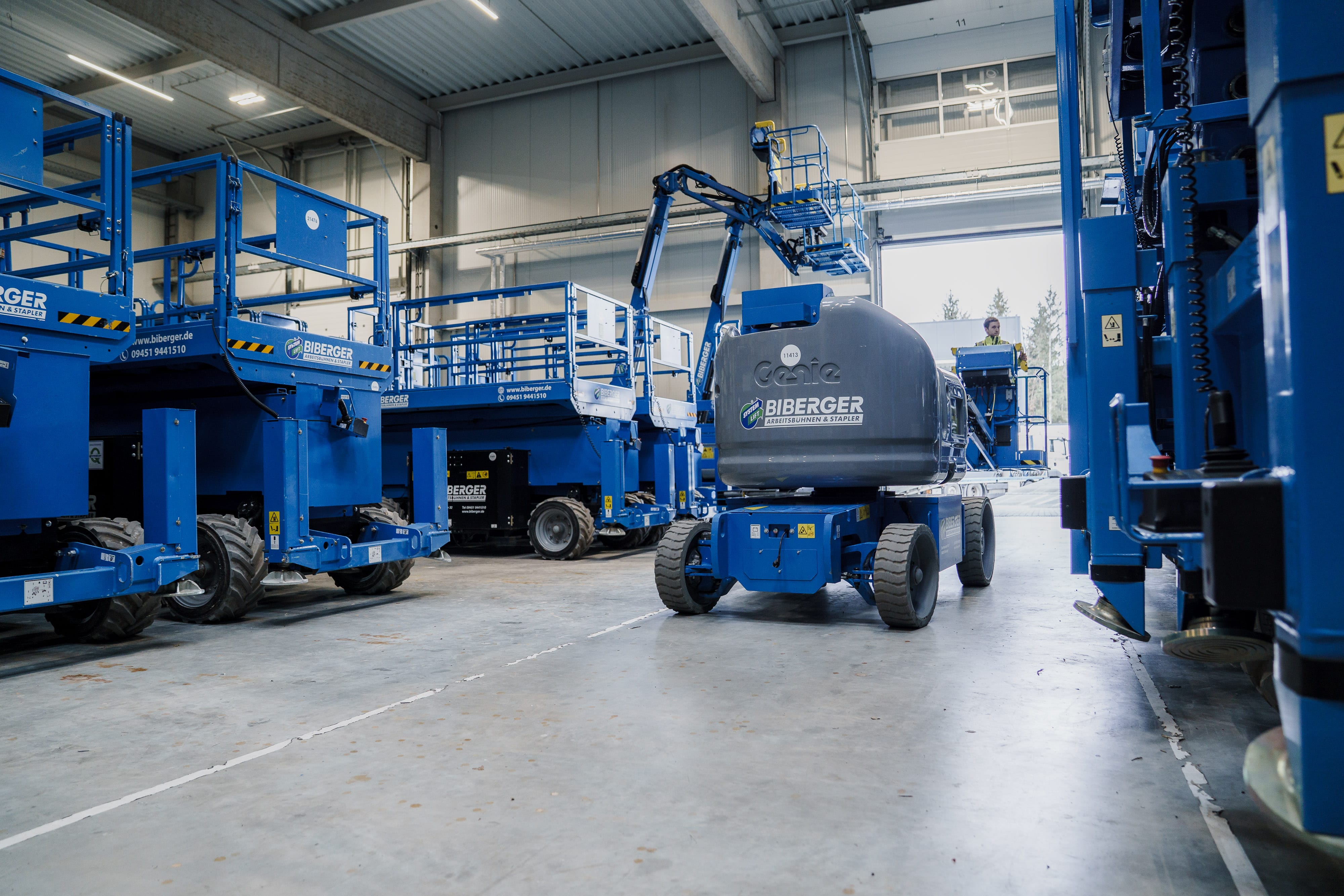
For work platforms, the center of gravity primarily affects the load on the platform . People, tools, and materials must be evenly distributed. Point loads at the edges can compromise stability.
Typical errors when dealing with the load center of gravity
- Overhanging loads (pipes, plates, machine components)
- Unevenly loaded pallets or big bags
- Oblique or side view
- Wrong attachments → shift the center of gravity further
How do you calculate the load center?
Formula: Distance load center = half load depth
Example: A pallet with a depth of 1,200 mm → load center at 600 mm.
Checklist for safe handling
- ✔ Know the weight of the load
- ✔ Check dimensions & load depth
- ✔ Consider attachments
- ✔ Pull the load as close to the machine as possible
- ✔ Always observe the manufacturer’s load diagrams
Practical examples for the load center
- Forklift: 2,000 kg @ 500 mm, pallet with 600 mm center of gravity → only ~1,600 kg possible
- Telehandler: 4,000 kg @ 3 m reach, at 6 m reach only ~1,500 kg
- Work platform: Platform 230 kg load capacity → only limited use if unevenly distributed
Load center and safety
Maintaining the load center of gravity is not optional, but a key requirement for safe work . Ignoring it risks instability, damage, and accidents. Training, manufacturer's diagrams, and correct load handling are mandatory.




Share:
Working height simply explained – definition, examples, areas of application
Toyota forklift error codes: understand, check, and fix safely
Our editorial quality standards
The subject content on biberger.de are editorially created, reviewed, and continuously updated. The basis is our daily work with aerial platforms, telehandlers, and industrial trucks – in rental, sales, operational planning, and technical support.
Each article draws on real-world experience and is editorially reviewed for clarity, accuracy, and practical relevance according to expert criteria. Technical statements are regularly compared against current industry standards and best practices.
The aim of our publications is to make reliable specialist knowledge accessible and to offer guidance to users, decision-makers and industry partners. BIBERGER sees itself as an independent information platform for safe, economical and modern height access technology – well-founded, comprehensible and free from advertising influence.