


 What You Need to Know
Whether it's an aerial work platform, forklift, telehandler, crane, or production machine: as soon as employees work with work equipment, clear legal requirements apply. The German Ordinance on Industrial Safety and Health (BetrSichV) regulates how work equipment must be safely provided, used, inspected, and maintained.
Many companies only deal with the BetrSichV when an authority requests documents or an accident has occurred. However, the ordinance aims to achieve the exact opposite: hazards should be identified and eliminated before people are harmed.
The article considers the legal status of 2026 after the last amendment in December 2025 and explains the most important requirements of the Ordinance on Industrial Safety and Health in an understandable, practical way, and without unnecessary legal jargon.
What is the BetrSichV?
The German Ordinance on Industrial Safety and Health (BetrSichV) is a central occupational safety ordinance in Germany. It regulates the safe provision and use of work equipment as well as the operation of systems requiring monitoring.
Simply put, the BetrSichV stipulates what measures companies must take so that employees can work safely with machines, devices, tools, and systems.
What is the legal background?
The BetrSichV is not a recommendation or a voluntary guideline. It is a binding legal regulation that employers and operators of certain systems must comply with.
The focus is on:
- Risk assessments
- Suitable work equipment
- Protective measures
- Instructions
- Inspections
- Documentation
The core of the BetrSichV is not bureaucracy. The core is a safely organized operation in which risks are identified, assessed, and controlled.
Why is the BetrSichV so important for companies?
Accidents rarely result from a single error. Often, several factors come together: lack of instructions, unsuitable work equipment, inadequate maintenance, or insufficient planning.
The BetrSichV aims to prevent precisely such situations.
What are the objectives of the ordinance?
- Protection of employees
- Prevention of industrial accidents
- Reduction of downtime
- Prevention of property damage
- Legal certainty for companies
- Avoidance of fines and liability risks
Especially for machines with increased hazard potential such as aerial work platforms, forklifts, telehandlers, or cranes, the BetrSichV plays a central role.
For whom does the Ordinance on Industrial Safety and Health apply?
The BetrSichV is primarily aimed at employers. It always applies when work equipment is made available to employees.
Typical affected companies
- Construction companies
- Industrial companies
- Craft businesses
- Logistics companies
- Warehouse operations
- Workshops
- Municipal companies
- Lessors of machines and work equipment
The ordinance does not only affect large corporations. Smaller companies with a few employees must also meet the requirements.
Does the BetrSichV also apply to rented work equipment?
Yes. The requirements of the BetrSichV apply regardless of whether a machine was purchased or rented.
The lessor is responsible for providing safe and inspected work equipment. However, the employer remains responsible for its safe use in their own operation.
This includes, for example:
- Selection of the appropriate machine
- Risk assessment
- Instruction of employees
- Organization of safe use
- Compliance with the operating manual
What work equipment is meant?
The term "work equipment" is deliberately defined very broadly in the BetrSichV. It refers to almost all tools, devices, machines, and systems that employees use in their work.
Typical examples of work equipment
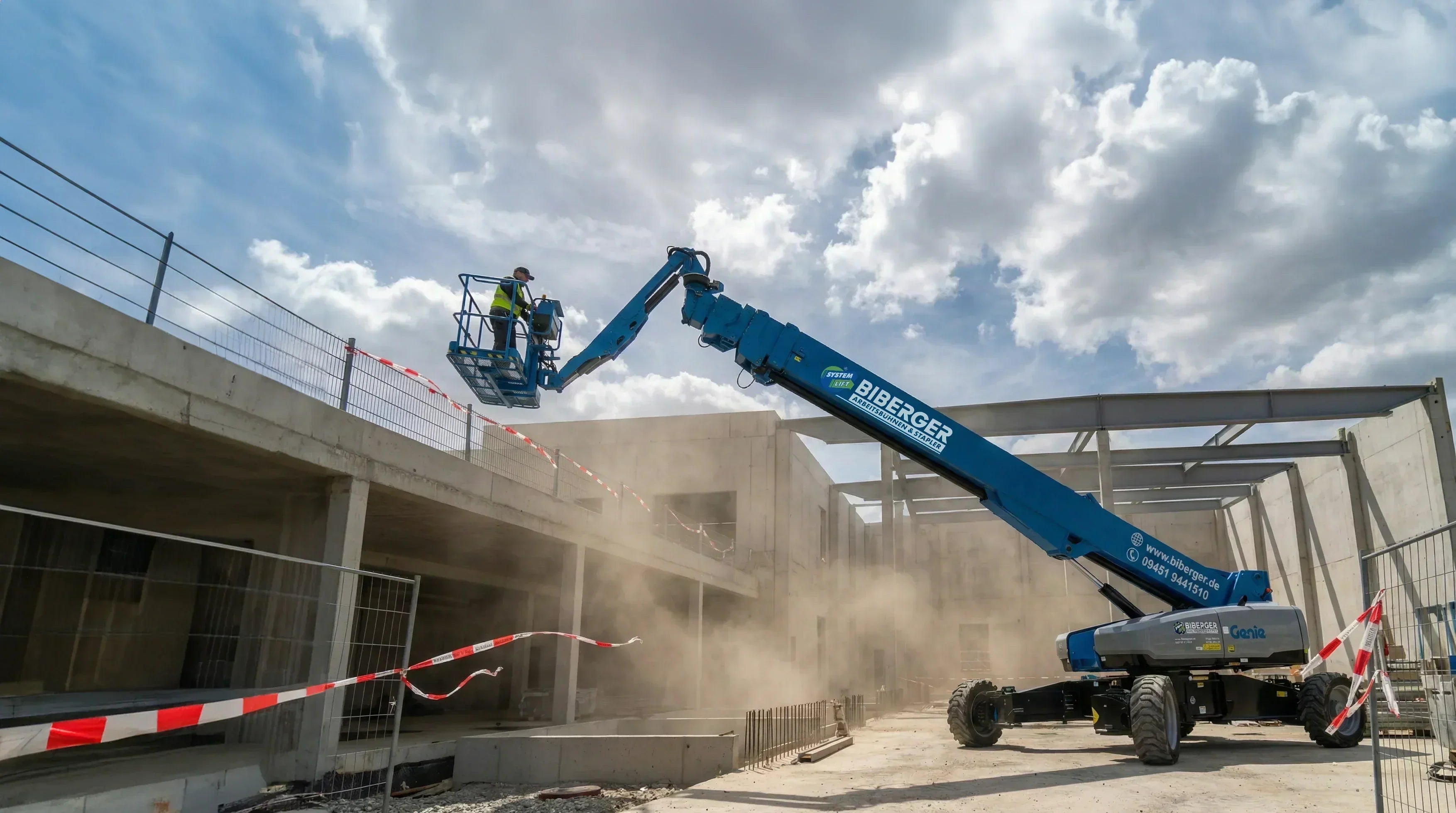
- Aerial work platforms
- Forklifts
- Telehandlers
- Cranes
- Ladders and steps
- Drills
- Welding equipment
- Compressors
- Production machines
- Pallet trucks
- Machine tools
The decisive factor is not the size or value of the work equipment. The decisive factor is whether employees use it for work and whether hazards can arise from it.
Work equipment must be suitable
A common misconception is that any functional machine can automatically be used.
However, the BetrSichV requires that work equipment must be suitable for the specific activity.
A scissor lift can be technically perfect. However, for working over obstacles, it would still be unsuitable if an articulated boom lift were required instead.
The selection of the right work equipment is therefore already an important part of operational safety.
What needs to be considered before purchasing new work equipment?
The risk assessment does not begin with the commissioning of a machine. It should ideally be carried out before the selection and procurement.
Those who purchase new work equipment should check early on what requirements will actually exist in later use.
Important questions before procurement
- What activities are to be carried out?
- What hazards can arise?
- What qualifications do operators need?
- How are maintenance and repair carried out?
- What inspections will be necessary?
- What operating locations are planned?
- Is additional accessories needed?
The earlier these points are considered, the lower the risk of wrong decisions and costly retrofits.
What are systems requiring monitoring?
In addition to ordinary work equipment, the BetrSichV also covers so-called systems requiring monitoring.
These are systems with particular hazards for which additional requirements apply.
The exact classification is made via Annex 2 of the BetrSichV. Depending on the type of system, different inspection, documentation, and sometimes permit requirements apply.
Which systems are listed in Annex 2 of the BetrSichV?
The most important systems requiring monitoring include:
- Lift systems
- Pressure systems
- Certain systems in potentially explosive atmospheres
- Certain filling systems
- Certain storage systems
The exact classification is made via the regulations in Annex 2 of the BetrSichV.
Why do special rules apply to these systems?
These systems can pose significant hazards. Depending on the type of system, there are risks from pressure, explosions, falls, or hazardous substances.
Therefore, additional requirements apply to:
- Inspections before commissioning
- Recurring inspections
- Documentation
- Operation and monitoring
- Partially approval or permit procedures
It is important to note that not all systems requiring monitoring are treated equally. The requirements differ depending on the type of system and the potential for hazards.
What is the risk assessment according to BetrSichV?
The risk assessment is the heart of the Ordinance on Industrial Safety and Health. Almost all other obligations arise from it.
It answers a central question:
What hazards can arise when using work equipment and what measures are necessary to control these risks?
Why is the risk assessment so important?
Without a risk assessment, neither suitable protective measures nor meaningful inspection intervals can be determined.
It forms the basis for:
- Selection of suitable work equipment
- Protective measures
- Instructions
- Inspections
- Maintenance intervals
- Operating instructions
What factors must be considered?
- Work equipment itself
- Type of activity
- Place of use
- Working environment
- Weather conditions
- Qualification of employees
- Simultaneous activities of other persons
- Emergency and rescue situations
Practical example: aerial work platform
An aerial work platform can be technically fully inspected and ready for use. Nevertheless, significant risks can arise if:
- The ground is not load-bearing
- Outriggers are missing
- Wind is underestimated
- Power lines are overlooked
- Untrained operators are used
The risk assessment is intended to identify and evaluate precisely such hazards at an early stage.
How are inspection intervals determined?
A common misconception is that fixed legal inspection intervals exist for every piece of work equipment.
In fact, inspection intervals must in many cases be derived from the risk assessment. This takes into account, among other things, frequency of use, stress, operating conditions, and possible damage.
The inspection interval of a rarely used machine can therefore differ from that of a device that is used daily under high loads.
What protective measures are mandatory?
The necessary protective measures result from the risk assessment. The BetrSichV does not prescribe the same measures for every activity. Instead, the protective measures must match the actual risks.
The higher the hazard, the more extensive the requirements.
Typical protective measures according to BetrSichV
- Select suitable work equipment
- Instruct employees
- Provide operating instructions
- Determine inspection intervals
- Maintain work equipment regularly
- Use protective devices
- Secure hazardous areas
- Only deploy qualified personnel
- Define emergency measures
Instructions are among the most important protective measures
Even the safest machine can become dangerous if employees do not know how to use it correctly.
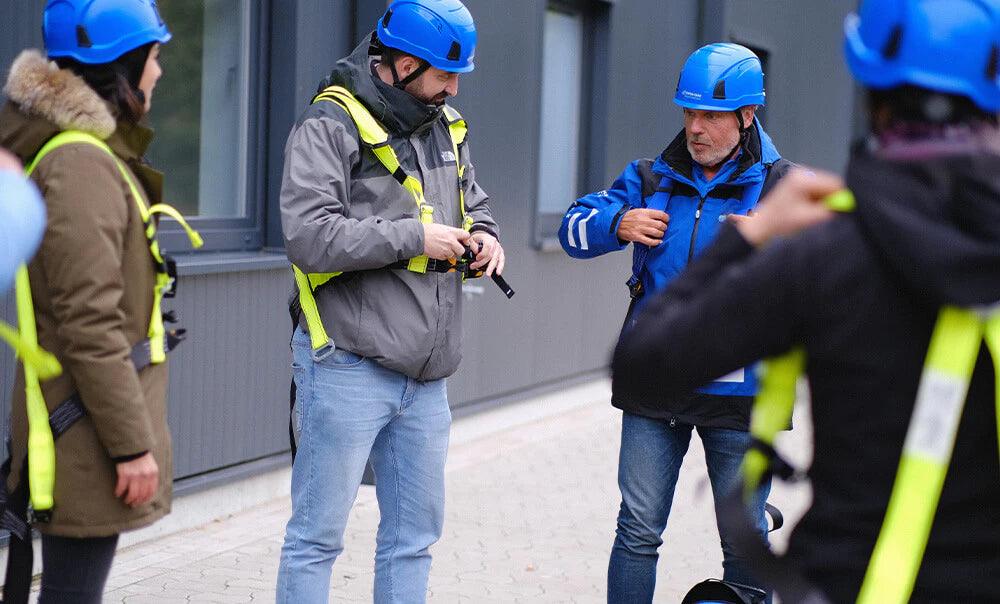
Employers must therefore ensure that operators are adequately instructed before use. The instruction must be understandable, practical, and tailored to the respective activity.
This is particularly important for machines with increased hazard potential such as aerial work platforms, forklifts, telehandlers, or cranes.
When must work equipment be inspected?
Inspections are among the central requirements of the BetrSichV. They serve to identify defects early on and to permanently ensure safe operation.
Inspections are not a voluntary measure, but an essential part of operational safety.
Inspection before first use
Certain work equipment must be inspected before its first use. This applies in particular if its safety depends on assembly or installation.
Examples are:
- Certain machine systems
- Complex work equipment
- Systems requiring monitoring
Recurring inspections
Many pieces of work equipment must be inspected regularly. The inspection intervals must be determined on the basis of the risk assessment. Key factors include frequency of use, stress, operating conditions, and possible damage.
Typical influencing factors are:
- Frequency of use
- Environmental conditions
- Wear and tear
- Age of the machine
- Previous inspection results
Inspection after changes or special events
Exceptional events can also necessitate a new inspection.
These include, for example:
- Accidents
- Damage from collisions
- Major repairs
- Significant changes
- Long periods of downtime
- Extreme loads
The goal is always to ensure that the work equipment can continue to be used safely.
Who is allowed to carry out inspections?
Not every inspection may be carried out by just any person. The BetrSichV distinguishes between different types of inspections and qualifications.
What is a "competent person for inspections"?
Many inspections may be carried out by a so-called competent person for inspections.
This person must have sufficient expertise. The qualification usually results from:
- Vocational training
- Professional experience
- Current professional activity
- Knowledge of the relevant regulations
The requirements always depend on the respective work equipment.
When is an approved monitoring body required?
For certain systems requiring monitoring, internal inspections are not sufficient.
Here, inspections by an approved monitoring body (ZÜS) are mandatory.
This applies, for example, to certain:
- Lift systems
- Pressure systems
- Systems in potentially explosive atmospheres
The difference is important: a competent person inspects many pieces of work equipment. An approved monitoring body is only required for certain types of systems.
What needs to be documented?
The BetrSichV requires not only safe work equipment but also verifiable records.
Companies must be able to document what measures have been taken and why.
Typical documentation obligations
- Risk assessments
- Inspection records
- Inspection intervals
- Defect reports
- Evidence of defect rectification
- Instructions
- Operating instructions
- Maintenance and repair measures
Why documentation is so important
In the event of damage, it is not enough to claim that everything was inspected.
Authorities, professional associations, or courts require verifiable evidence. Therefore, clean documentation not only creates order but also legal certainty.
What are the consequences of violations?
Violations of the BetrSichV can have significant consequences. Depending on the severity of the violation, these range from official measures to criminal consequences.
Possible consequences
- Fines
- Shutdown of work equipment
- Shutdown of systems
- Conditions imposed by authorities
- Liability risks for those responsible
- Criminal consequences for serious violations
It becomes particularly critical if mandatory inspections are omitted or known defects are ignored.
What does the BetrSichV mean for aerial work platforms, forklifts, and telehandlers?
Especially for mobile machines with lifting functions, the BetrSichV plays a central role. Here, moving loads, great heights, changing operating locations, and different operators converge.
Aerial work platforms
When using aerial work platforms, the following points must be considered, among others:
- Select suitable platform type
- Check the load-bearing capacity of the ground
- Consider hazards from power lines
- Assess wind and weather
- Secure the work area
- Instruct operators
Forklifts
With forklifts, collisions, overturning, and risks to personnel are often at the center of the risk assessment.
Special attention should be paid to:
- Travel paths
- Visibility conditions
- Traffic regulations in the company
- Load handling
- Qualification of drivers
Telehandlers
Telehandlers combine the risks of a forklift with those of an aerial work platform or a crane.
Particularly relevant are:
- Changes in reach
- Load charts
- Outriggers
- Ground conditions
- Attachments
- Changing operating conditions
Especially with telehandlers, the risk assessment should be carried out particularly carefully.
Conclusion: The BetrSichV begins long before the first inspection
The Ordinance on Industrial Safety and Health is often reduced to inspection dates. In reality, operational safety begins much earlier – already with the selection of work equipment.
The risk assessment forms the basis for all further measures. It gives rise to protective measures, instructions, inspection intervals, and organizational requirements.
Companies that organize these processes properly not only reduce their liability risk, but also create the conditions for safe and trouble-free operation.
Especially when using aerial work platforms, forklifts, and telehandlers, it becomes clear that the right machine alone is not enough. It is crucial that it is operated by qualified personnel under safe conditions.




Share:
How safe is a rented aerial work platform, actually?
Blind Spots on Telehandlers: How to Avoid Dangerous Shunting Accidents
Our editorial quality standards
The subject content on biberger.de are editorially created, reviewed, and continuously updated. The basis is our daily work with aerial platforms, telehandlers, and industrial trucks – in rental, sales, operational planning, and technical support.
Each article draws on real-world experience and is editorially reviewed for clarity, accuracy, and practical relevance according to expert criteria. Technical statements are regularly compared against current industry standards and best practices.
The aim of our publications is to make reliable specialist knowledge accessible and to offer guidance to users, decision-makers and industry partners. BIBERGER sees itself as an independent information platform for safe, economical and modern height access technology – well-founded, comprehensible and free from advertising influence.