


 What You Need to Know
Do you need a work platform for your project, but are unsure whether leasing is really the best option? Many people opt for long-term financing models, ignoring the fact that renting can often be more flexible and ultimately more cost-effective – especially when demand and utilization fluctuate.
Here you'll get a comprehensive overview: leasing models and contract pitfalls at an expert level, plus practical scenarios for everyday life.
Brief overview: Who is what suitable for?
| option | Strengthen | Typical application |
|---|---|---|
| leasing | Predictable installments, balance sheet advantages | Permanent, well-planned use with high basic utilization |
| Rent | Maximum flexibility , usually including service, quickly available | Changing projects, seasonal needs, short-term assignments |
| Purchase/financing | Full control, long-term use | Very regular use, defined technology over years |
Is aerial work platform leasing really the best choice?
With leasing, you usually commit to a fixed contract term with monthly installments for several years – regardless of actual usage. This makes sense for companies that require a stage on an ongoing basis . For many projects with fluctuating workloads, renting is more cost-effective: You only pay when the stage is actually in use, have less organizational overhead, and get the right equipment faster.
Leasing models in comparison
| Model | Description | Balance sheet effect |
|---|---|---|
| Full amortization leasing | Installments cover the entire purchase price during the term. Residual value risk lies with the lessor. | Often balance sheet neutral, installments as expenses |
| Partial amortization leasing | Only a part is paid in installments, at the end residual value is determined (follow-up leasing/return). | Often balance sheet neutral, lower rates, residual value risk proportional |
| Operating lease (cancellable) | Shorter, more flexible contracts, often with service packages. Residual value with the leasing company. | Not always balance sheet neutral, lower fixed costs |
Tax treatment of aerial platform leasing
Operating leasing
With an operating lease, the contract is considered a rental agreement for tax purposes. The leased asset is capitalized by the lessor, while the lessee records all lease payments as immediately deductible operating expenses. This eliminates the need to capitalize the lease on the lessee's balance sheet, and the equity ratio and debt-to-equity ratio remain unchanged.
Finance leasing (capital lease)
With a finance lease, the lessee acquires economic ownership of the aerial work platform. It must be capitalized as an asset in the balance sheet and depreciated over its useful life. The lease payments are divided into interest and principal portions and reported accordingly in the income statement and cash flow statement.
Special leasing
Regardless of the lease term or contractual options, the leased asset is always allocated to the lessee for tax purposes in special leasing. This means that capitalization in the balance sheet and depreciation according to the applicable depreciation rules are mandatory.
For VAT purposes, leasing payments from companies entitled to deduct input tax can be recorded net as transitory items. In sale-and-leaseback transactions, the leaseback is treated as a loan for tax purposes and not as a supply.
Common cost traps in leasing (and how to recognize them)
- Provision & downtime: Costs often start from provision – even if the stage is not in productive use.
- Service, maintenance, insurance: Inspections, wear parts, and machine breakdown insurance are not always included.
- Residual value and usage limits: If the market value falls below the calculated residual value, you pay the difference; hourly/mileage limits result in additional charges.
- Contract duration & termination: 24–60 months are common; early termination is usually expensive or impossible.
- One-off fees & withdrawal costs: Conclusion, administration, withdrawal – often only transparent at a late stage, but add up noticeably.
Practice: When is renting clearly the advantage?
- Speed: Selection – clarify duration – in many cases ready for use on the same day .
- Flexibility: Adapt the rental period precisely to the project plan, no long-term commitment.
- Calculable costs: Often all-inclusive (maintenance, insurance, accident prevention regulations), less organizational effort.
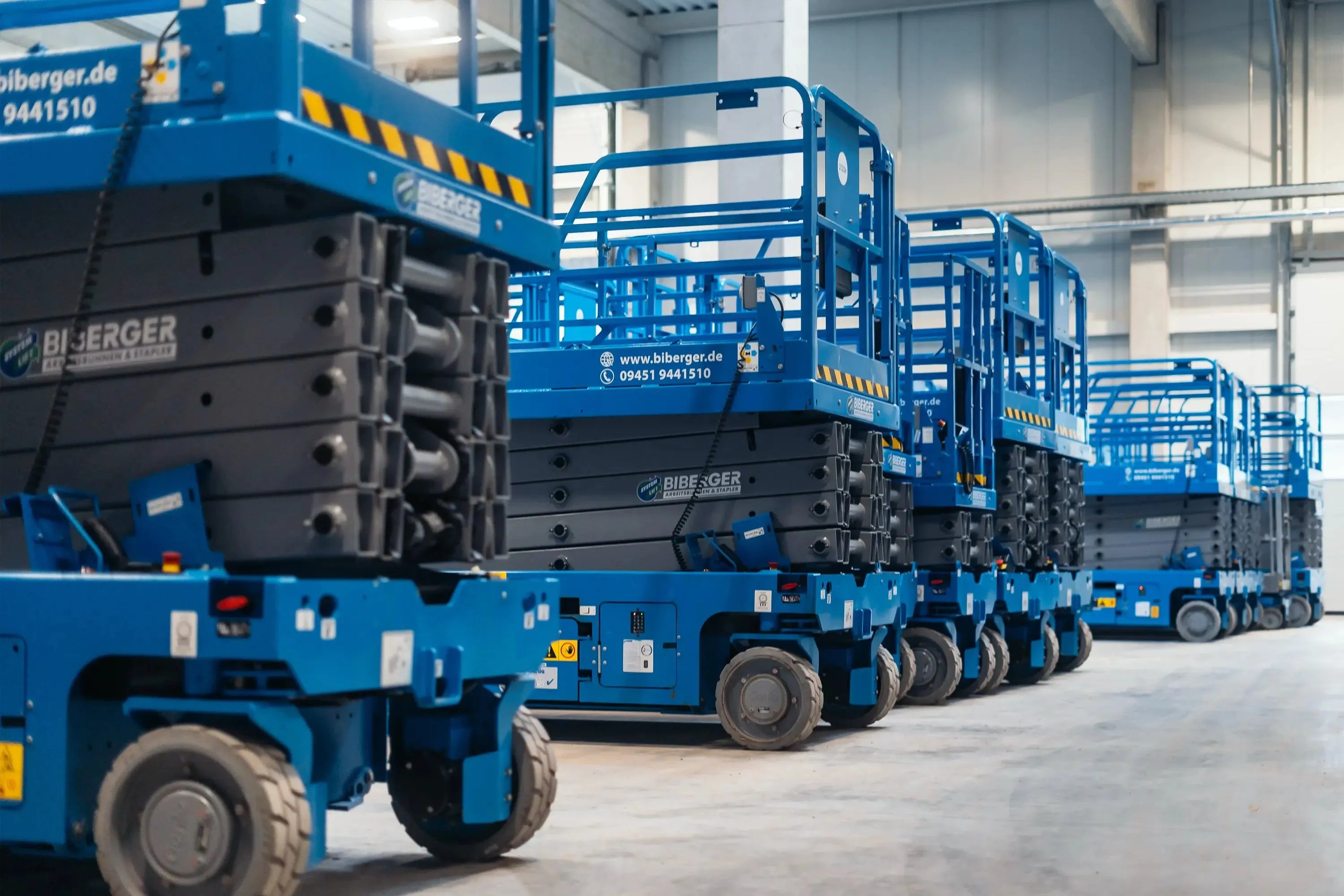
- The right model for every job: From scissor lifts to truck-mounted platforms – the right technology for every job instead of “one platform for everything”.
“New, used, leasing, renting” – what’s really worth it?
Capacity utilization is crucial: If your needs are consistent and consistent, purchasing or leasing may be a good option. If your needs fluctuate, renting or lease-to-own/finance are more suitable. Used, professionally maintained platforms are often a good compromise if you plan to use them frequently but are reluctant to make a full investment.
Alternatives to leasing – clearly compared
| alternative | Advantages | Disadvantages |
|---|---|---|
| Short-term/long-term rental | Maximum flexibility, usually including service/insurance, fast availability | Higher daily rates, fewer balance sheet effects |
| Hire purchase | Becomes your property, predictable installments, no return costs | Balance sheet activation, long-term commitment to the device |
| purchase | Full control, no ongoing leasing costs | High initial investment, capital commitment |
| Financing (loan) | Depreciation possible, terms adjustable | Interest costs, creditworthiness dependency |
| Construction equipment subscription | Predictable monthly rate, device change possible | Still a young market, check contract details |
Decision-making aid: 60-second check
- Use: Regular & predictable → consider leasing/purchase. Irregular & project-related → consider renting/hire-purchase.
- Capital commitment: As low as possible → rent/operating lease. Invest long-term → purchase/financing.
- Cost: Minimal administration/service → rent. In-house maintenance is okay → lease/purchase.
- Technology changes: Frequently changing requirements → rent. Consistent technology → lease/purchase.
At BIBERGER , you can lease or rent – depending on what best suits your project. Our team will help you understand the differences and choose the most cost-effective model for you.
Whether flexible rental for short-term use or leasing for predictable long-term needs: We advise you transparently and ensure a quick, smooth transaction.
Conclusion
Leasing is a strong option when demand and utilization can be planned for the long term and balance sheet effects are desired. Renting wins when flexibility, rapid availability, and low fixed costs are paramount. Those who carefully examine the lease terms, residual values, and services—and realistically calculate how often the platform will actually be used—make the most cost-effective decision.




Share:
Genie vs. JLG – Two market leaders in comparison
Cohesive soil on construction sites – properties, risks and solutions
Our editorial quality standards
The subject content on biberger.de are editorially created, reviewed, and continuously updated. The basis is our daily work with aerial platforms, telehandlers, and industrial trucks – in rental, sales, operational planning, and technical support.
Each article draws on real-world experience and is editorially reviewed for clarity, accuracy, and practical relevance according to expert criteria. Technical statements are regularly compared against current industry standards and best practices.
The aim of our publications is to make reliable specialist knowledge accessible and to offer guidance to users, decision-makers and industry partners. BIBERGER sees itself as an independent information platform for safe, economical and modern height access technology – well-founded, comprehensible and free from advertising influence.