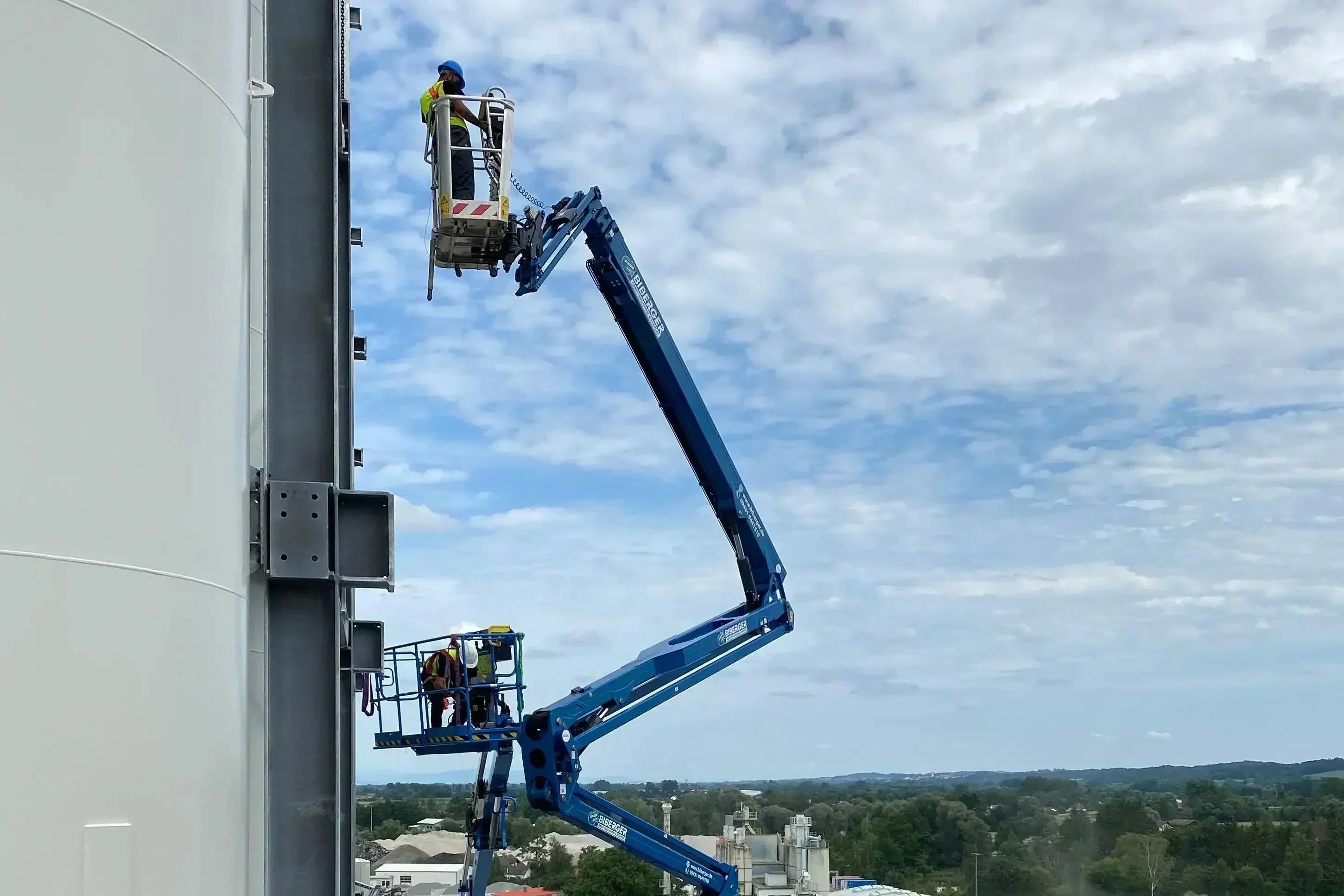
Reading now: Entering and leaving the work basket of a mobile elevating work platform in working position
Zusammenfassung What You Need to Know

Leaving the work basket of a mobile elevating work platform at height is generally prohibited, but is permitted in justified exceptional cases – for example, during special assembly work. Prerequisites include a comprehensive risk assessment, written training of employees, and the use of personal protective equipment against falls from a height (PPE) with suitable, tested anchor points.Exit may only be made via the openings provided on the side facing the building – climbing over railings or using ladders is prohibited.expressly prohibited.

In addition, a second, secured operator must accompany the person disembarking, ensure continuous communication, and the device must not be moved during the process.An existing rescue plan and sufficient distance from fixed structures are also mandatory to minimize the risk of crushing and falling. Only by adhering to all these measures is a safe exit from the platform even justifiable.

Zusammenfassung What You Need to Know

Leaving the work basket of a mobile elevating work platform at height is generally prohibited, but is permitted in justified exceptional cases – for example, during special assembly work. Prerequisites include a comprehensive risk assessment, written training of employees, and the use of personal protective equipment against falls from a height (PPE) with suitable, tested anchor points.Exit may only be made via the openings provided on the side facing the building – climbing over railings or using ladders is prohibited.expressly prohibited.

In addition, a second, secured operator must accompany the person disembarking, ensure continuous communication, and the device must not be moved during the process.An existing rescue plan and sufficient distance from fixed structures are also mandatory to minimize the risk of crushing and falling. Only by adhering to all these measures is a safe exit from the platform even justifiable.

Leaving the work basket at height often creates uncertainty. Some consider it strictly forbidden, while others simply do it. The truth is: Exiting is only permitted in clearly justified exceptional cases – and then strictly according to the rules.

Here you will find a complete guide: legal situation, best practices, checklists and special regulations for work baskets – including work basket for forklift regulations .

Getting out of mobile elevating work platforms – what is permitted?

Mobile elevating work platforms (MEWPs) are designed for work to be carried out in the cage . They are not climbing systems. Climbing over them is strictly prohibited and only permitted if it is technically necessary, planned, and safe .

The basis for this is, among others, EN 280 , DGUV Information 208-019 , DGUV Principle 308-008 , and DGUV Rule 101-005 . Manufacturers generally explicitly prohibit the opt-out in their operating instructions.

Work basket regulations at a glance

An exit may only take place if all points are met:

  • Risk assessment proves necessity and residual risks.
  • Written instructions from the contractor are available (who, when, how, where).
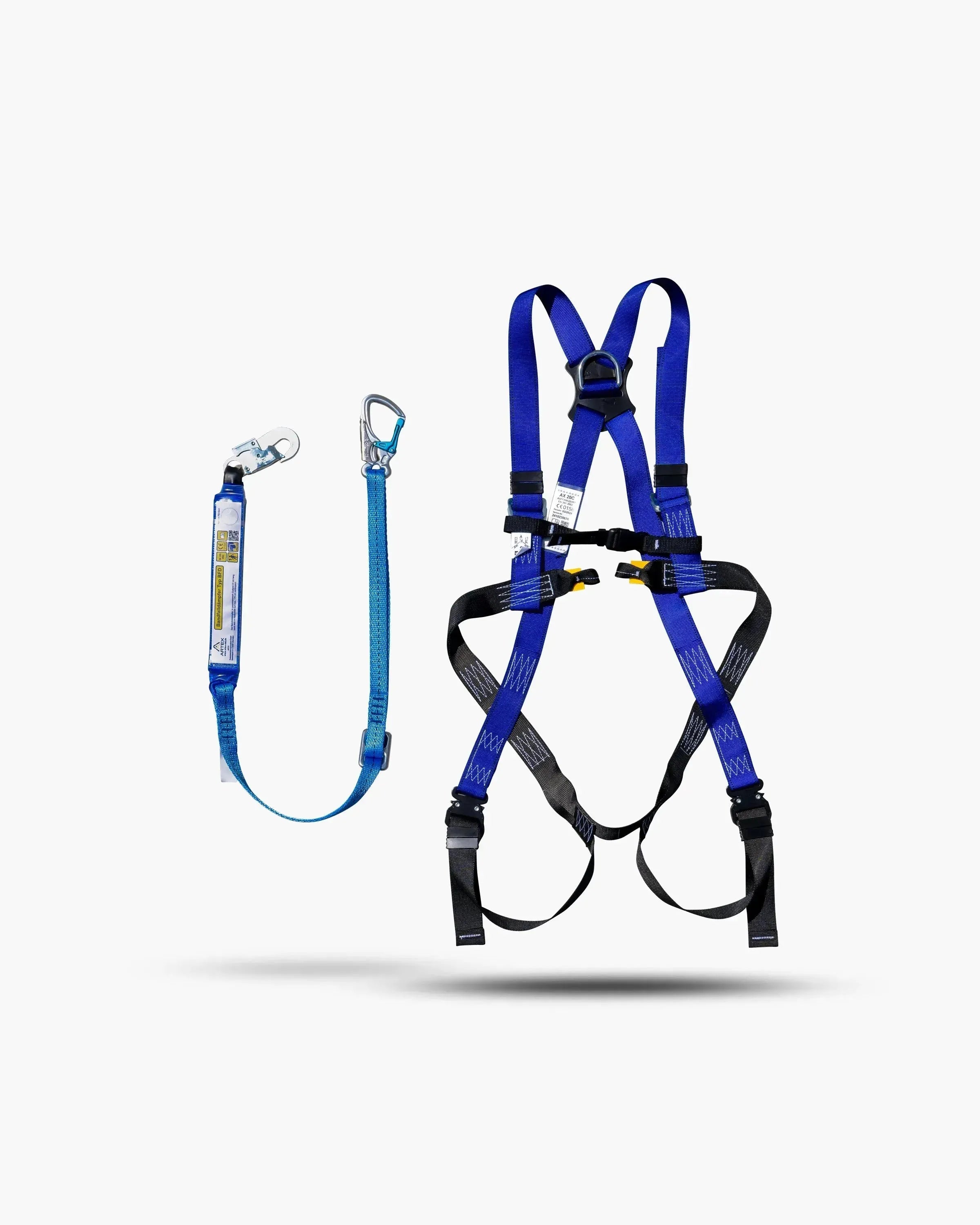
  • PPE is used correctly; connect external anchor point before exiting.
  • A second operator provides security from the ground; communication is possible at any time.
  • Rescue concept is documented and practiced.
  • Do not move the platform while climbing; secure the controls against incorrect operation.
situation Allowed? Conditions
Exit on a level surface (close to the ground, e.g. transition into a hall) Yes, exceptionally GBU, written release, PPEgA at external anchor point, stage shut down
Exit on roof surface/facade at height Only with conditions Safe anchor points ≥ 10 kN, second operator, edge/fall-through protection, rescue plan
Climbing onto scaffolding or ladders Basically no Only if there is no safe alternative and all protective measures are met

Specific risks when crossing

The greatest dangers arise when changing the safety device and from uncontrolled movements.

  • Fall due to unloading of the boom or misstep.
  • Danger of being trapped between the cage and the structure.
  • Falling tools endanger people below.
  • Incorrect operation of the controls, jerky movements, gusts of wind.

How to plan a safe exit – step by step

1) Risk assessment & approval

Formulate the purpose, select the appropriate stage, and determine anchor points. Establish responsibilities and document the approval.

2) Prepare your workplace

Close off the area, secure any falling/impact edges, secure tools with safety lines , test the radio, check the weather.

3) PPE & anchor point

Before exiting the cage, redirect/re-secure yourself , and only then switch from the internal to the external anchor point. Anchor points must be strong and suitable .

4) Implementation

Stop the platform , activate the emergency stop, and stop moving while climbing. Slow, coordinated movements – the second operator maintains an overview.

5) Rescue

Practice emergency rolls, evacuation routes, emergency lowering , and re-belaying beforehand. Only start with a clear plan.

Work basket for forklifts – special regulations

Work baskets on forklift trucks (man baskets) are only permitted for occasional, short-term work and require strict conditions.

  • Only use approved work baskets with CE marking and operating instructions.
  • Ensure manufacturer approval and suitability of the forklift (load capacity, residual load capacity, load center).
  • Anti-slip/locking device to prevent slipping/lifting off the tines.
  • Limit the number of people (usually max. 1-2 people, depending on the type plate).
  • Securing in the basket with PPE, stable standing surface, railing, door lock.
  • Only trained operators ; annual instruction, regular inspection by qualified persons.
Requirement Why important? Practical tip
Approved work basket Safety equipment and statics tested Check the type plate and instructions, no homemade items
Calculate residual load-bearing capacity Basket + people + tools move center of gravity Use values from the data sheet, never plan “on edge”
Locking on the mast/tines Prevents slipping or lifting Only work with tested anti-slip protection
PPE and door locking Protects against falls and accidental opening Attach the belt to suitable points, function test
Examination/instruction Detects defects early, reduces accidents Annual instruction, keeping an inspection log

Law, responsibility and consequences

Employers must provide suitable work equipment, train employees, and authorize their use. Operators must follow instructions and report hazards.

Anyone who exits the vehicle without permission or disregards regulations risks personal injury, property damage, and liability . Insurance may limit coverage if the work is carried out improperly.

Conclusion: Exception instead of routine – only with a plan and a team

Exiting from mobile elevating work platforms is not an everyday maneuver. It remains the exception and requires clear planning, strict safety precautions, and practiced procedures . With a risk assessment, personal protective equipment (PPE), a second operator, and a rescue plan, you can remain legally compliant and safe.

Does your project need support? Contact us – we'll help you with selection, planning, and training.

Rectangle_1 - BIBERGER
About the author

Martin Biberger

Managing Director

Martin is the founder and managing director of BIBERGER Arbeitsbühnen & Forklifts.

He is responsible for thetechnical areaTogether with his team, he is responsible for thetechnical purchasingthe machines thatFurther development of the machine inventoryand the smooth operation of over 1,500 BIBERGER rental devices.

From many years of experience he knows theStrengths and weaknesses of all device classes, the possibleAreas of applicationand thetechnical possibilities– always with a view to theDevelopment of the entire industryand future innovations.

Our editorial quality standards

The subject content on biberger.de are editorially created, reviewed, and continuously updated. The basis is our daily work with aerial platforms, telehandlers, and industrial trucks – in rental, sales, operational planning, and technical support.

Each article draws on real-world experience and is editorially reviewed for clarity, accuracy, and practical relevance according to expert criteria. Technical statements are regularly compared against current industry standards and best practices.

The aim of our publications is to make reliable specialist knowledge accessible and to offer guidance to users, decision-makers and industry partners. BIBERGER sees itself as an independent information platform for safe, economical and modern height access technology – well-founded, comprehensible and free from advertising influence.

Leave a comment

Please note, comments need to be approved before they are published.

This site is protected by hCaptcha and the hCaptcha Privacy Policy and Terms of Service apply.

FAQ

Ist das Aussteigen aus der Arbeitsbühne grundsätzlich verboten?

Im Grundsatz ja. Zulässig nur ausnahmsweise mit GBU, Freigabe, PSAgA, zweitem Bediener und Rettungsplan – und wenn der Hersteller es nicht explizit verbietet.

Was brauche ich mindestens, um sicher auszusteigen?

Gefährdungsbeurteilung, schriftliche Anweisung, PSAgA am externen Anschlagpunkt, statische Eignung des Anschlagpunktes, zweiter Bediener, Rettungskonzept.

Arbeitskorb für Stapler – worauf kommt es an?

Nur zugelassene Körbe nutzen, Resttragfähigkeit prüfen, Verriegelung am Mast/Zinken, PSAgA und Unterweisung. Einsatz nur kurzzeitig und geplant.

What is DGUV?

TheDGUVis theGerman statutory accident insurance, the umbrella organization of the industrial employers’ liability insurance associations and accident insurance funds. It develops regulations and rules forOccupational safety and health protection, such as the well-knownDGUV regulations and testsfor machines, vehicles and work equipment.

Relevant topics

View all

Typische Planungsfehler beim ersten Einsatz von Arbeitsbühnen – und wie du sie vermeidest - BIBERGER

Typical planning mistakes when using aerial work platforms for the first time – and how to avoid them.

Introduction Why errors occur even before deployment The safe operation of a work platform begins long before the basket lifts off. Mistakes don't happen during the lift itself, but in the preparation: assessing the ground conditions, selecting the right equipment,...

Read more

Wind und Arbeitsbühnen: Was Du für einen sicheren Einsatz unbedingt wissen musst - BIBERGER

Wind and aerial work platforms: What you absolutely need to know for safe use

Key problem: Why wind loads are so often underestimated Wind load is one of the most underestimated risks when using aerial work platforms. At ground level, wind force 6, with 12.5 m/s or around 45 km/h, often seems relatively harmless....

Read more

Arbeitsbühnen weltweit: Der internationale Vergleich von Märkten, Herstellern & Kosten - BIBERGER

Aerial work platforms worldwide: An international comparison of markets, manufacturers & costs

Aerial work platforms are indispensable on almost every construction site and in many industries. However, although the basic technology is similar worldwide, markets differ significantly in terms of regulation, manufacturing landscape, pace of innovation, and typical application profiles. Understanding international...

Read more

Arbeitsbühne Privat mieten – Was ist erlaubt? - BIBERGER

Renting a work platform as a private individual – What is allowed?

Aerial work platforms are primarily designed, standardized, and planned for commercial use. Typical applications include facade construction, plant and building technology, and industrial maintenance. Accordingly, equipment selection, insurance models, and rental procedures are geared primarily towards commercial users with trained...

Read more

Anschlagen von Lasten – Anschlagmittel richtig auswählen und sicher einsetzen - BIBERGER

Lifting loads – selecting and safely using lifting equipment

Safely attaching loads is one of the most demanding tasks when operating cranes , forklifts , and lifting equipment. Errors almost never occur during the lifting itself, but almost always result from misjudging the load capacity, type of attachment, or...

Read more

Staplerfahrer werden

Become a forklift driver: safely, trained and responsibly

A moment of inattention 7:15 a.m. A forklift driver begins his early shift. Routine. He only gives the forklift a cursory check – time pressure, the truck is waiting. On the third lift, the fork tine snaps at an old...

Read more

CAN-Bus und J1939-Diagnose bei Baumaschinen - BIBERGER

CAN bus and J1939 diagnostics in construction machinery

Modern construction machinery is now highly networked systems. Sensors, control units and safety modules communicate with each other constantly – and this happens via the so-called CAN bus . The CAN bus is essentially the nervous system of every modern...

Read more

Magni Diagnose-Leitfaden: Fehlermeldungen richtig deuten - BIBERGER

Magni Diagnostic Guide: How to correctly interpret error messages

If your Magni telehandler (RTH / HTH series) suddenly displays a warning, it's rarely a total breakdown. Usually, a safety or protective function is being activated. This guide explains the most important error codes, their meaning, and how to react...

Read more