



 What You Need to Know
Aerial work platforms are among the most important machines on construction sites, in industry, and at utility companies today. But the path to this point was long. From antique wooden scaffolding to hydraulically controlled MEWPs, a development has taken place that has fundamentally changed technology, occupational safety, and efficiency. This guide shows you how aerial work platforms have evolved over the centuries – and why many innovations emerged precisely when they were most urgently needed.
Early access techniques: From antiquity to 1850
Wooden scaffolding, pulleys and muscle power
Even the ancient Egyptians used simple wooden scaffolding and ramp systems to move stone blocks. The Greeks and Romans employed pulleys, scaffolding, and primitive lifting baskets. While these systems ensured the safe transport of materials, they offered no protection whatsoever for the workers.
In the Middle Ages, the first combinations of winches, ropes, and platforms emerged. However, the construction of large cathedrals revealed how dangerous these methods were – falls were a daily occurrence.
The first step towards modern lifting technology
In 1823, the "Ascending Room" was built in London – an early passenger lift. It was rope-supported and risky, but an important technological milestone. The decisive breakthrough came in 1852 with Elisha Graves Otis's safety lift, which was the first to use an automatic safety catch system.
The Hydraulic Revolution (1850–1950)
Hydraulics as the basis of modern work platforms
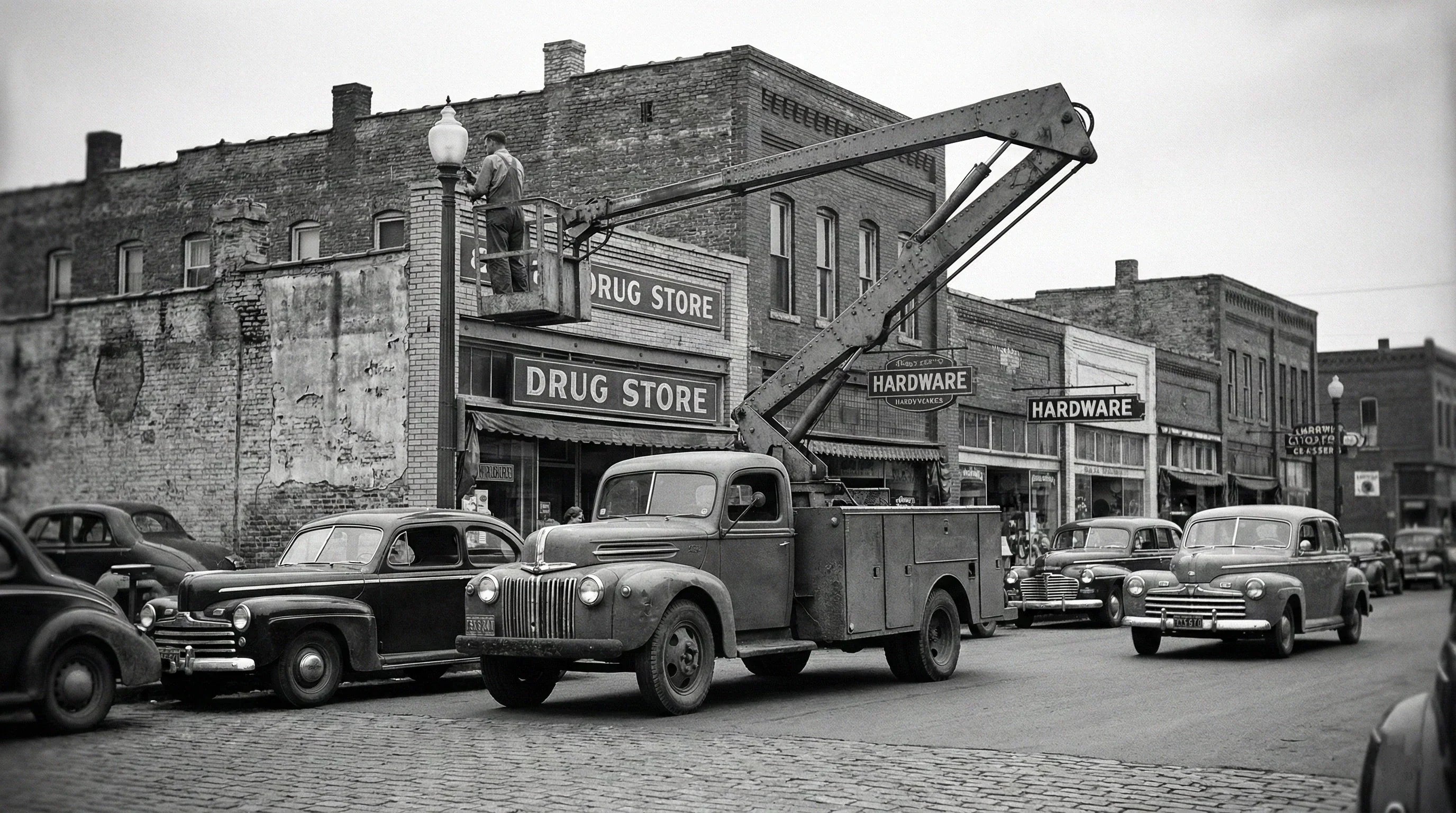
The first hydraulic lifting systems were patented in 1846. However, it wasn't until decades later that hydraulics became commonplace in everyday industrial life. By the 1920s, Scandinavian cities were already using hydraulic lamppost maintenance platforms – a small taste of later boom lifts.
Why hydraulics changed everything
Hydraulics enables precise movements and high power density. This made lifting vehicles more compact, powerful, and easier to control. From the 1950s onward, hydraulics influenced the entire crane and lifting industry and paved the way for modern AWP designs.
The invention of the modern work platform (1944–1970)
Jay Eitel – The Cherry Pickers (from 1944)
Jay Eitel developed the first mobile cherry picker in 1944 because working on ladders while picking fruit was dangerous and inefficient. His invention, later known as the "Cherry Picker," was quickly adopted by utility companies. In 1953, Eitel founded the Telsta Corporation and professionalized the technology.

One of the early scissor-type lifting devices on a utility vehicle – used for fruit harvesting and working at low heights. AI-generated image.
Walter E. Thornton-Trump – The Boom Lift
In 1951, Thornton-Trump designed the "Giraffe" in Canada – an early telescopic boom lift. Patented solutions for boom-driven lifts followed, significantly expanding the operating range.
John L. Grove – The Birth of JLG
Grove, originally a crane manufacturer, founded JLG Industries in 1969 after witnessing a serious scaffolding accident. His vision: a significantly safer alternative to makeshift access to heights. In 1970, the first modern JLG aerial work platform was developed – featuring a hydraulic boom, stable chassis, and controlled steering.
What distinguished early work platforms
Early aerial work platforms offered systematic access to heights for the first time. However, they were heavy, expensive, and prone to technical problems. Control systems were rudimentary, reach was limited, and maintenance failures were frequent.
Key features
Hydraulic drives, simple operating levers, and limited mobility characterized the first decades. Nevertheless, they represented a quantum leap compared to ladders, scaffolding, and rope-operated platforms.
Initial problems
A lack of standards led to accidents. Binding safety regulations for boom lifts only emerged in the 1980s. Operator training, safety systems, and guardrail heights were defined subsequently – often as a reaction to serious incidents.
Development surge from the 1970s onwards
Specialization of building designs
The 1970s saw the development of various types of equipment: scissor lifts, articulated boom lifts, and compact vertical lifts. In 1973, JLG presented its first in-house scissor lift, while manufacturers such as MEC, UpRight, and Genie developed new variations.
Technological milestones in the 1980s
Oscillating axes, improved joint geometries, and larger booms made stages more stable and versatile. The decade also saw the introduction of the first safety-related standards.
Innovations of the 1990s and 2000s
Increased working heights, fuel cell technology, hybrid drives, and compact electric devices expanded the range of applications. Manufacturers responded to fleet operators demanding low-maintenance, efficient equipment.
Major manufacturers in the industry
North America
JLG, Genie, Snorkel, MEC, UpRight and Telsta shaped the technical development. They set standards for boom lifts, scissor lifts and compact vertical lifts.
Europe
Haulotte, Pinguely, Palfinger and Wumag shaped the European industry. Their devices were often more compact, precise and optimized for demanding indoor and urban applications.
Asia Pacific
With Aichi (Japan) and Skyjack (Canada, later globally), robust and durable models came onto the market. They introduced new standards for reliability and suitability for mass production.
The development of modern safety standards
Standards such as ANSI/SAIA A92 and EN 280 redefined access control, platform railings, load limits, stability, and training requirements. From 2019 onward, ANSI regulations significantly tightened these requirements, focusing on operator training, rescue plans, and risk analysis.
The work platform today: Digitization, electrification, automation
Modern MEWPs utilize sensors, telematics, driver assistance systems, and fully electric powertrains. Manufacturers are developing autonomous driving functions, precise laser scanners, and digital monitoring systems. The industry is on the cusp of its next phase of development.
Historical timeline of the most important milestones
| Year | milestone | Meaning |
|---|---|---|
| Ancient times | Wooden scaffolding, ramps, pulleys | First systematic access to higher altitudes |
| Medieval Times | Winches and primitive platforms | Construction of large cathedrals, high risk of falls |
| 1823 | “Ascending Room” | First rope-supported passenger elevator |
| 1852 | Otis safety elevator | Breakthrough in fall protection |
| 1920s | Hydraulic lantern stages in Scandinavia | First application of modern lifting platforms |
| 1944 | Jay Eitel develops Cherry Picker | Foundation of mobile work platforms |
| 1951 | “Giraffe” Boom Lift | First modern telescopic boom |
| 1953 | Telsta Corporation founded | Commercialization of mobile high-altitude access |
| 1969 | Founding of JLG Industries | The beginning of the modern MEWP industry |
| 1970 | First JLG Aerial Work Platform | New Era of Safer Access to Heights |
| 1973 | JLG's first scissor lift | Beginning of vertical lifting systems |
| 1980–1989 | New axle concepts, stronger booms | Technical leap in stability and range |
| 1999 | Fuel cell boom lift | First step towards alternative drive systems |
| 2004 | Hybrid lifts | Hybrid technology is becoming market-ready. |
| 2019 | New ANSI/SAIA A92 standards | Strictest safety standards to date |
Conclusion: Why history remains important
The aerial work platform is a product of ingenuity, safety awareness, and technological development. Only through the combination of these factors have machines been created that operate precisely, efficiently, and safely today. Anyone who understands modern aerial work platforms recognizes the long journey behind these machines – and the value that technological advancement has for occupational safety.




Share:
Tenders for work platforms: Between wish and reality
Double increase: More flexibility with two additional Nifty HR17N
Our editorial quality standards
The subject content on biberger.de are editorially created, reviewed, and continuously updated. The basis is our daily work with aerial platforms, telehandlers, and industrial trucks – in rental, sales, operational planning, and technical support.
Each article draws on real-world experience and is editorially reviewed for clarity, accuracy, and practical relevance according to expert criteria. Technical statements are regularly compared against current industry standards and best practices.
The aim of our publications is to make reliable specialist knowledge accessible and to offer guidance to users, decision-makers and industry partners. BIBERGER sees itself as an independent information platform for safe, economical and modern height access technology – well-founded, comprehensible and free from advertising influence.