Reading now: Seat belt requirement on work platforms: When is fall protection on mobile elevating work platforms mandatory?
Zusammenfassung What You Need to Know

The requirement to wear a seat belt on work platforms does not depend on the height, but on the type of platform and the location where it is used.For telescopic and truck-mounted platforms,PPEgA mandatory, as well as for operations over water, machinery or traffic. Scissor lifts with fixed railings, on the other hand, requireusually no fall protection.

Important:The PPE mustcorrectly struck, regularly checked andonly after trainingbe used. Arestraint systemis usually safer than pure fall protection.Helmet with chin strap (EN 12492)is mandatory. Only those who use the technology, harness, and anchor point correctly can work truly safely.

Zusammenfassung What You Need to Know

The requirement to wear a seat belt on work platforms does not depend on the height, but on the type of platform and the location where it is used.For telescopic and truck-mounted platforms,PPEgA mandatory, as well as for operations over water, machinery or traffic. Scissor lifts with fixed railings, on the other hand, requireusually no fall protection.

Important:The PPE mustcorrectly struck, regularly checked andonly after trainingbe used. Arestraint systemis usually safer than pure fall protection.Helmet with chin strap (EN 12492)is mandatory. Only those who use the technology, harness, and anchor point correctly can work truly safely.

Work platforms have become indispensable in the construction and industrial sectors. They enable safe working at heights and offer significantly more flexibility than conventional scaffolding or ladders. However, any work at height always involves a certain amount of risk. Falls are among the most common causes of accidents, which is why there are clear regulations regarding fall protection.

A key question is: When is the use of personal protective equipment against falls from a height ( PPE) mandatory? While a railing is considered sufficient protection for some work platforms, the use of a safety harness is mandatory for others. But what regulations apply exactly? At what height is fall protection required? And what requirements must be met for safe use? In this article, you'll learn when you need fall protection, what to consider when using PPE, and when training is mandatory.

At what height is PPE mandatory on a mobile elevating work platform?

Many people assume that fall protection is only required above a certain height. In reality, however, the requirement to wear personal protective equipment depends not only on the height, but also, and above all, on the design of the work platform and the specific location .

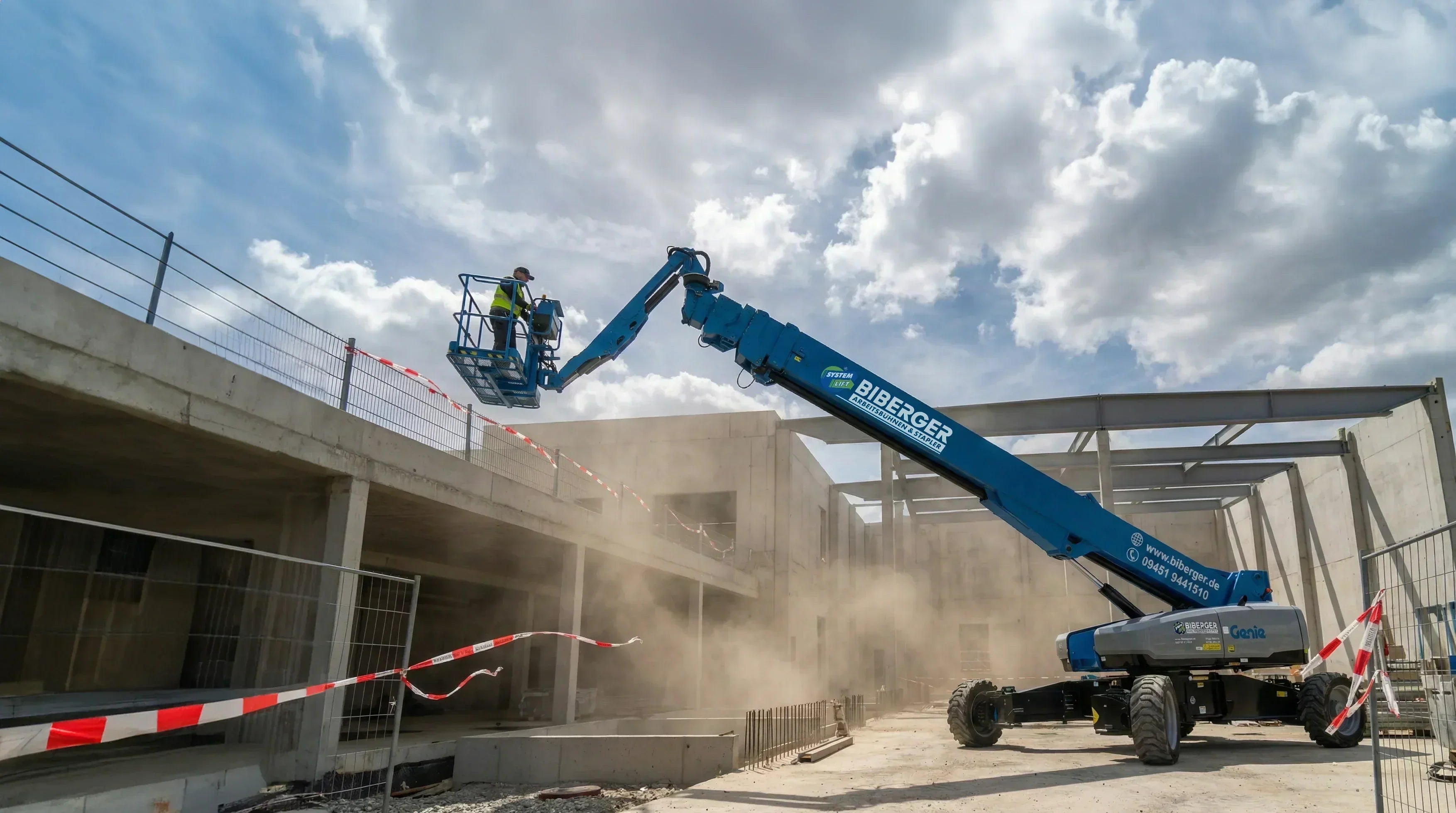
Scissor lifts with fixed railings generally do not require a harness, as the railing already provides protection against falls. This is different for telescopic and truck-mounted lifts . Due to the design of these machines, sudden jolts can occur during movement or pivoting. Without proper safety equipment, there is a risk of a person being ejected from the work platform. Therefore, fall protection is mandatory.

The location also plays a role. If a work platform is used over water, machinery, or busy roads, wearing a harness may be mandatory regardless of its design. The general rule is: Where a fall is not prevented by a fixed railing or where special circumstances increase the risk, PPE is mandatory.

Protection against ejection

A common misconception is that fall protection systems only protect against a direct fall. However, one of the greatest dangers when working on aerial work platforms is ejection . Sudden movements, uneven ground, or abrupt stops can cause the operator to be ejected from the work platform.

For this reason, the wearing of personal protective equipment (PPE) against falls from a height is mandatory for many mobile elevating work platforms . This not only depends on the height, but also on the platform's movement and the possibility of being ejected over the edge .

The German Industrial Safety Ordinance (BetrSichV) requires that work equipment be used as intended . This means that each aerial work platform must be individually assessed to determine which protective measures are required.

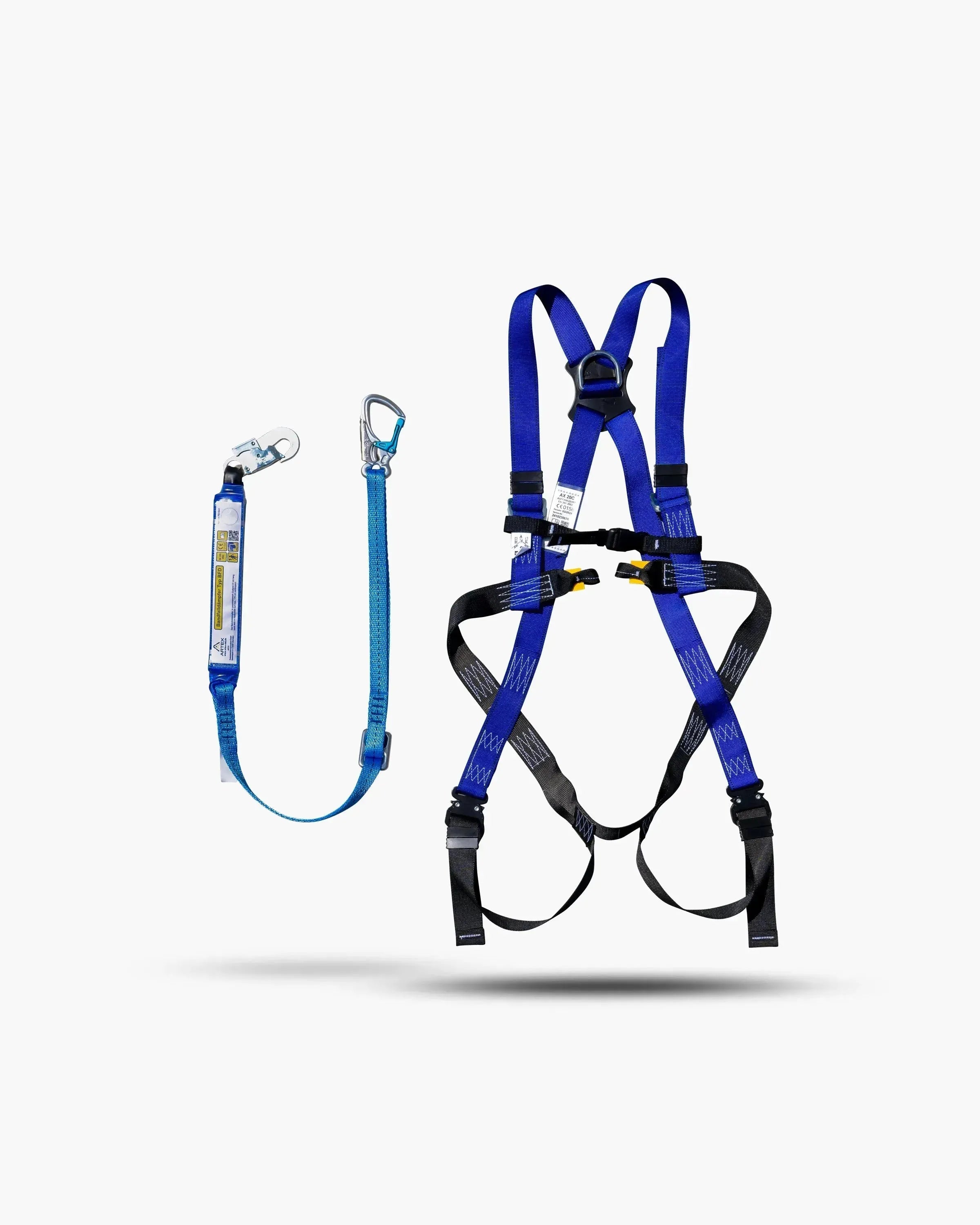
The correct anchorage device is crucial. The full body harness must be attached to a designated anchorage eyelet , and the length between the anchor point and the fall arrest system should be selected to prevent excessive fall height . Some applications also require a retractable fall arrester (HRA) or a shock absorber to further reduce mechanical hazards .

Remember: The best protection against ejection is properly fitted PPE in conjunction with a suitable anchor point . The correct application and use of PPE should be learned in a PPE training course – only then can the system save lives in an emergency!

What should be considered when using PPE on mobile elevating work platforms?

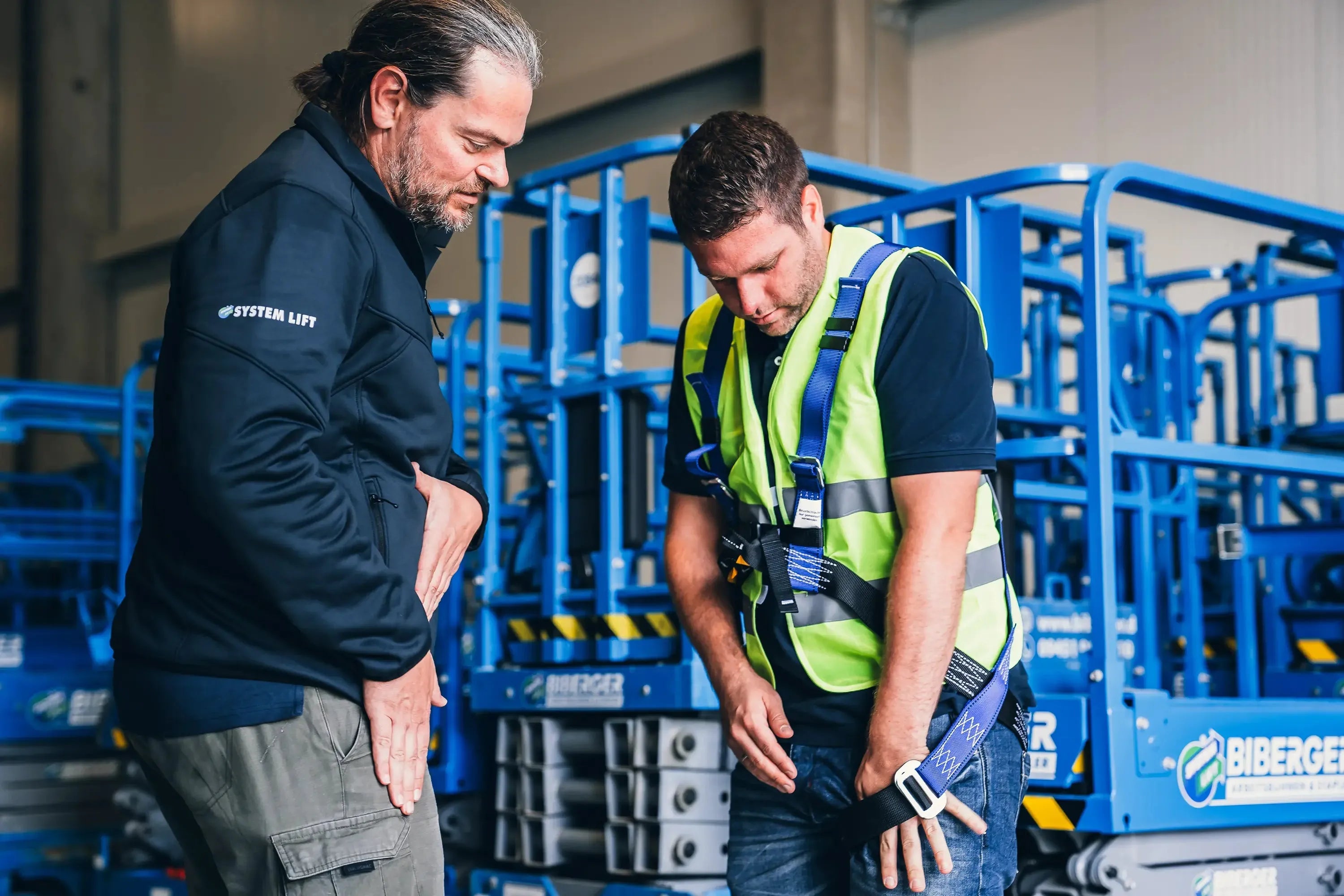
Wearing a harness alone is not enough to ensure safe protection. It is crucial that personal protective equipment is used correctly. A key factor is choosing the right anchor point . The harness must not be attached to any location on the work platform, but must be connected to a designated anchor point.

The length of the lanyard is equally important. If the lanyard is too long, it can lead to a dangerous pendulum fall. In most cases, a restraint system is a better choice than a fall arrest system alone. The length of the harness is adjusted so that falling out of the cage is impossible.

Another aspect is regular equipment inspection. Safety harnesses, lanyards, and carabiners are subject to natural wear and tear. They should therefore be checked regularly and replaced immediately if there is any visible damage.

Last but not least, anyone using PPE should have completed appropriate PPE/PPE training. Incorrect use can result in the protective equipment not working properly or even create additional hazards.

When is PPE training required?

Even the safest harness is useless if it's worn or used incorrectly. Therefore, training in safe work with PPE is required by law. This training must be provided if:

  • a company employs employees in areas with a risk of falling,
  • a work platform is used,
  • there are special risks associated with the location (e.g. over water or machinery),
  • an annual repetition of the training is required.

Since this is a legal requirement, PPE cannot simply be used at one's own discretion. Failure to receive adequate training not only risks one's own safety but also exposes the company to severe penalties.

We offer PPE training courses where you'll learn how to properly secure yourself and use your protective equipment correctly. This way, you can minimize risks and easily comply with legal regulations.

Which helmet is required when using PPE?

If you're using a harness, you should also consider appropriate head protection. A conventional construction helmet isn't sufficient in this case, as it can easily slip or even fall off in the event of a fall. Therefore, a helmet with a chin strap is required.

The best helmets are those that comply with EN 12492 and are specifically designed for work involving a risk of falls. These helmets fit securely on the head, provide protection from falling objects, and stay in place even in the event of a sudden jolt. Those who regularly work on work platforms should look for a lightweight and well-ventilated model for increased comfort.

Conclusion: Safety first – always take seat belt use seriously!

The regulations regarding mandatory fall protection for mobile elevating work platforms are not just a formality, but a vital safety measure. The requirement to wear a harness depends not only on the height, but also on the platform's design and the specific risks of the work site. Anyone using PPE should know exactly how to use it correctly – and this includes training.

Would you like to learn more about the safe use of aerial work platforms or complete PPE training? We're happy to advise you!

Benjamin_Biberger_f09df03b-780b-4e03-8991-ca3f20113b29 - BIBERGER
About the author

Benjamin Biberger

Managing Director

Benjamin is the founder and managing director of BIBERGER Arbeitsbühnen & Forklifts.

He is responsible for thecommercial and administrative areasof the company and, together with his team, ensures theOptimization of operational processesand theoptimal customer supportin their projects.

Through his many years of experience in the areas of organization andProject managementIt provides a stable foundation – in its own daily business, in sustainableFurther development of processesas well as in theCollaboration with partners and customers.

Our editorial quality standards

The subject content on biberger.de are editorially created, reviewed, and continuously updated. The basis is our daily work with aerial platforms, telehandlers, and industrial trucks – in rental, sales, operational planning, and technical support.

Each article draws on real-world experience and is editorially reviewed for clarity, accuracy, and practical relevance according to expert criteria. Technical statements are regularly compared against current industry standards and best practices.

The aim of our publications is to make reliable specialist knowledge accessible and to offer guidance to users, decision-makers and industry partners. BIBERGER sees itself as an independent information platform for safe, economical and modern height access technology – well-founded, comprehensible and free from advertising influence.

Leave a comment

Please note, comments need to be approved before they are published.

This site is protected by hCaptcha and the hCaptcha Privacy Policy and Terms of Service apply.

FAQ

Wann muss eine PSAgA getragen werden?

Eine PSA gegen Absturz (PSAgA) muss immer dann getragen werden, wenn ein Absturz nicht durch andere Schutzmaßnahmen, wie ein festes Geländer, verhindert wird. Besonders bei Teleskopbühnen, LKW-Arbeitsbühnen und Arbeitskörben ohne feste Umwehrung ist die Sicherung mit einem Auffanggurt Pflicht. Die genauen Vorgaben regeln die TRBS 2121 und die DGUV Information 208-019.

Ist die PSAgA-Schulung Pflicht?

Ja, eine PSAgA-Schulung ist Pflicht, wenn Beschäftigte eine persönliche Schutzausrüstung gegen Absturz nutzen müssen. Laut Betriebssicherheitsverordnung (BetrSichV) und TRBS 2121 darf PSAgA nur von geschulten Personen verwendet werden. Die Schulung muss regelmäßig, mindestens einmal jährlich, wiederholt werden.

Welche PSA bei Hubarbeitsbühnen?

Bei Hubarbeitsbühnen wird in der Regel eine PSA gegen Absturz (PSAgA) benötigt. Diese besteht aus einem Auffanggurt nach EN 361, einem Verbindungsmittel mit Falldämpfer oder einem Höhensicherungsgerät (HSG) sowie einem geeigneten Anschlagpunkt. Zusätzlich ist ein Helm mit Kinnriemen nach EN 12492 vorgeschrieben, um den Kopf bei einem Sturz zu schützen. Die genaue PSA-Anforderung hängt von der Art der Arbeitsbühne und dem Einsatzort ab.

Was versteht man unter dem Begriff PSAgA?

PSAgA steht für Persönliche Schutzausrüstung gegen Absturz. Sie umfasst alle sicherheitsrelevanten Ausrüstungen, die das Absturzrisiko minimieren oder einen Sturz auffangen. Dazu gehören ein Auffanggurt (EN 361), ein Verbindungsmittel mit Falldämpfer oder Höhensicherungsgerät, eine geeignete Anschlageinrichtung sowie ein Helm mit Kinnriemen (EN 12492). Die Verwendung von PSAgA ist in bestimmten Arbeitsbereichen, wie auf Hubarbeitsbühnen, gesetzlich vorgeschrieben.

Wann muss die PSAgA geprüft werden?

Die PSAgA muss mindestens einmal jährlich von einer fachkundigen Person geprüft werden, wie es die DGUV Regel 112-198 und die Betriebssicherheitsverordnung (BetrSichV) vorschreiben. Zusätzlich ist eine Sichtprüfung vor jeder Nutzung durch den Anwender erforderlich, um Schäden oder Verschleiß frühzeitig zu erkennen. Beschädigte oder veraltete Schutzausrüstung darf nicht mehr verwendet werden und muss sofort ersetzt werden.

Was gehört zu einer PSAgA?

Eine PSA gegen Absturz (PSAgA) besteht aus mehreren Komponenten, die zusammen das Absturzrisiko minimieren:

  • Auffanggurt (EN 361) – sorgt für sicheren Halt im Falle eines Sturzes.
  • Verbindungsmittel mit Falldämpfer oder Höhensicherungsgerät (EN 355 / EN 360) – begrenzt die Fallhöhe und reduziert die Aufprallkräfte.
  • Anschlageinrichtung (EN 795) – ein sicherer Befestigungspunkt für die PSAgA.
  • Helm mit Kinnriemen (EN 12492) – schützt den Kopf bei einem Sturz oder Anstoßen.

Die genaue Ausstattung hängt von der jeweiligen Arbeitssituation ab und muss regelmäßig geprüft werden.

Ist ein Geländer ein Anschlagpunkt für die PSAgA?

Nein, ein Geländer ist kein zulässiger Anschlagpunkt für die PSAgA. Anschlagpunkte müssen bestimmten Sicherheitsanforderungen entsprechen, insbesondere der Norm EN 795, und eine ausreichende Tragfähigkeit für die auftretenden Kräfte im Falle eines Sturzes aufweisen.

Hubarbeitsbühnen verfügen in der Regel über vorgesehene Anschlagpunkte, die vom Hersteller gekennzeichnet sind. Die Benutzung unsicherer Befestigungen, wie Geländer oder andere Konstruktionsteile, kann lebensgefährlich sein und ist nicht erlaubt.

Welche Mindestfestigkeit sollte ein Anschlagpunkt in der PSAgA haben?

Ein Anschlagpunkt für die PSA gegen Absturz (PSAgA) muss eine Mindestfestigkeit von 12 kN (Kilonewton) pro gesicherter Person aufweisen. Dies entspricht den Anforderungen der Norm EN 795 für Anschlageinrichtungen.

In der Praxis bedeutet das, dass Anschlagpunkte von Herstellern geprüft und freigegeben sein müssen. Improvisierte Befestigungen, wie Geländer oder ungeprüfte Konstruktionsteile, sind nicht zulässig, da sie die auftretenden Kräfte im Falle eines Sturzes oft nicht sicher aufnehmen können.

Relevant topics

View all

Typische Planungsfehler beim ersten Einsatz von Arbeitsbühnen – und wie du sie vermeidest - BIBERGER

Typical planning mistakes when using aerial work platforms for the first time – and how to avoid them.

Introduction Why errors occur even before deployment The safe operation of a work platform begins long before the basket lifts off. Mistakes don't happen during the lift itself, but in the preparation: assessing the ground conditions, selecting the right equipment,...

Read more

Wind und Arbeitsbühnen: Was Du für einen sicheren Einsatz unbedingt wissen musst - BIBERGER

Wind and aerial work platforms: What you absolutely need to know for safe use

Key problem: Why wind loads are so often underestimated Wind load is one of the most underestimated risks when using aerial work platforms. At ground level, wind force 6, with 12.5 m/s or around 45 km/h, often seems relatively harmless....

Read more

Arbeitsbühnen weltweit: Der internationale Vergleich von Märkten, Herstellern & Kosten - BIBERGER

Aerial work platforms worldwide: An international comparison of markets, manufacturers & costs

Aerial work platforms are indispensable on almost every construction site and in many industries. However, although the basic technology is similar worldwide, markets differ significantly in terms of regulation, manufacturing landscape, pace of innovation, and typical application profiles. Understanding international...

Read more

Arbeitsbühne Privat mieten – Was ist erlaubt? - BIBERGER

Renting a work platform as a private individual – What is allowed?

Aerial work platforms are primarily designed, standardized, and planned for commercial use. Typical applications include facade construction, plant and building technology, and industrial maintenance. Accordingly, equipment selection, insurance models, and rental procedures are geared primarily towards commercial users with trained...

Read more

Anschlagen von Lasten – Anschlagmittel richtig auswählen und sicher einsetzen - BIBERGER

Lifting loads – selecting and safely using lifting equipment

Safely attaching loads is one of the most demanding tasks when operating cranes , forklifts , and lifting equipment. Errors almost never occur during the lifting itself, but almost always result from misjudging the load capacity, type of attachment, or...

Read more

Staplerfahrer werden

Become a forklift driver: safely, trained and responsibly

A moment of inattention 7:15 a.m. A forklift driver begins his early shift. Routine. He only gives the forklift a cursory check – time pressure, the truck is waiting. On the third lift, the fork tine snaps at an old...

Read more

CAN-Bus und J1939-Diagnose bei Baumaschinen - BIBERGER

CAN bus and J1939 diagnostics in construction machinery

Modern construction machinery is now highly networked systems. Sensors, control units and safety modules communicate with each other constantly – and this happens via the so-called CAN bus . The CAN bus is essentially the nervous system of every modern...

Read more

Magni Diagnose-Leitfaden: Fehlermeldungen richtig deuten - BIBERGER

Magni Diagnostic Guide: How to correctly interpret error messages

If your Magni telehandler (RTH / HTH series) suddenly displays a warning, it's rarely a total breakdown. Usually, a safety or protective function is being activated. This guide explains the most important error codes, their meaning, and how to react...

Read more