Reading now: Getting a crane license: Theory and practice for prospective crane operators
Zusammenfassung What You Need to Know

Anyone who carries out crane work needs a crane license.

It is mandatory for commercial use – whether on construction sites, in warehouses, or in industry. The training includes both theory and practice and concludes with an exam.

  • Valid for: e.g. truck loading cranes, tower cranes, indoor cranes
  • Cost: depending on the crane type approx. 500–1,500 €
  • Requirements: Minimum age 18 years, health suitability, knowledge of German
  • Duty: annual instruction for safe handling

Tip:Funding opportunities are available through employers or employment agencies.

Zusammenfassung What You Need to Know

Anyone who carries out crane work needs a crane license.

It is mandatory for commercial use – whether on construction sites, in warehouses, or in industry. The training includes both theory and practice and concludes with an exam.

  • Valid for: e.g. truck loading cranes, tower cranes, indoor cranes
  • Cost: depending on the crane type approx. 500–1,500 €
  • Requirements: Minimum age 18 years, health suitability, knowledge of German
  • Duty: annual instruction for safe handling

Tip:Funding opportunities are available through employers or employment agencies.

Are you about to get your crane license ?

Here you will learn what a crane license is, how the training and exams work, and what costs you can expect.

Introduction

What is a crane license?

The crane license is official proof that a person is authorized to operate a crane safely, professionally, and legally . In Germany, it is mandatory for everyone who works with cranes professionally – whether in construction, industry, or intralogistics.

The training includes both theoretical content —such as regulations, load handling equipment, and safety rules—as well as practical exercises on the specific crane type . The goal is to prevent accidents and ensure safe, efficient crane operation .

With a valid crane license, you are authorized to operate certain types of cranes, such as tower cranes, mobile cranes, or overhead cranes, as part of your job. Which crane you are permitted to operate depends on your training and the relevant type of qualification.

Costs for the crane license

This is what the crane license costs

The cost of a crane operator's license depends on the provider, region, and crane type . Typically, it ranges between €500 and €1,500 , including training materials, practical training sessions, and exam fees.

The decisive factor for the price is primarily the type of crane for which the training is aimed: training courses for mobile cranes or tower cranes are usually more extensive and therefore more expensive than courses for indoor or truck loading cranes.

The length of the training – usually between two and five days – also influences the total cost. Despite the investment, the crane operator's license is a sought-after additional qualification that significantly expands your career options and creates new opportunities in the long term.

Funding opportunities

In certain cases, the Federal Employment Agency will help cover the costs of a crane operator's license —particularly if the qualification significantly improves job market prospects . This usually requires a consultation and the issuance of a training voucher .

Many employers also cover all or part of the course costs if a crane operator's license is required for the job or expands the company's range of applications. For companies, investing in qualified personnel is often a financial advantage.

Our tip: Before starting your course, find out about possible funding programs, grants, or cost sharing options to secure financial support. Clarifying this early on not only saves money but also provides planning security.

Training and education to become a crane operator

Requirements for the crane driver's license

To obtain a crane operator's license, you must be at least 18 years old and demonstrate physical fitness to operate a crane safely. Good eyesight and hearing are particularly important, as the work requires full concentration and clear perception.

In addition, sufficient German language skills are generally required – many safety regulations, operating instructions, and examination documents are available exclusively in German. Anyone who wants to operate a crane safely must be able to understand and apply this content.

Contents of the training

theory

Similar to the aerial platform driver's license, the theoretical part of the crane training first covers the fundamentals. The basics of crane operation, important occupational health and safety regulations, and accident prevention are covered. You'll learn about the hazards that can occur when operating a crane and how to protect yourself and others. The seminar training covers chapters such as DGUV Regulation 52 and DGUV Rule 100-500, laying the foundation for safe practice in operating a crane in the future.

Practice crane license exam questions

Practice

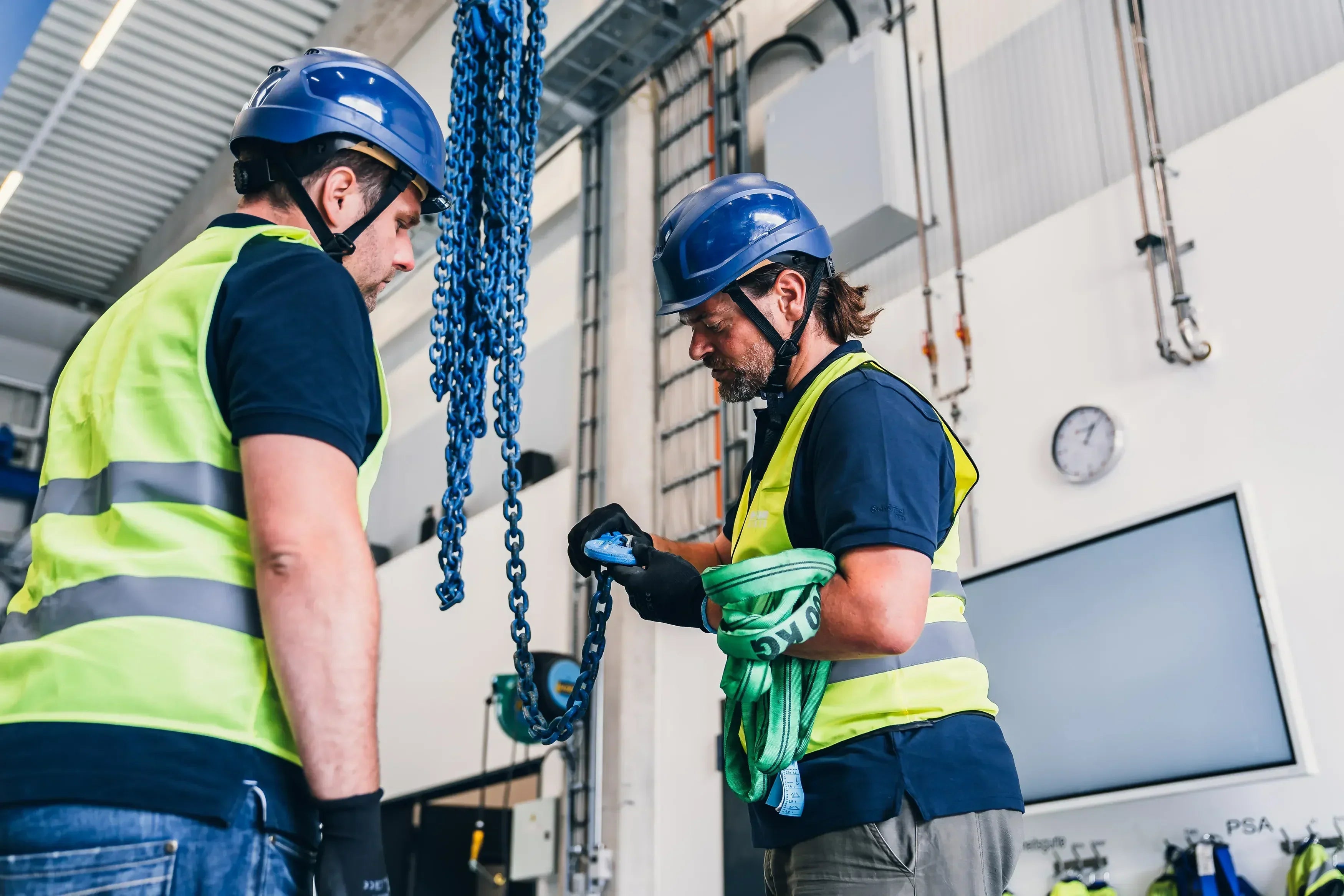
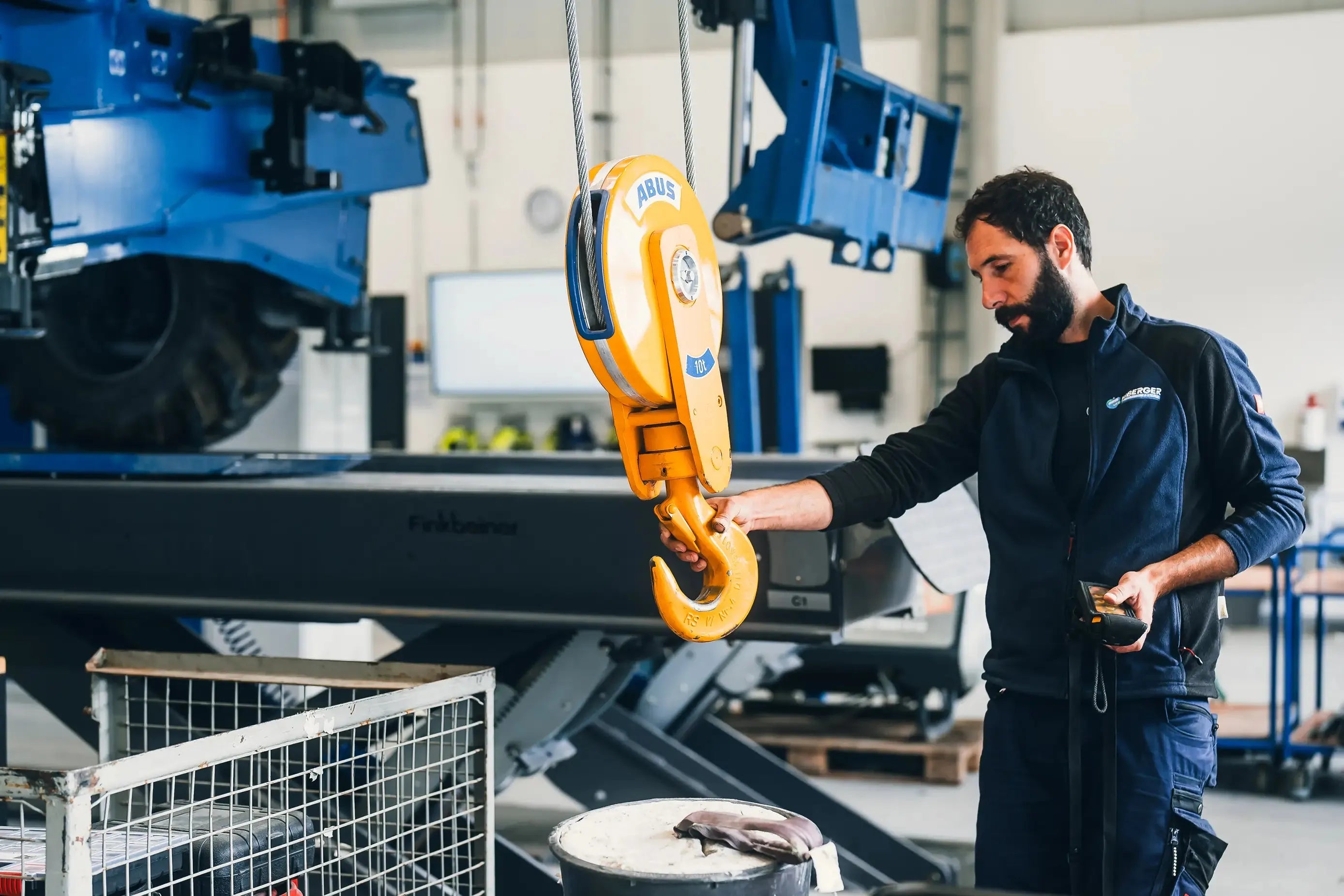
The practical part of the crane training includes exercises on controlling and operating the crane, safely slinging loads , and supporting the crane at the job site. Participants practice using the controls safely and learn how to move loads stably and precisely. After passing the practical exam, participants receive a crane license, which authorizes them to operate cranes in commercial applications.

Annual instruction

Anyone wishing to operate a crane must attend a training session at least once a year after completing crane training to refresh their knowledge and familiarize themselves with current safety standards and new regulations. This regular training is mandatory and helps prevent accidents caused by unsafe operation. This training ensures that knowledge of safe crane handling is always up to date.

Crane types and specific crane certificates

There are different types of cranes , each requiring specific knowledge and skills. Operating certain types of cranes, such as tower cranes or truck-mounted cranes, requires special crane licenses. These qualifications address the specific requirements and safety precautions of each crane type and ensure that the crane operator can operate the equipment safely.

tower crane

A tower crane is a large and powerful crane frequently used on construction sites. The tower crane operator's license provides specialized knowledge for safely erecting, operating, and moving heavy loads at great heights. The training is demanding, as tower cranes place particular demands on stability and safety precautions.

truck loading crane

A truck-mounted crane is a mobile crane mounted on a truck and often used for loading and unloading materials. Training for a truck-mounted crane license covers topics such as properly supporting the vehicle, operating the crane, and safely slinging loads. This type of crane license is particularly in demand in the logistics and transport sectors.

Mobile cranes and other types of cranes

In addition to indoor cranes, tower cranes, and truck-mounted cranes, there are also other types of cranes, such as overhead cranes and overhead cranes, each of which has its own operating requirements. Training can vary depending on the application and crane type. Those who wish to operate multiple crane types can therefore acquire additional training and crane licenses to expand their range of applications.

How do you get a crane license?

The "Crane Operator's License" can be obtained from certified training providers, vocational schools or training centers that specialize in the training of crane operators.

Special training centers of the Chamber of Industry and Commerce (IHK), as well as some larger construction and logistics companies, also offer crane license training. Some courses also offer the option of completing the theoretical part online while the practical part takes place on-site.

Looking for a training center near you? Here you can find all our SYSTEM-CARD training centers.

Benjamin_Biberger_f09df03b-780b-4e03-8991-ca3f20113b29 - BIBERGER
About the author

Benjamin Biberger

Managing Director

Benjamin is the founder and managing director of BIBERGER Arbeitsbühnen & Forklifts.

He is responsible for thecommercial and administrative areasof the company and, together with his team, ensures theOptimization of operational processesand theoptimal customer supportin their projects.

Through his many years of experience in the areas of organization andProject managementIt provides a stable foundation – in its own daily business, in sustainableFurther development of processesas well as in theCollaboration with partners and customers.

Our editorial quality standards

The subject content on biberger.de are editorially created, reviewed, and continuously updated. The basis is our daily work with aerial platforms, telehandlers, and industrial trucks – in rental, sales, operational planning, and technical support.

Each article draws on real-world experience and is editorially reviewed for clarity, accuracy, and practical relevance according to expert criteria. Technical statements are regularly compared against current industry standards and best practices.

The aim of our publications is to make reliable specialist knowledge accessible and to offer guidance to users, decision-makers and industry partners. BIBERGER sees itself as an independent information platform for safe, economical and modern height access technology – well-founded, comprehensible and free from advertising influence.

Leave a comment

Please note, comments need to be approved before they are published.

This site is protected by hCaptcha and the hCaptcha Privacy Policy and Terms of Service apply.

FAQ

For which crane do you need a crane license?

In Germany, crane operator training is required for all cranes that lift and move loads. This includes tower cranes, indoor cranes, truck-mounted cranes and bridge cranes. The crane license ensures that crane operators have the necessary skills to operate cranes safely and in accordance with the regulations of the professional associations. This makes a significant contribution to accident prevention.

Is a crane license mandatory?

Yes, a crane operator's license is mandatory in Germany if cranes are operated commercially. The crane license is for safety reasons and is required by law by the regulations of the professional associations in order to avoid accidents when operating cranes.

How long is the crane license valid?

A crane license is valid indefinitely. However, crane operators must complete appropriate training at least once a year to refresh their knowledge and the safe operation of cranes in accordance with current regulations.

Is the crane license difficult?

The crane license is easy to obtain. The exam consists of a theoretical and a practical part, in which all the important basics are explained and practiced step by step to the prospective crane operatorsWith sufficient preparation and the right knowledge about how to operate cranes safely, most participants pass the theoretical and practical exams.

Can I operate an indoor crane without a crane license?

To operate ahall craneis in Germany ainstruction and assignmentrequired by the employer. Acrane licenseis not always mandatory, butregular use,higher load capacitiesor more complex controls are necessary. Occasional operations undersupervisionare with asafety briefingallowed. The exact requirements depend on theDGUV Regulation 52and theIndustrial Safety Ordinance (BetrSichV)

What happens if an accident occurs without a crane license?

If aaccident with a cranehappens and the operatorno crane licenseThis can have serious consequences:

  • employer's liability: The employer must ensure that onlytrained staffCranes are operated. Violations may result infinesandlegal consequences.
  • Criminal consequences for the operator: If the crane operator has acted negligently, this can lead tocriminal proceedings for gross negligencecome.
  • problems with insurance: Theprofessional association (BG)or theliability insurancemay refuse payment if the crane operator was not sufficiently qualified.
  • claims for damages: In case of damage to property or personal injury, the operator or the employer can be held responsible for theCostbe held liable.

Without a crane license orappropriate instructionSo you not only riskhigh costs, but alsolegal consequences.

How much does a crane license cost?

The cost of acrane licensein Germany vary depending oncrane type,training providersandregionHere are some guidelines:

  • floor-controlled hall cranes: from approx.200 euros.
  • truck loading cranes: approx.390 eurosfor a two-day training course.
  • tower cranes: approx.900 euros.
  • mobile cranes: up to3,000 euros.

Employers or the employment agency often cover the costs of the crane license, especially if the training takes place in a certified facility.

Was kostet ein Lkw-Kranschein?

Die Kosten für einen Lkw-Kranschein liegen in der Regel zwischen 300 und 800 Euro, abhängig vom Anbieter, der Kursdauer und den enthaltenen Leistungen. Im Preis enthalten sind meist Theorieunterricht, Praxisteil und Prüfung. Förderungen durch Arbeitgeber oder die Agentur für Arbeit sind in vielen Fällen möglich.

Wie bekommt man einen Kranschein?

Einen Kranschein bekommst du durch die Teilnahme an einer anerkannten Kranführerschulung, die aus theoretischem Unterricht, praktischem Training und einer Abschlussprüfung besteht. Die Schulung erfolgt bei zertifizierten Ausbildungsstellen und ist für Personen ab 18 Jahren mit gesundheitlicher Eignung möglich.

Welchen Kranschein brauche ich?

Welchen Kranschein du brauchst, hängt vom Krantyp und dem Einsatzbereich ab. Für Ladekrane auf Lkw, Hallenkrane oder Turmdrehkrane sind jeweils spezifische Schulungen erforderlich. Die Ausbildung richtet sich nach dem DGUV Grundsatz 309-003 und muss zum konkreten Kranmodell passen, das du später bedienen willst.

How is a crane transported?

A crane is transported differently depending on its design:Mobile cranesdrive to the construction site independently, whileTower cranesdisassembled into individual parts and delivered on a low-loader. TheConstruction with assembly cranes or additional auxiliary cranesso that the crane is ready for use.

How do crane operators get onto the crane?

Crane operators usually climb overLadders or stairs inside the crane towerupwards. With very high cranes there are oftenIntermediate platforms, elevators or even small passenger cabinsso that the climb is safe and less strenuous.

Relevant topics

View all

Typische Planungsfehler beim ersten Einsatz von Arbeitsbühnen – und wie du sie vermeidest - BIBERGER

Typical planning mistakes when using aerial work platforms for the first time – and how to avoid them.

Introduction Why errors occur even before deployment The safe operation of a work platform begins long before the basket lifts off. Mistakes don't happen during the lift itself, but in the preparation: assessing the ground conditions, selecting the right equipment,...

Read more

Wind und Arbeitsbühnen: Was Du für einen sicheren Einsatz unbedingt wissen musst - BIBERGER

Wind and aerial work platforms: What you absolutely need to know for safe use

Key problem: Why wind loads are so often underestimated Wind load is one of the most underestimated risks when using aerial work platforms. At ground level, wind force 6, with 12.5 m/s or around 45 km/h, often seems relatively harmless....

Read more

Arbeitsbühnen weltweit: Der internationale Vergleich von Märkten, Herstellern & Kosten - BIBERGER

Aerial work platforms worldwide: An international comparison of markets, manufacturers & costs

Aerial work platforms are indispensable on almost every construction site and in many industries. However, although the basic technology is similar worldwide, markets differ significantly in terms of regulation, manufacturing landscape, pace of innovation, and typical application profiles. Understanding international...

Read more

Arbeitsbühne Privat mieten – Was ist erlaubt? - BIBERGER

Renting a work platform as a private individual – What is allowed?

Aerial work platforms are primarily designed, standardized, and planned for commercial use. Typical applications include facade construction, plant and building technology, and industrial maintenance. Accordingly, equipment selection, insurance models, and rental procedures are geared primarily towards commercial users with trained...

Read more

Anschlagen von Lasten – Anschlagmittel richtig auswählen und sicher einsetzen - BIBERGER

Lifting loads – selecting and safely using lifting equipment

Safely attaching loads is one of the most demanding tasks when operating cranes , forklifts , and lifting equipment. Errors almost never occur during the lifting itself, but almost always result from misjudging the load capacity, type of attachment, or...

Read more

Staplerfahrer werden

Become a forklift driver: safely, trained and responsibly

A moment of inattention 7:15 a.m. A forklift driver begins his early shift. Routine. He only gives the forklift a cursory check – time pressure, the truck is waiting. On the third lift, the fork tine snaps at an old...

Read more

CAN-Bus und J1939-Diagnose bei Baumaschinen - BIBERGER

CAN bus and J1939 diagnostics in construction machinery

Modern construction machinery is now highly networked systems. Sensors, control units and safety modules communicate with each other constantly – and this happens via the so-called CAN bus . The CAN bus is essentially the nervous system of every modern...

Read more

Magni Diagnose-Leitfaden: Fehlermeldungen richtig deuten - BIBERGER

Magni Diagnostic Guide: How to correctly interpret error messages

If your Magni telehandler (RTH / HTH series) suddenly displays a warning, it's rarely a total breakdown. Usually, a safety or protective function is being activated. This guide explains the most important error codes, their meaning, and how to react...

Read more