
Reading now: Getting a crane license: Theory and practice for prospective crane operators
Zusammenfassung What You Need to Know

Thecrane operator's licenseis thelegally required certificate of competence, in order toOperating or running a crane professionallyto be allowed to use (e.g., hall crane, bridge crane, truck-mounted crane, mobile crane or tower crane).

Short and sweet:

  • Legal basis:DGUV Regulation 52, DGUV Rule 100-500, DGUV Principle 309-003
  • Validity:Unlimited –only with annual training for crane operators
  • Requirements: 18 years, personalSuitability (G25), Theory & Practice
  • Test:Theory (multiple choice) + practice with real loads
  • Duration & Costs:Depending on the type of crane1–15 days, approx.€200–600 (overhead crane)

The crane operator's license increasesOccupational safety,Applicationsand often pays off in practiceafter a short time.

Zusammenfassung What You Need to Know

Thecrane operator's licenseis thelegally required certificate of competence, in order toOperating or running a crane professionallyto be allowed to use (e.g., hall crane, bridge crane, truck-mounted crane, mobile crane or tower crane).

Short and sweet:

  • Legal basis:DGUV Regulation 52, DGUV Rule 100-500, DGUV Principle 309-003
  • Validity:Unlimited –only with annual training for crane operators
  • Requirements: 18 years, personalSuitability (G25), Theory & Practice
  • Test:Theory (multiple choice) + practice with real loads
  • Duration & Costs:Depending on the type of crane1–15 days, approx.€200–600 (overhead crane)

The crane operator's license increasesOccupational safety,Applicationsand often pays off in practiceafter a short time.

Are you about to get your crane operator's license and want to know not only how the training works, but also whether becoming a crane operator in 2026 is really worthwhile for you professionally and financially?

This guide (as of 2026) answers all crucial questions about the crane operator's license according to the current DGUV regulations: Where is the crane operator's license mandatory? Which crane types require which training? How do the theoretical and practical exams actually work? What mistakes lead to failing? And: How does the investment really pay off?

Crane Operator's License – Proof of Qualification for Operating Cranes according to DGUV

The crane operator's license (also known as Kranführerschein) is the legally required proof of qualification for all persons who professionally operate or control a crane.

It confirms that the crane operator has sufficient theoretical and practical knowledge, personal suitability, and appropriate training according to DGUV Principle 309-003 and meets the requirements of DGUV Regulation 52 as well as the Industrial Safety Ordinance.

Legal Basis for the Crane Operator's License

  • DGUV Regulation 52 – Cranes
  • DGUV Rule 100-500
  • DGUV Regulation 1 – Principles of Prevention
  • DGUV Principle 309-003
Occupational Safety Note: The crane operator's license is a proof of qualification, but not a permanent operating permit – without at least annual, documented instruction according to DGUV Regulation 1 and the Industrial Safety Ordinance, the employer may not employ personnel as crane operators.

Where is the Crane Operator's License Required? Industries & Application Scenarios

A crane operator's license is required wherever loads are moved with cranes. In practice, this affects significantly more industries than just traditional building construction.

Construction & Building Construction

In construction, the crane operator's license is mandatory for tower cranes, mobile cranes, and gantry cranes. Without valid qualification, no crane operator may lift or position loads.

Industry, Assembly & Production

In industrial and production facilities, overhead cranes, bridge cranes, pillar cranes, and rail-mounted trolleys are frequently used. Here, loads are regularly moved over workplaces – a particularly safety-critical area.

Logistics & Transport

In the logistics sector, the crane operator's license for truck-mounted loading cranes is particularly in demand. It enables the independent loading and unloading of heavy goods without additional aids.

Career and Salary Impact

The crane operator's license is considered a real career stepping stone in many companies. Qualified crane operators are scarce – accordingly, the added value is high.

Validity of the Crane Operator's License & Annual Instruction for Crane Operators

How long is the crane operator's license valid?

The crane operator's license is valid indefinitely. There is no fixed expiry date and no automatic renewal.

Annual Instruction for Crane Operators (Mandatory)

Regardless of the validity of the crane operator's license, an annual instruction is mandatory.

  • at least once a year
  • according to DGUV Regulation 1
  • Duration: approx. 0.5–1 day
Note: If the annual instruction is not carried out or documented, the authorization to operate expires – even with a valid crane operator's license.

Refresher Training for Crane Operators

Additionally, a refresher course is recommended every 4–5 years, especially after longer breaks in operation or when changing crane types.

Prerequisites for Crane Operator Training

  • Minimum age: 18 years
  • physical and mental suitability
  • sufficient German language skills

G25 Examination – Medical Fitness

In practice, the occupational medical examination G25 is the common standard to prove health suitability for driving, controlling, and monitoring activities, but in some industries, it is only recommended and not explicitly required.

  • Eyesight and hearing
  • spatial vision
  • reaction time

Crane Training & Crane Operator Training

Theoretical Training

The theoretical part of the crane training provides all the basics for safe, efficient, and legally compliant crane operation.

  • DGUV Regulation 52 & DGUV Rule 100-500
  • Crane types, designs, and crane jibs
  • Load moment, center of gravity, lever principle
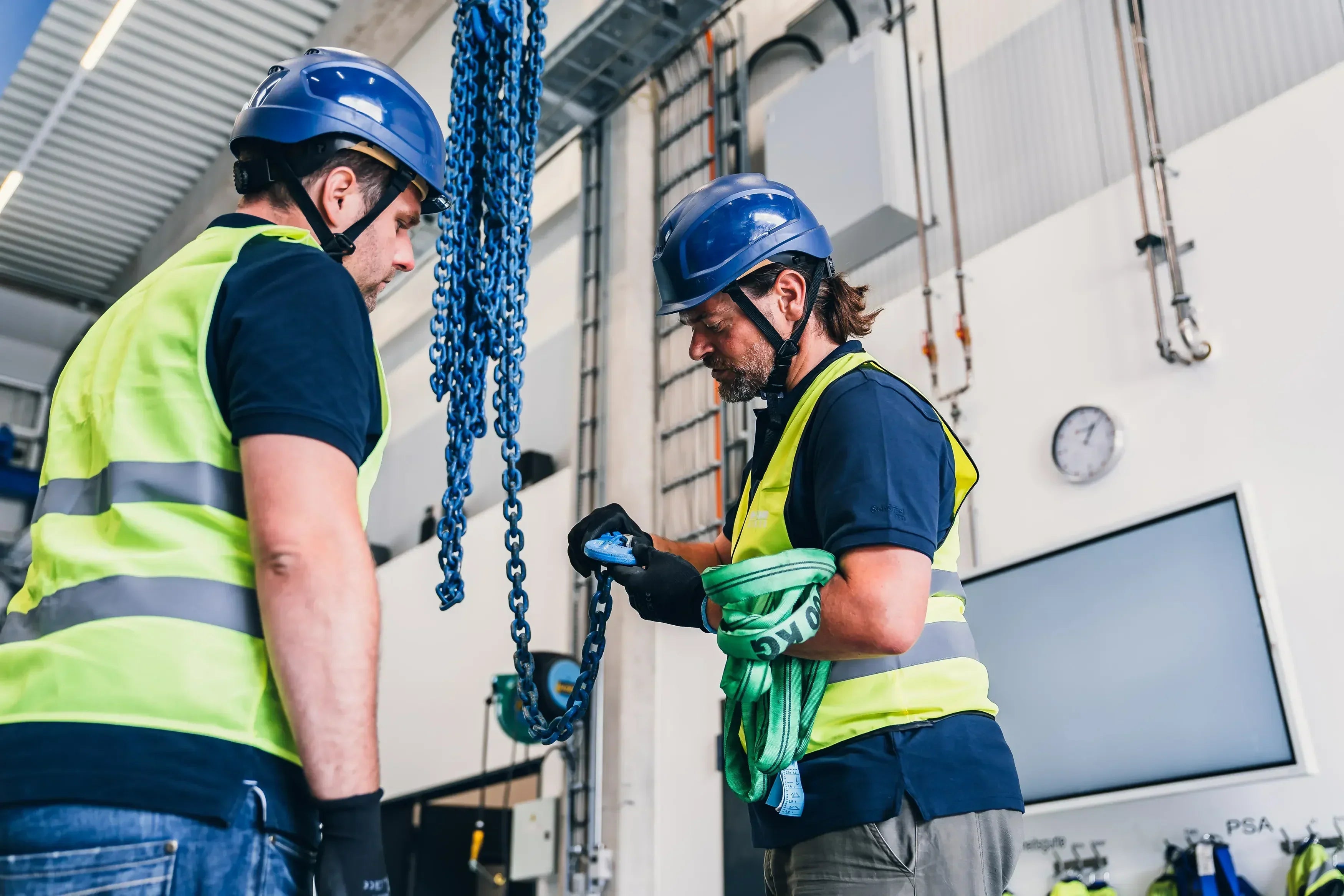
  • Slinging of loads
  • Accident prevention and occupational safety

Practice Crane Operator's License Exam Questions

Practical Training – Operating a Crane

In practice, participants learn to safely operate a crane, correctly sling loads, and move them in a controlled manner.

Theoretical Exam for Crane Operator's License – Procedure & Evaluation

The theoretical exam is a multiple-choice test.

  • 40–50 questions
  • Question pool with approx. 180 questions
  • Processing time: approx. 90 minutes
  • Passing score: approx. 70–80 %

Example Exam Questions (Theory)

Question: Which DGUV regulation applies to cranes?

A) DGUV Regulation 1
B) DGUV Regulation 3
C) DGUV Regulation 52
D) DGUV Rule 112-198

Question: How is the load moment calculated?

A) Weight
B) Weight × Lever arm
C) Height × Weight
D) Angle of rotation × Weight

Practical Exam – Procedure, Tasks & Reasons for Failure

The practical exam lasts 30–60 minutes, depending on the type of crane.

Typical Exam Tasks

  • Picking up and moving a load
  • Safely setting down a load
  • Communication with the signalman

Common Reasons for Failure

  • Endangering persons
  • incorrect slinging of loads
  • Disregarding hand signals

Crane Types – Comparison by Effort & Cost

Crane Type Application Duration Costs Complexity
Overhead Crane Industry 1–2 Days 450–650 € Low
Truck-Mounted Loading Crane Logistics 2–4 Days 600–1,200 € Medium
Tower Crane Building Construction 10–15 Days 800 - 1,500 € High

Case Studies: Is a Crane Operator's License Worth It?

Case Study 1: Anna – Overhead Crane Operator

Anna works as a warehouse employee in a logistics center.

  • Current Salary: 33,000 €/year (Standard warehouse job 2026)
  • Perspective: Limited, no special career opportunities

Decision: Get an overhead crane license

  • Course: 450 €
  • G25: 80 €
  • Total Investment: 530 €

Result after 3 months:

  • New Job: Overhead crane operator in the same company
  • New Salary: 40,500 €/year
  • Additional Earnings: +7,500 €/year
  • ROI: 530 € → +7,500 € = 15×, Amortization in less than 1 month
  • Long-term Perspective: With 5+ years of experience: 42,000–45,000 €+
Anna's Conclusion: "The course paid for itself after 3 weeks. Now I'm in demand instead of interchangeable – and earning significantly more."

Case Study 2: Peter – Truck-Mounted Loading Crane

Peter expands his qualifications for logistics operations.

Investment: 850 €

Added Value: +700 €/month

Case Study 3: Thomas – Tower Crane

Thomas changes from construction helper to permanent crane operator.

Investment: 2,500 €

Added Value: +25,000 €/year

Conclusion: Crane Operator's License as a Key for Safe and Professional Crane Operation

The crane operator's license is much more than a formal proof. Anyone who possesses a crane operator's license demonstrates that they can operate cranes professionally, safely, and in accordance with legal requirements. The crane operator's license training or crane training imparts comprehensive knowledge for safe and efficient crane operation – from correctly slinging loads to safely working with crane systems in warehouses, industrial, and assembly halls.

Which training is required depends on the crane design: overhead cranes, bridge cranes (including rail-mounted trolleys), gantry cranes, pillar and slewing cranes, or special applications such as the crane operator's license for truck-mounted loading cranes each require appropriate qualification.

During the training, participants learn to safely operate cranes, correctly move loads, and identify risks early – supported by practical exercises, clear instructions, and personal guidance from experienced instructors.

Crucial for long-term deployment is not just the license itself, but also the regular annual instruction for crane operators. It ensures that knowledge remains current and that the safe handling of cranes in everyday life is guaranteed.

Anyone who acquires their qualification at the appropriate training center and regularly refreshes it lays the foundation for greater occupational safety, better employment opportunities, and sustainable professional development – and can often significantly reduce course costs through employer subsidies or education vouchers from the employment agency.

Benjamin_Biberger_f09df03b-780b-4e03-8991-ca3f20113b29 - BIBERGER
About the author

Benjamin Biberger

Managing Director

Benjamin is the founder and managing director of BIBERGER Arbeitsbühnen & Forklifts.

He is responsible for thecommercial and administrative areasof the company and, together with his team, ensures theOptimization of operational processesand theoptimal customer supportin their projects.

Through his many years of experience in the areas of organization andProject managementIt provides a stable foundation – in its own daily business, in sustainableFurther development of processesas well as in theCollaboration with partners and customers.

Our editorial quality standards

The subject content on biberger.de are editorially created, reviewed, and continuously updated. The basis is our daily work with aerial platforms, telehandlers, and industrial trucks – in rental, sales, operational planning, and technical support.

Each article draws on real-world experience and is editorially reviewed for clarity, accuracy, and practical relevance according to expert criteria. Technical statements are regularly compared against current industry standards and best practices.

The aim of our publications is to make reliable specialist knowledge accessible and to offer guidance to users, decision-makers and industry partners. BIBERGER sees itself as an independent information platform for safe, economical and modern height access technology – well-founded, comprehensible and free from advertising influence.

Leave a comment

Please note, comments need to be approved before they are published.

This site is protected by hCaptcha and the hCaptcha Privacy Policy and Terms of Service apply.

FAQ

For which crane do you need a crane license?

In Germany, crane operator training is required for all cranes that lift and move loads. This includes tower cranes, indoor cranes, truck-mounted cranes and bridge cranes. The crane license ensures that crane operators have the necessary skills to operate cranes safely and in accordance with the regulations of the professional associations. This makes a significant contribution to accident prevention.

Is a crane license mandatory?

Yes, a crane operator's license is mandatory in Germany if cranes are operated commercially. The crane license is for safety reasons and is required by law by the regulations of the professional associations in order to avoid accidents when operating cranes.

How long is the crane license valid?

A crane license is valid indefinitely. However, crane operators must complete appropriate training at least once a year to refresh their knowledge and the safe operation of cranes in accordance with current regulations.

Is the crane license difficult?

The crane license is easy to obtain. The exam consists of a theoretical and a practical part, in which all the important basics are explained and practiced step by step to the prospective crane operatorsWith sufficient preparation and the right knowledge about how to operate cranes safely, most participants pass the theoretical and practical exams.

Can I operate an indoor crane without a crane license?

To operate ahall craneis in Germany ainstruction and assignmentrequired by the employer. Acrane licenseis not always mandatory, butregular use,higher load capacitiesor more complex controls are necessary. Occasional operations undersupervisionare with asafety briefingallowed. The exact requirements depend on theDGUV Regulation 52and theIndustrial Safety Ordinance (BetrSichV)

What happens if an accident occurs without a crane license?

If aaccident with a cranehappens and the operatorno crane licenseThis can have serious consequences:

  • employer's liability: The employer must ensure that onlytrained staffCranes are operated. Violations may result infinesandlegal consequences.
  • Criminal consequences for the operator: If the crane operator has acted negligently, this can lead tocriminal proceedings for gross negligencecome.
  • problems with insurance: Theprofessional association (BG)or theliability insurancemay refuse payment if the crane operator was not sufficiently qualified.
  • claims for damages: In case of damage to property or personal injury, the operator or the employer can be held responsible for theCostbe held liable.

Without a crane license orappropriate instructionSo you not only riskhigh costs, but alsolegal consequences.

How much does a crane license cost?

The cost of acrane licensein Germany vary depending oncrane type,training providersandregionHere are some guidelines:

  • floor-controlled hall cranes: from approx.200 euros.
  • truck loading cranes: approx.390 eurosfor a two-day training course.
  • tower cranes: approx.900 euros.
  • mobile cranes: up to3,000 euros.

Employers or the employment agency often cover the costs of the crane license, especially if the training takes place in a certified facility.

Was kostet ein Lkw-Kranschein?

Die Kosten für einen Lkw-Kranschein liegen in der Regel zwischen 300 und 800 Euro, abhängig vom Anbieter, der Kursdauer und den enthaltenen Leistungen. Im Preis enthalten sind meist Theorieunterricht, Praxisteil und Prüfung. Förderungen durch Arbeitgeber oder die Agentur für Arbeit sind in vielen Fällen möglich.

Wie bekommt man einen Kranschein?

Einen Kranschein bekommst du durch die Teilnahme an einer anerkannten Kranführerschulung, die aus theoretischem Unterricht, praktischem Training und einer Abschlussprüfung besteht. Die Schulung erfolgt bei zertifizierten Ausbildungsstellen und ist für Personen ab 18 Jahren mit gesundheitlicher Eignung möglich.

Welchen Kranschein brauche ich?

Welchen Kranschein du brauchst, hängt vom Krantyp und dem Einsatzbereich ab. Für Ladekrane auf Lkw, Hallenkrane oder Turmdrehkrane sind jeweils spezifische Schulungen erforderlich. Die Ausbildung richtet sich nach dem DGUV Grundsatz 309-003 und muss zum konkreten Kranmodell passen, das du später bedienen willst.

How is a crane transported?

A crane is transported differently depending on its design:Mobile cranesdrive to the construction site independently, whileTower cranesdisassembled into individual parts and delivered on a low-loader. TheConstruction with assembly cranes or additional auxiliary cranesso that the crane is ready for use.

How do crane operators get onto the crane?

Crane operators usually climb overLadders or stairs inside the crane towerupwards. With very high cranes there are oftenIntermediate platforms, elevators or even small passenger cabinsso that the climb is safe and less strenuous.

Relevant topics

View all

Wie sicher ist eine gemietete Arbeitsbühne eigentlich?

How safe is a rented aerial work platform, actually?

Anyone who rents an aerial work platform relies on the equipment functioning safely. After all, the safety of operators, fitters, and other personnel on the construction site depends directly on the technical condition of the machine. But how is it...

Read more

Höhenzugang auf Großflächen: So planst du Geräte, Logistik und Abläufe ohne Leerlauf

Accessing large areas at height: How to plan equipment, logistics and processes without downtime

What large-scale advertising is really about On large forecourts and long facades, you don't lose time at height, but on the ground. Repositioning, waiting times for transport, incorrect equipment width, restricted areas – all of that eats up hours. The...

Read more

DGUV 308-008, SYSTEM-CARD® oder IPAF: Welche Hubarbeitsbühnen-Schulung braucht dein Team wirklich?

DGUV 308-008, SYSTEM-CARD® or IPAF: Which mobile elevating work platform training does your team really need?

In Germany, several relevant training systems for mobile elevating work platform operators exist in practice: the DGUV principle 308-008 as the employers' liability insurance association basis, the SYSTEM-CARD® based on it as an association-organized quality system, and the international IPAF...

Read more

Typische Planungsfehler beim ersten Einsatz von Arbeitsbühnen – und wie du sie vermeidest - BIBERGER

Typical planning mistakes when using aerial work platforms for the first time – and how to avoid them.

Introduction Why errors occur even before deployment The safe operation of a work platform begins long before the basket lifts off. Mistakes don't happen during the lift itself, but in the preparation: assessing the ground conditions, selecting the right equipment,...

Read more

Wind und Arbeitsbühnen: Was Du für einen sicheren Einsatz unbedingt wissen musst - BIBERGER

Wind and aerial work platforms: What you absolutely need to know for safe use

Key problem: Why wind loads are so often underestimated Wind load is one of the most underestimated risks when using aerial work platforms. At ground level, wind force 6, with 12.5 m/s or around 45 km/h, often seems relatively harmless....

Read more

Arbeitsbühnen weltweit: Der internationale Vergleich von Märkten, Herstellern & Kosten - BIBERGER

Aerial work platforms worldwide: An international comparison of markets, manufacturers & costs

Aerial work platforms are indispensable on almost every construction site and in many industries. However, although the basic technology is similar worldwide, markets differ significantly in terms of regulation, manufacturing landscape, pace of innovation, and typical application profiles. Understanding international...

Read more

Arbeitsbühne Privat mieten – Was ist erlaubt? - BIBERGER

Renting a work platform for private use – what is allowed?

Aerial work platforms are primarily designed, standardized, and planned for commercial use. Typical applications include facade construction, plant and building technology, and industrial maintenance. Accordingly, equipment selection, insurance models, and rental procedures are geared primarily towards commercial users with trained...

Read more

Anschlagen von Lasten – Anschlagmittel richtig auswählen und sicher einsetzen - BIBERGER

Lifting loads – selecting and safely using lifting equipment

Safely attaching loads is one of the most demanding tasks when operating cranes , forklifts , and lifting equipment. Errors almost never occur during the lifting itself, but almost always result from misjudging the load capacity, type of attachment, or...

Read more