Reading now: Working height vs. platform height: What's the difference?
Zusammenfassung What You Need to Know

ThePlatform heightis the actualStanding height on stage– e.g. 10 m. TheWorking heightcalculates flat rate2 m added– so12 mbecause an operator can reach so far while standing. The decisive factor for the selection is always theWorking height, because only it shows whether you actually achieve your goal.

Tip:Never choose too narrowly. Improvising makes you work insecurely.At BIBERGER you will find both values clearly stated– and, if you wish, you will receive personal advice on the appropriate working height for your project.

Zusammenfassung What You Need to Know

ThePlatform heightis the actualStanding height on stage– e.g. 10 m. TheWorking heightcalculates flat rate2 m added– so12 mbecause an operator can reach so far while standing. The decisive factor for the selection is always theWorking height, because only it shows whether you actually achieve your goal.

Tip:Never choose too narrowly. Improvising makes you work insecurely.At BIBERGER you will find both values clearly stated– and, if you wish, you will receive personal advice on the appropriate working height for your project.

Anyone looking to rent or use a mobile elevating work platform will quickly come across two terms in the technical specifications: platform height and working height . Both are crucial – but not the same thing. And if you confuse them, you'll quickly choose the wrong device.

In this article, you'll learn what these values ​​really mean, how they're calculated, and what you should definitely pay attention to when making your selection.

What is the platform height?

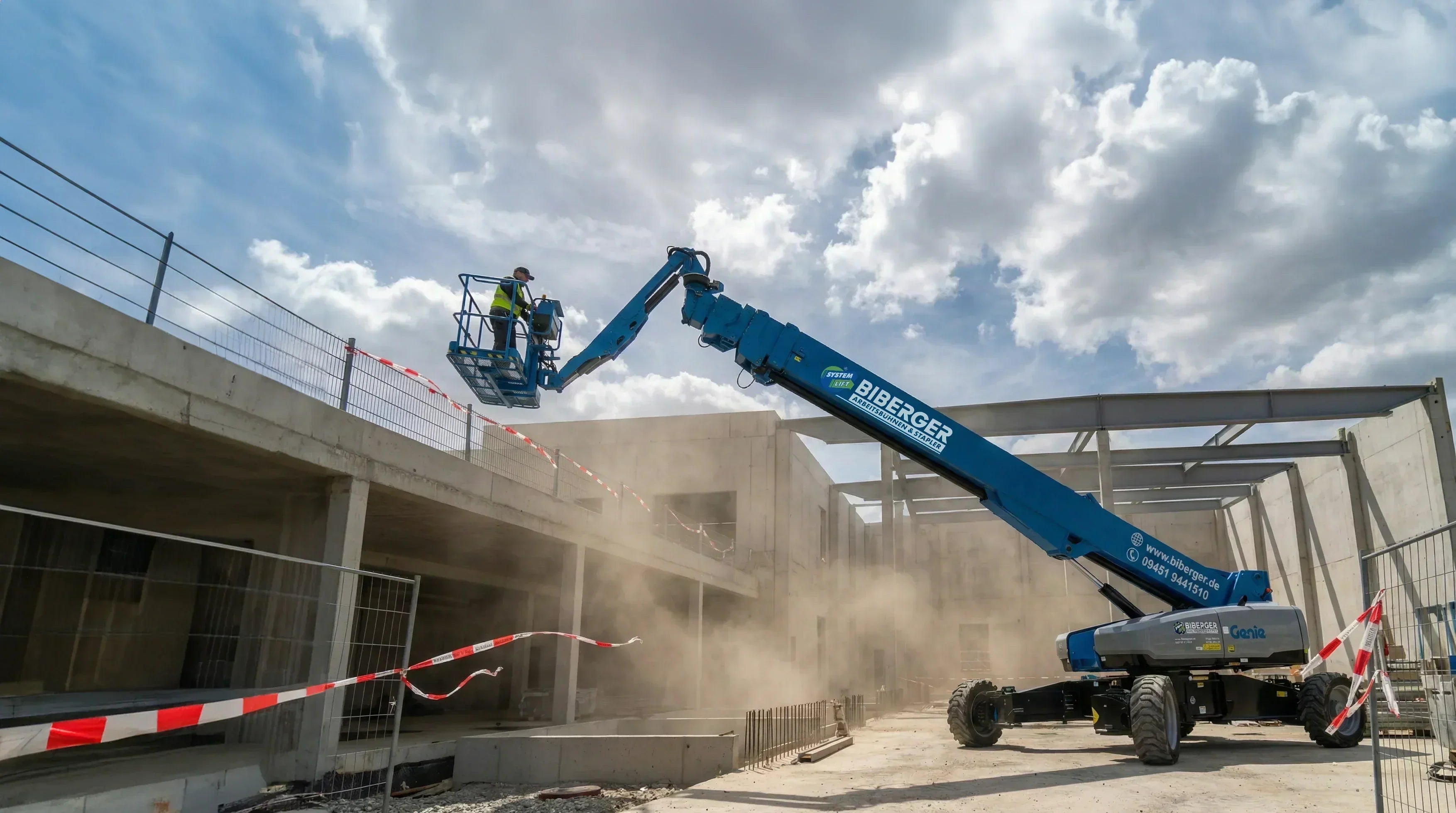
The platform height indicates how high the work platform is measured from the ground when fully extended. It therefore shows the actual standing height at which the operator is standing.

Example: A scissor lift with a platform height of 8 m brings the operator to exactly this height – 8 m above the ground.

Note: The platform height is a technical value that describes the lifting capacity of the platform itself – without an operator, without tools, without reach.

What is the working height?

The working height describes how high a person can actually work on the platform – i.e. with outstretched arms, tools or materials.

It is calculated as a flat rate: platform height + 2 meters .

These 2 m are considered the average reach height of a standing operator .

Example:

Platform height: 8 m → Working height: 10 m

Important:

The working height is the value that counts if you want to know whether you can really reach the desired area of ​​use.

Why are both statements made?

Because they say different things – but both are relevant :

  1. You need the platform height for transport planning, access routes or static calculations, for example .
  2. You need the working height for practical decisions on the construction site : Is the height sufficient? Do I need a larger platform?

How do I calculate the working height?

The calculation is simple:

Working height = platform height + 2 m

Tip: Always plan with some margin . Stages that are too small can quickly lead to unsafe behavior—for example, leaning out, stretching, or improvising with tools.

Platform height Working height
6 m 8 m
8 m 10 m
10 m 12 m
12 m 14 m
15 m 17 m
Working height vs. platform height in comparison

What happens if the working height is not sufficient?

In short: That's when things get dangerous.

If you choose too low, you will overstretch yourself, stand unsteadily or reach for the ladder in the basket – which is absolutely forbidden.

The result: risk of falling, loss of control or collisions.

Therefore, always pay attention to the working height not just the platform height .

Platform height or working height – what is available in the rental shop?

Most suppliers – including us at BIBERGER – state the working height in the overview because it is more practical .

The platform height is also listed separately in the technical data sheets .

Example from the rental shop:

  • Working height: 12 m
  • Platform height: 10 m
  • Load capacity: 230 kg

If you are unsure, ask specifically about the platform height , especially if you are working in tight spaces or need to check clearance heights.

Conclusion: Working height determines safe operations

Platform height = actual standing height

Working height = achievable working height (platform + 2 m)

Both pieces of information are important – but only the working height shows you whether you are really reaching your goal.

If you want to be on the safe side, plan with reserves and don't rely on estimates.

At BIBERGER you will receive the exact measurements for each stage , clear instructions – and, if you wish, advice for your specific area of ​​application .

Rectangle_1 - BIBERGER
About the author

Martin Biberger

Managing Director

Martin is the founder and managing director of BIBERGER Arbeitsbühnen & Forklifts.

He is responsible for thetechnical areaTogether with his team, he is responsible for thetechnical purchasingthe machines thatFurther development of the machine inventoryand the smooth operation of over 1,500 BIBERGER rental devices.

From many years of experience he knows theStrengths and weaknesses of all device classes, the possibleAreas of applicationand thetechnical possibilities– always with a view to theDevelopment of the entire industryand future innovations.

Our editorial quality standards

The subject content on biberger.de are editorially created, reviewed, and continuously updated. The basis is our daily work with aerial platforms, telehandlers, and industrial trucks – in rental, sales, operational planning, and technical support.

Each article draws on real-world experience and is editorially reviewed for clarity, accuracy, and practical relevance according to expert criteria. Technical statements are regularly compared against current industry standards and best practices.

The aim of our publications is to make reliable specialist knowledge accessible and to offer guidance to users, decision-makers and industry partners. BIBERGER sees itself as an independent information platform for safe, economical and modern height access technology – well-founded, comprehensible and free from advertising influence.

Leave a comment

Please note, comments need to be approved before they are published.

This site is protected by hCaptcha and the hCaptcha Privacy Policy and Terms of Service apply.

Relevant topics

View all

Typische Planungsfehler beim ersten Einsatz von Arbeitsbühnen – und wie du sie vermeidest - BIBERGER

Typical planning mistakes when using aerial work platforms for the first time – and how to avoid them.

Introduction Why errors occur even before deployment The safe operation of a work platform begins long before the basket lifts off. Mistakes don't happen during the lift itself, but in the preparation: assessing the ground conditions, selecting the right equipment,...

Read more

Wind und Arbeitsbühnen: Was Du für einen sicheren Einsatz unbedingt wissen musst - BIBERGER

Wind and aerial work platforms: What you absolutely need to know for safe use

Key problem: Why wind loads are so often underestimated Wind load is one of the most underestimated risks when using aerial work platforms. At ground level, wind force 6, with 12.5 m/s or around 45 km/h, often seems relatively harmless....

Read more

Arbeitsbühnen weltweit: Der internationale Vergleich von Märkten, Herstellern & Kosten - BIBERGER

Aerial work platforms worldwide: An international comparison of markets, manufacturers & costs

Aerial work platforms are indispensable on almost every construction site and in many industries. However, although the basic technology is similar worldwide, markets differ significantly in terms of regulation, manufacturing landscape, pace of innovation, and typical application profiles. Understanding international...

Read more

Arbeitsbühne Privat mieten – Was ist erlaubt? - BIBERGER

Renting a work platform as a private individual – What is allowed?

Aerial work platforms are primarily designed, standardized, and planned for commercial use. Typical applications include facade construction, plant and building technology, and industrial maintenance. Accordingly, equipment selection, insurance models, and rental procedures are geared primarily towards commercial users with trained...

Read more

Anschlagen von Lasten – Anschlagmittel richtig auswählen und sicher einsetzen - BIBERGER

Lifting loads – selecting and safely using lifting equipment

Safely attaching loads is one of the most demanding tasks when operating cranes , forklifts , and lifting equipment. Errors almost never occur during the lifting itself, but almost always result from misjudging the load capacity, type of attachment, or...

Read more

Staplerfahrer werden

Become a forklift driver: safely, trained and responsibly

A moment of inattention 7:15 a.m. A forklift driver begins his early shift. Routine. He only gives the forklift a cursory check – time pressure, the truck is waiting. On the third lift, the fork tine snaps at an old...

Read more

CAN-Bus und J1939-Diagnose bei Baumaschinen - BIBERGER

CAN bus and J1939 diagnostics in construction machinery

Modern construction machinery is now highly networked systems. Sensors, control units and safety modules communicate with each other constantly – and this happens via the so-called CAN bus . The CAN bus is essentially the nervous system of every modern...

Read more

Magni Diagnose-Leitfaden: Fehlermeldungen richtig deuten - BIBERGER

Magni Diagnostic Guide: How to correctly interpret error messages

If your Magni telehandler (RTH / HTH series) suddenly displays a warning, it's rarely a total breakdown. Usually, a safety or protective function is being activated. This guide explains the most important error codes, their meaning, and how to react...

Read more