






 What You Need to Know
Where wheels reach their limits, tracks show their strengths. On mud, slopes, or sensitive surfaces, the tracked chassis provides traction, stability, and low ground pressure. Here you'll find everything you need to know: operating principle, variants, advantages and disadvantages, areas of application, costs – practical and to the point.
What is a crawler track?
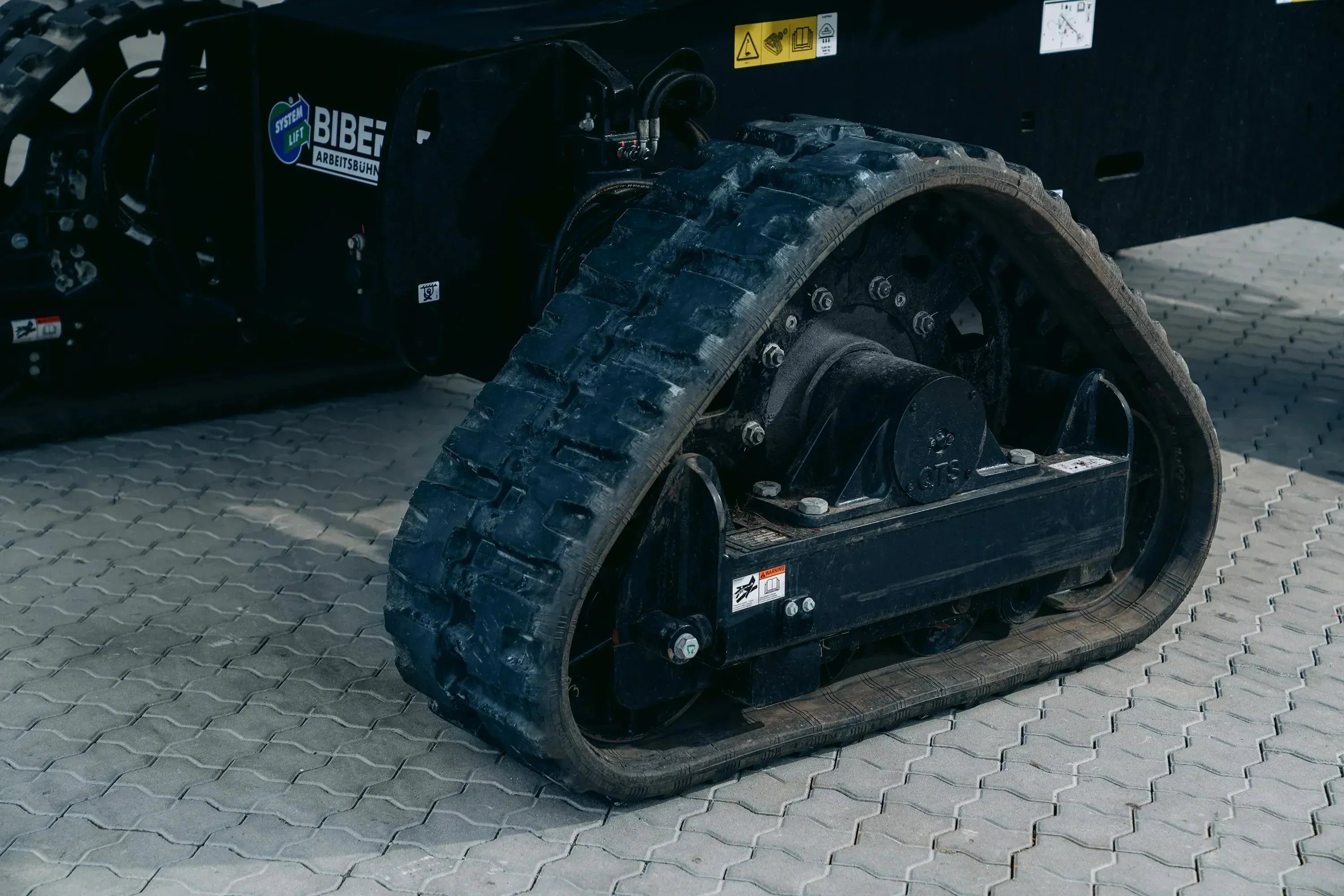
A crawler track replaces tires with revolving tracks . The large contact area distributes the weight and significantly reduces ground pressure. A drive wheel drives the track, and deflection and support rollers guide it across the track. This allows the machine to move smoothly even on poor ground.
Variants of the caterpillar
- Rubber tracks: gentle on the ground, quieter, ideal for mixed indoor/outdoor use.
- Steel chains: maximum robustness, wear-resistant in heavy earthworks and civil engineering.
- Combo/pad solutions: Steel tracks with screwed-on rubber pads for hard surfaces.
Advantages at a glance
- Traction stability: large contact area, little spinning, secure footing on slopes.
- Soil protection: low surface pressure protects lawns, paving and sub-bases.
- Off-road capability: moves forward on mud, sand, gravel and uneven terrain.
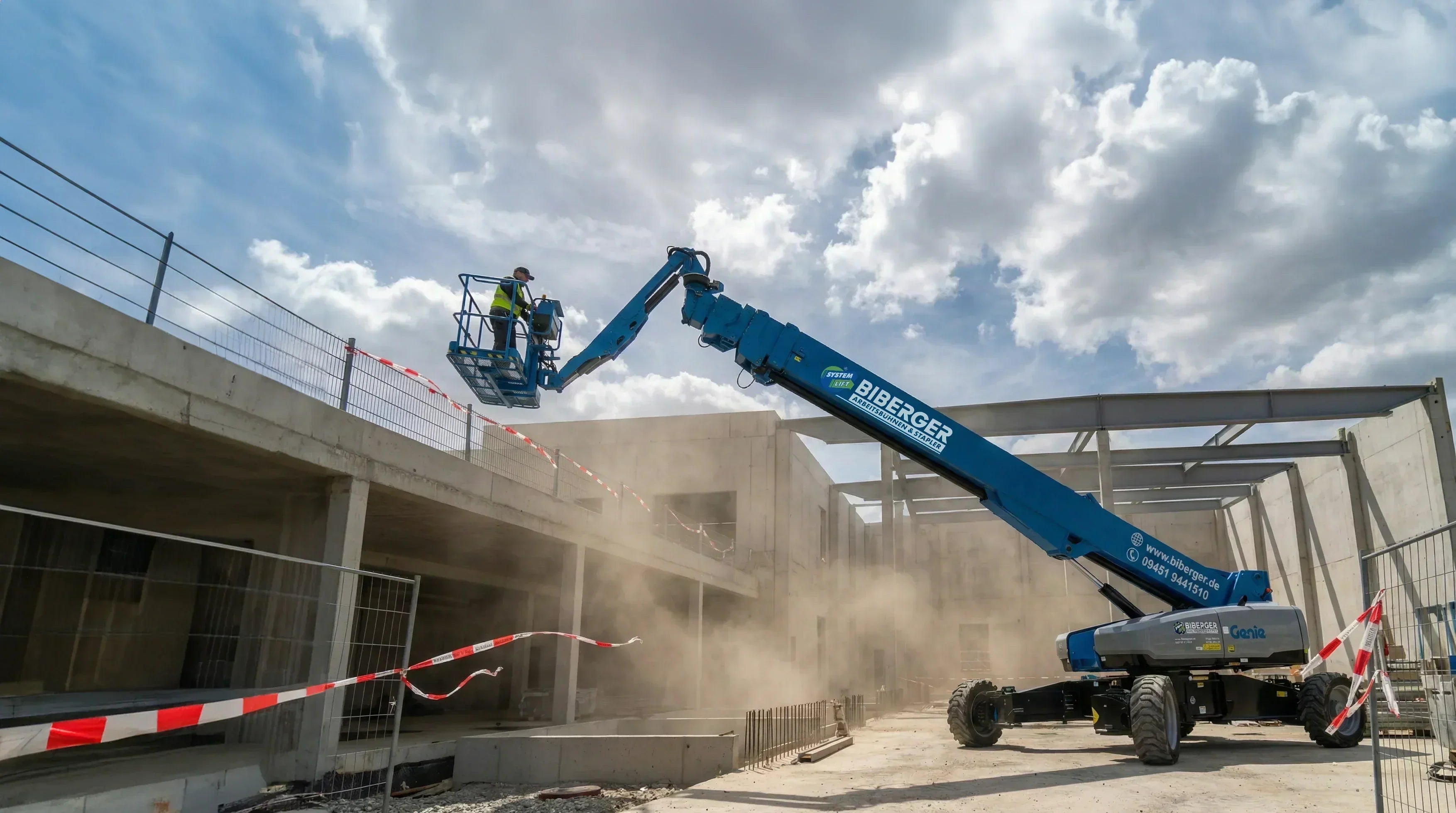
- Stability for height access: reduces tipping moments on telescopic and articulated booms.
Limitations and disadvantages
- Slower: significantly lower driving speed than wheeled chassis.
- Heavier: more weight, more complex transport, limited load-bearing capacity of floors/ramps.
- Inefficient on hard surfaces: higher wear and consumption on asphalt/concrete.
- More maintenance-intensive: Chain tension, rollers, seals and conveyor belts require care.
- Higher costs: Purchase and wear (e.g. changing rubber bands) are more expensive.
Caterpillar vs. Tire – the direct comparison
| criterion | Crawler chassis | Wheel chassis |
|---|---|---|
| Off-road traction | Very high, even on soft ground | Medium to low in mud/sand |
| Ground pressure | Low – protects the ground | Higher – occasionally stressful |
| speed | Low | High |
| Transport logistics | More complex (weight/dimensions) | Easier |
| Wear on asphalt | High | Low |
| Acquisition/operating costs | Higher | Lower |
Typical areas of application
- Civil engineering: mini excavators, crawler excavators, tracked dumpers, crawler cranes.
- Height access: spider and telescopic crawler platforms for rough terrain.
- Forestry and landscaping: Soil-friendly access to forest and park areas.
- Infrastructure: Bridge, pipeline and route construction on unpaved roads.
- Agriculture: Harvesters/tractors with tracks to reduce compaction.
Crawler work platforms – what is important
Crawler platforms combine off-road capability with safe access at height. They are compact, can be positioned in tight spaces, and require less support area than truck-mounted platforms on poor ground.
Types and key data
| type | Typical working height | Lateral reach | Basket load | drive |
|---|---|---|---|---|
| Spider stages (compact) | 13–18 m | 6–9 m | 200–230 kg | Battery/Hybrid/Combustion engine |
| Telescopic crawler platforms | 20–35 m | 10–14 m | 230–300 kg | Battery/Hybrid/Combustion engine |
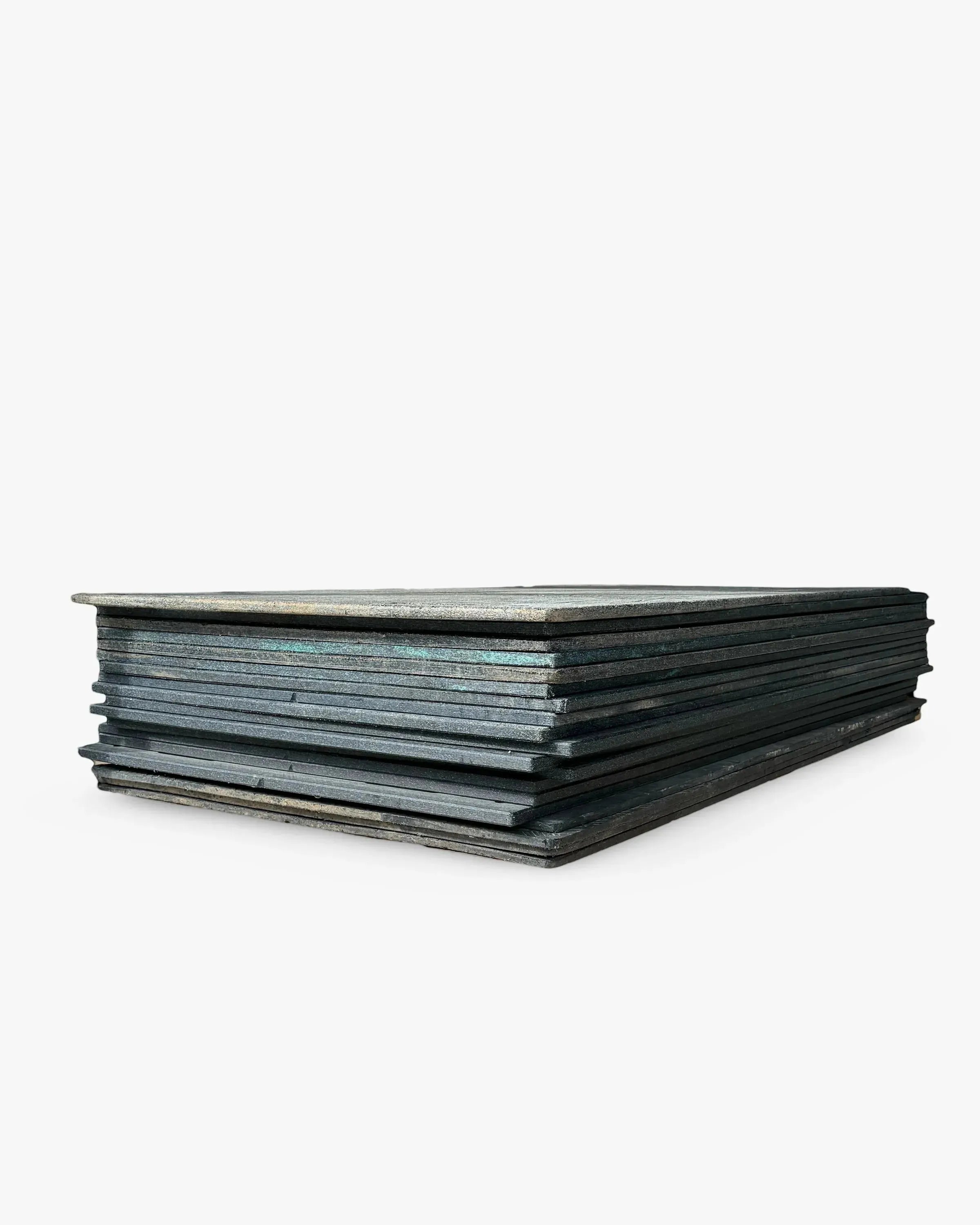
Practice: Work with load distribution plates on sensitive soils. Follow the work diagram, observe wind limits, and do not exceed the cage load.
Selection criteria – how to make the right decision
- Surface load-bearing capacity: Soft, sensitive, sloping? Tracked. Hard and level? Wheels are often sufficient.
- Application profile: Long distances are recommended for wheels, while occasional off-road use is recommended for tracks.
- Transport weight: Does the total weight match the trailer, permit and construction site access?
- Maintenance window: Clarify availability of service, spare parts and chain belts.
- Cost/benefit: Calculate project duration, area sensitivity and failure risks.
Costs Economic Efficiency
8. Costs & Profitability
| Cost items | orientation | Notice |
|---|---|---|
| Purchase of compact crawler platform | from ~40,000 € | Equipment, working height and drive influence the price |
| Purchase >30 m working height | up to ~200,000 € | Range, basket load, hybrid technology increase costs |
| Rent a crawler scissor lift | from ~190 €/day | Compact devices for indoor/outdoor use, floor-friendly |
| Rent a spider crawler platform | from ~200 €/day | Flexible boom, access even in hard-to-reach places |
| Leasing/hire purchase | from ~600 €/month | Term, down payment, residual value vary |
| Rubber band replacement | ~5,000–10,000 € per ~2,000 units | including assembly; depends on width/length |
| UVV & Maintenance | yearly | Inspection, lubrication, oil change, wear parts |
Maintenance operation – that counts in everyday life
- Check chain tension: too loose = jump/hit, too tight = roller damage.
- Rollers and guides: check for wear, running noise, and burrs.
- Cleaning: Remove mud/gravel from the undercarriage and teeth to reduce wear.
- Lubrication: Grease pivot points and chassis bearings as per specifications.
- Floor protection: work with mats/plates on sensitive surfaces.
Safety and logistics information
- Transport: Use lashing points, observe ramp angles, check axle loads.
- Standing location: create a stable, level surface; ensure load distribution.
- Slopes: Observe manufacturer's limits; avoid turning on slopes.
- Working diagram: Observe range and wind limits, do not exceed basket load.
Conclusion
Crawler tracks are unbeatable in terms of off-road capability and soil protection. For tough, long, and fast journeys, wheels remain the advantage. Your application profile is crucial: terrain, paths, height, load, and logistics. If you tell us your specific requirements, we'll find the right solution—crawler or wheeled, without compromising on safety and efficiency.



Share:
Understanding lifting height: How to choose the right device
Forklift sideshift: functions, advantages, prices, maintenance
Our editorial quality standards
The subject content on biberger.de are editorially created, reviewed, and continuously updated. The basis is our daily work with aerial platforms, telehandlers, and industrial trucks – in rental, sales, operational planning, and technical support.
Each article draws on real-world experience and is editorially reviewed for clarity, accuracy, and practical relevance according to expert criteria. Technical statements are regularly compared against current industry standards and best practices.
The aim of our publications is to make reliable specialist knowledge accessible and to offer guidance to users, decision-makers and industry partners. BIBERGER sees itself as an independent information platform for safe, economical and modern height access technology – well-founded, comprehensible and free from advertising influence.