Reading now: Stage V engines: What does the emissions standard mean for the construction industry?
Zusammenfassung What You Need to Know

Stage V is currently the strictest emissions standard for diesel-powered machines – and applies to all new work platforms and forklifts.Among other things, it requires diesel particulate filters and AdBlue use, which leads tohigher acquisition costs, more complex technology and more maintenance effortleads.

More and more companies are therefore opting for rental or even electric and hybrid models.They areemission-free, low-maintenance and often cheaper to operate– ideal for inner-city areas and sensitive locations. Those who continue to use diesel must prepare for strict regulations and rising operating costs.

Zusammenfassung What You Need to Know

Stage V is currently the strictest emissions standard for diesel-powered machines – and applies to all new work platforms and forklifts.Among other things, it requires diesel particulate filters and AdBlue use, which leads tohigher acquisition costs, more complex technology and more maintenance effortleads.

More and more companies are therefore opting for rental or even electric and hybrid models.They areemission-free, low-maintenance and often cheaper to operate– ideal for inner-city areas and sensitive locations. Those who continue to use diesel must prepare for strict regulations and rising operating costs.

The Stage V emissions standard has been in force since 2019 and affects all diesel-powered machines in the construction and industrial sectors.

But what does this mean specifically for companies that work with aerial work platforms , forklifts , and other construction machinery? What technical changes did the new engines bring? And how did the regulations affect their use and costs?

In this article you will learn everything you need to know – explained in a compact and understandable way.

What is the Stage V emissions standard?

Stage V is currently the strictest European emissions standard for non-road mobile machinery (NRMM). It was introduced by the EU to drastically reduce emissions of nitrogen oxides (NOx), particulate matter (PM), and soot particles .

The most important innovations:

  1. Particle number (PN) limits – not only particle mass counts, but also the number of soot particles emitted.
  2. Diesel particulate filter (DPF) mandatory – exhaust gas aftertreatment is now required for many engine classes.
  3. Applies to all engine sizes – from the smallest machines to heavy cranes and excavators.
  4. Hybrid and electric technologies are on the rise – because diesel engines are becoming more complex and expensive.

The regulations apply to both new machines and retrofits for existing fleets.

Impact on work platforms & forklifts

The Stage V standard is particularly noticeable for aerial work platforms and forklifts. Diesel-powered models now require more complex exhaust emission control systems, which impacts purchase, rental, and maintenance costs.

Stage V engine: higher acquisition costs & more complex technology

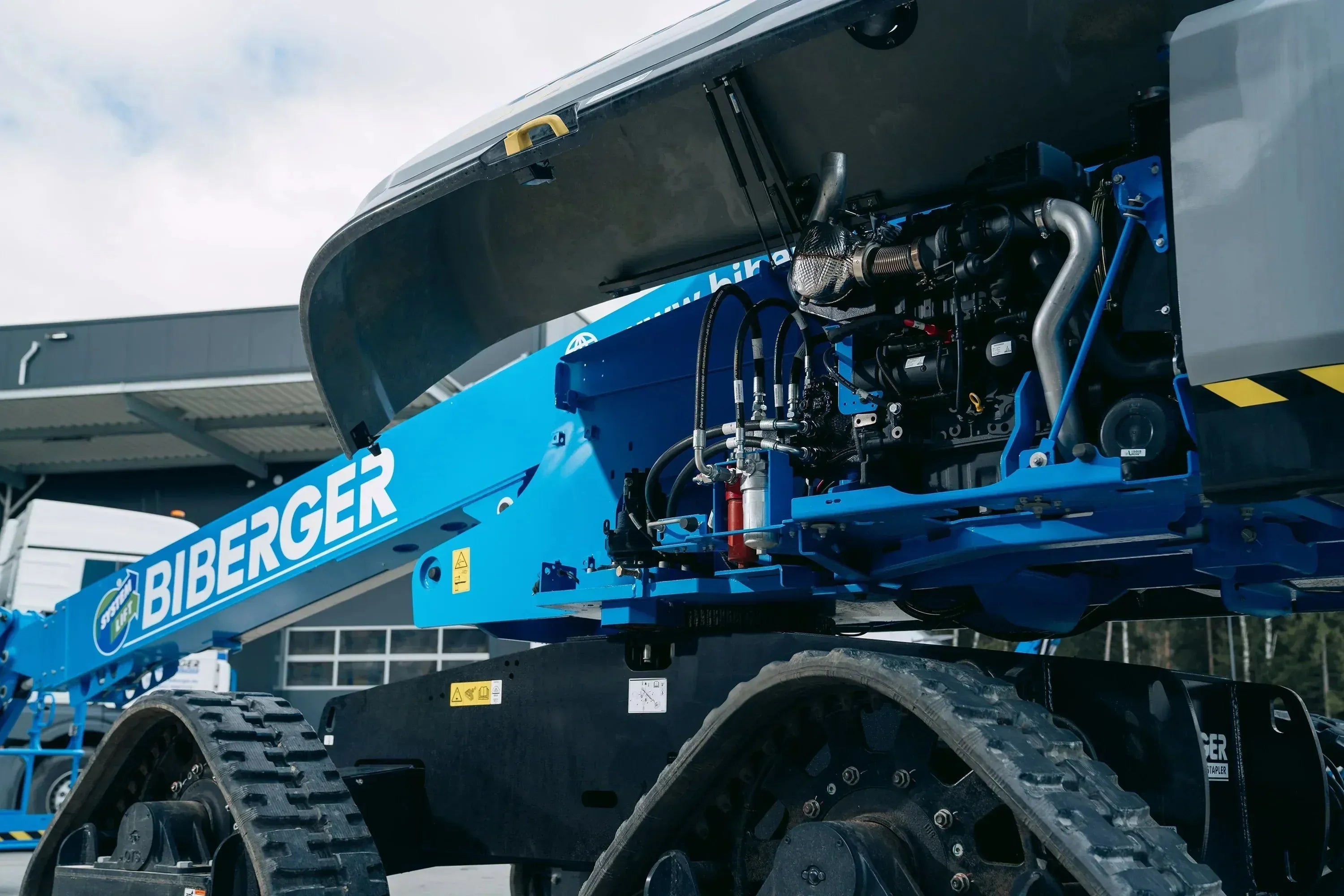
Due to the requirement for exhaust aftertreatment, Stage V engines are more expensive and require:

  • AdBlue additives for nitrogen oxide reduction (SCR technology).
  • Diesel particulate filter (DPF) for soot separation.
  • Regeneration cycles to keep the filters free of deposits.

More space, higher weight - less emissions

Aerial platforms and forklifts with Stage V engines require more space for the additional technology, resulting in larger machines and higher dead weight. This can complicate transport logistics and operation on sensitive surfaces.

Trend towards alternative drives

Since Stage V diesel machines are more expensive and require more maintenance, more and more manufacturers are turning to electric and hybrid drives . The range of emission-free models is growing, especially for scissor lifts, articulated boom lifts, and warehouse forklifts .

Impact on operations and costs

The stricter regulations have not only technical but also economic consequences.

Maintenance & operating costs increase

  • AdBlue refilling becomes mandatory and incurs ongoing costs.
  • Regeneration of the diesel particulate filter can lead to downtime.
  • Repairs to complex exhaust gas purification systems are more expensive than for older engines.

Rent instead of buy?

Since new diesel machines are more expensive, many companies prefer to rent Stage V compliant machines rather than incur high purchase costs.

Future of the construction industry: Is diesel coming to an end soon?

Stage V is a further step toward emission-free construction sites. Experts expect that diesel in small and medium-sized machines will soon be replaced by electric, hydrogen, or hybrid drives .

The development at a glance

  • Short term: Diesel remains important, but with high requirements.
  • Medium term: Hybrid models gain market share.
  • Long term: Electric drives are becoming established in many areas.

Some cities and construction site operators are already opting for zero-emission zones , where only electric machines are permitted.

Conclusion: What does Stage V mean to you?

The Stage V emissions standard had far-reaching consequences for the construction industry:

  1. More expensive diesel engines due to exhaust aftertreatment.
  2. Maintenance costs increase due to new technology.
  3. Alternatives such as electric and hybrid models are becoming more attractive.
  4. For many companies, renting is becoming more economically viable than buying.

Those who continue to rely on diesel must prepare for higher costs and new regulations. At the same time, Stage V opens up new opportunities for sustainable, future-proof drive systems .

Choosing the right machines is therefore becoming increasingly important – and we at BIBERGER are happy to help you find the best solution for your requirements.

Rectangle_1 - BIBERGER
About the author

Martin Biberger

Managing Director

Martin is the founder and managing director of BIBERGER Arbeitsbühnen & Forklifts.

He is responsible for thetechnical areaTogether with his team, he is responsible for thetechnical purchasingthe machines thatFurther development of the machine inventoryand the smooth operation of over 1,500 BIBERGER rental devices.

From many years of experience he knows theStrengths and weaknesses of all device classes, the possibleAreas of applicationand thetechnical possibilities– always with a view to theDevelopment of the entire industryand future innovations.

Our editorial quality standards

The subject content on biberger.de are editorially created, reviewed, and continuously updated. The basis is our daily work with aerial platforms, telehandlers, and industrial trucks – in rental, sales, operational planning, and technical support.

Each article draws on real-world experience and is editorially reviewed for clarity, accuracy, and practical relevance according to expert criteria. Technical statements are regularly compared against current industry standards and best practices.

The aim of our publications is to make reliable specialist knowledge accessible and to offer guidance to users, decision-makers and industry partners. BIBERGER sees itself as an independent information platform for safe, economical and modern height access technology – well-founded, comprehensible and free from advertising influence.

Leave a comment

Please note, comments need to be approved before they are published.

This site is protected by hCaptcha and the hCaptcha Privacy Policy and Terms of Service apply.

Relevant topics

View all

Typische Planungsfehler beim ersten Einsatz von Arbeitsbühnen – und wie du sie vermeidest - BIBERGER

Typical planning mistakes when using aerial work platforms for the first time – and how to avoid them.

Introduction Why errors occur even before deployment The safe operation of a work platform begins long before the basket lifts off. Mistakes don't happen during the lift itself, but in the preparation: assessing the ground conditions, selecting the right equipment,...

Read more

Wind und Arbeitsbühnen: Was Du für einen sicheren Einsatz unbedingt wissen musst - BIBERGER

Wind and aerial work platforms: What you absolutely need to know for safe use

Key problem: Why wind loads are so often underestimated Wind load is one of the most underestimated risks when using aerial work platforms. At ground level, wind force 6, with 12.5 m/s or around 45 km/h, often seems relatively harmless....

Read more

Arbeitsbühnen weltweit: Der internationale Vergleich von Märkten, Herstellern & Kosten - BIBERGER

Aerial work platforms worldwide: An international comparison of markets, manufacturers & costs

Aerial work platforms are indispensable on almost every construction site and in many industries. However, although the basic technology is similar worldwide, markets differ significantly in terms of regulation, manufacturing landscape, pace of innovation, and typical application profiles. Understanding international...

Read more

Arbeitsbühne Privat mieten – Was ist erlaubt? - BIBERGER

Renting a work platform as a private individual – What is allowed?

Aerial work platforms are primarily designed, standardized, and planned for commercial use. Typical applications include facade construction, plant and building technology, and industrial maintenance. Accordingly, equipment selection, insurance models, and rental procedures are geared primarily towards commercial users with trained...

Read more

Anschlagen von Lasten – Anschlagmittel richtig auswählen und sicher einsetzen - BIBERGER

Lifting loads – selecting and safely using lifting equipment

Safely attaching loads is one of the most demanding tasks when operating cranes , forklifts , and lifting equipment. Errors almost never occur during the lifting itself, but almost always result from misjudging the load capacity, type of attachment, or...

Read more

Staplerfahrer werden

Become a forklift driver: safely, trained and responsibly

A moment of inattention 7:15 a.m. A forklift driver begins his early shift. Routine. He only gives the forklift a cursory check – time pressure, the truck is waiting. On the third lift, the fork tine snaps at an old...

Read more

CAN-Bus und J1939-Diagnose bei Baumaschinen - BIBERGER

CAN bus and J1939 diagnostics in construction machinery

Modern construction machinery is now highly networked systems. Sensors, control units and safety modules communicate with each other constantly – and this happens via the so-called CAN bus . The CAN bus is essentially the nervous system of every modern...

Read more

Magni Diagnose-Leitfaden: Fehlermeldungen richtig deuten - BIBERGER

Magni Diagnostic Guide: How to correctly interpret error messages

If your Magni telehandler (RTH / HTH series) suddenly displays a warning, it's rarely a total breakdown. Usually, a safety or protective function is being activated. This guide explains the most important error codes, their meaning, and how to react...

Read more