Reading now: What does a work platform really cost? – TCO & Depreciation 2026 explained
Zusammenfassung What You Need to Know

If you want to realistically calculate the costs of a work platform, you have to think far beyond the rental or purchase price.The decisive factors are the actual operating costs – i.e. energy consumption, maintenance, wear and tear, insurance, residual value and depreciation afterDepreciation tableMobile stages are11 years, stationary over15 yearsOn average, work platforms run1,500 to 2,000 hours per year, with a service life of around10,000 to 12,000 hoursThese values determine what an hour of use actually costs.

Batteries, subsidies and market trends also change the calculation noticeably.A battery lasts with good care5–8 years, Regeneration saves up to80% of the replacement costs. Funding programs fromBAFA, KfW, Bavaria and NRWsignificantly reduce investments in electrical appliances. The market is clearly moving toward electric:stable residual values, lower maintenance, lower insurance premiums, but more expensive purchase and performance losses in cold weather.TCO (Total Cost of Ownership)Knowing and planning realistically avoids making wrong decisions – whether as an operator or landlord.

Zusammenfassung What You Need to Know

If you want to realistically calculate the costs of a work platform, you have to think far beyond the rental or purchase price.The decisive factors are the actual operating costs – i.e. energy consumption, maintenance, wear and tear, insurance, residual value and depreciation afterDepreciation tableMobile stages are11 years, stationary over15 yearsOn average, work platforms run1,500 to 2,000 hours per year, with a service life of around10,000 to 12,000 hoursThese values determine what an hour of use actually costs.

Batteries, subsidies and market trends also change the calculation noticeably.A battery lasts with good care5–8 years, Regeneration saves up to80% of the replacement costs. Funding programs fromBAFA, KfW, Bavaria and NRWsignificantly reduce investments in electrical appliances. The market is clearly moving toward electric:stable residual values, lower maintenance, lower insurance premiums, but more expensive purchase and performance losses in cold weather.TCO (Total Cost of Ownership)Knowing and planning realistically avoids making wrong decisions – whether as an operator or landlord.

The costs of a work platform seem simple at first glance: purchase price or rental, electricity or diesel – that's it. In practice, however, it's a different story. Anyone operating a work platform has to consider many hidden factors: energy consumption, maintenance, wear and tear, residual value, and even risks such as breakdowns or repairs. All of this influences the actual total cost per operating hour – also known as TCO (Total Cost of Ownership) .

Therefore, it's worthwhile to look beyond the pure rental or purchase prices. For operators, this means: realistic calculations protect against unpleasant surprises. For landlords, it means: factoring in risks, providing services, and avoiding disruptions. Only those who keep both in mind achieve true profitability.

Why the TCO analysis is so important

Aerial work platforms are among the core machines in many projects – whether construction, industry, or event technology. Hardly any other piece of equipment combines so many cost factors: energy consumption, tires, hydraulics, software, and safety technology. Added to this are external influences such as environmental regulations, funding programs, and infrastructure costs.

Those who fail to consider this risk making poor decisions: A seemingly inexpensive machine can quickly become expensive to operate. For renters, a total cost of ownership (TCO) analysis helps to realistically compare diesel and electric vehicles. For lessors, it provides the basis for calculating fair terms, mitigating risks, and operating their fleet economically.

Example calculations

Scissor lift with 8 m working height

Cost drivers Electricity (€/hr) Diesel (€/hr)
Energy / Fuel 8 kWh × €0.20/kWh = 1.60 2.5 L × €1.50/L = 3.75
Tire wear Smooth profile: 0.25 Profile tire: 0.40
Maintenance / Wear and Tear 2.00 3.00
Depreciation* (€20,000 – 10% RW) / 4,000 hours = 4.50 (€40,000 – 10% RW) / 4,000 hours = 9.00
Total (ongoing) €8.35/hour €16.15/hr

*RW = Residual value after 4,000 operating hours

Articulated telescopic platform with a working height of 16 m

Cost drivers Electricity (€/hr) Diesel (€/hr)
Energy / Fuel 15 kWh × €0.20/kWh = 3.00 4 L × €1.50/L = 6.00
Tire wear Smooth profile: 0.30 Profile tire: 0.60
Maintenance / Wear and Tear 5.00 6.50
Depreciation* (€55,000 – 10% RW) / 4,000 hours = 12.38 (€60,000 – 10% RW) / 4,000 hours = 13.50
Total (ongoing) €20.68/hour €26.60/hour

Realistic depreciation and amortization data

Useful life according to depreciation table

  • Mobile work platforms: 11-year service life
  • Stationary stages: 15-year service life

For multi-shift operation, a surcharge of +25% applies for double shifts and +50% for three or four shifts . More demanding operations or frequent transport may justify a shorter service life. The previously mentioned 4,000-hour baseline corresponds to approximately two years of use in practice – however, 1,500 to 2,000 hours per year are more realistic.

Practical operating hours calculation

Aerial work platforms typically have a total service life of 10,000 to 12,000 hours . After approximately 10,000 hours , repair costs increase exponentially, especially for hydraulics and electronics. Maintenance intervals are usually around 150 operating hours or every two years . Therefore, a total cost of ownership (TCO) calculation should be based on a realistic annual usage of 1,500–2,000 hours to obtain predictable figures.

Detailed Battery TCO

Lifespan and regeneration

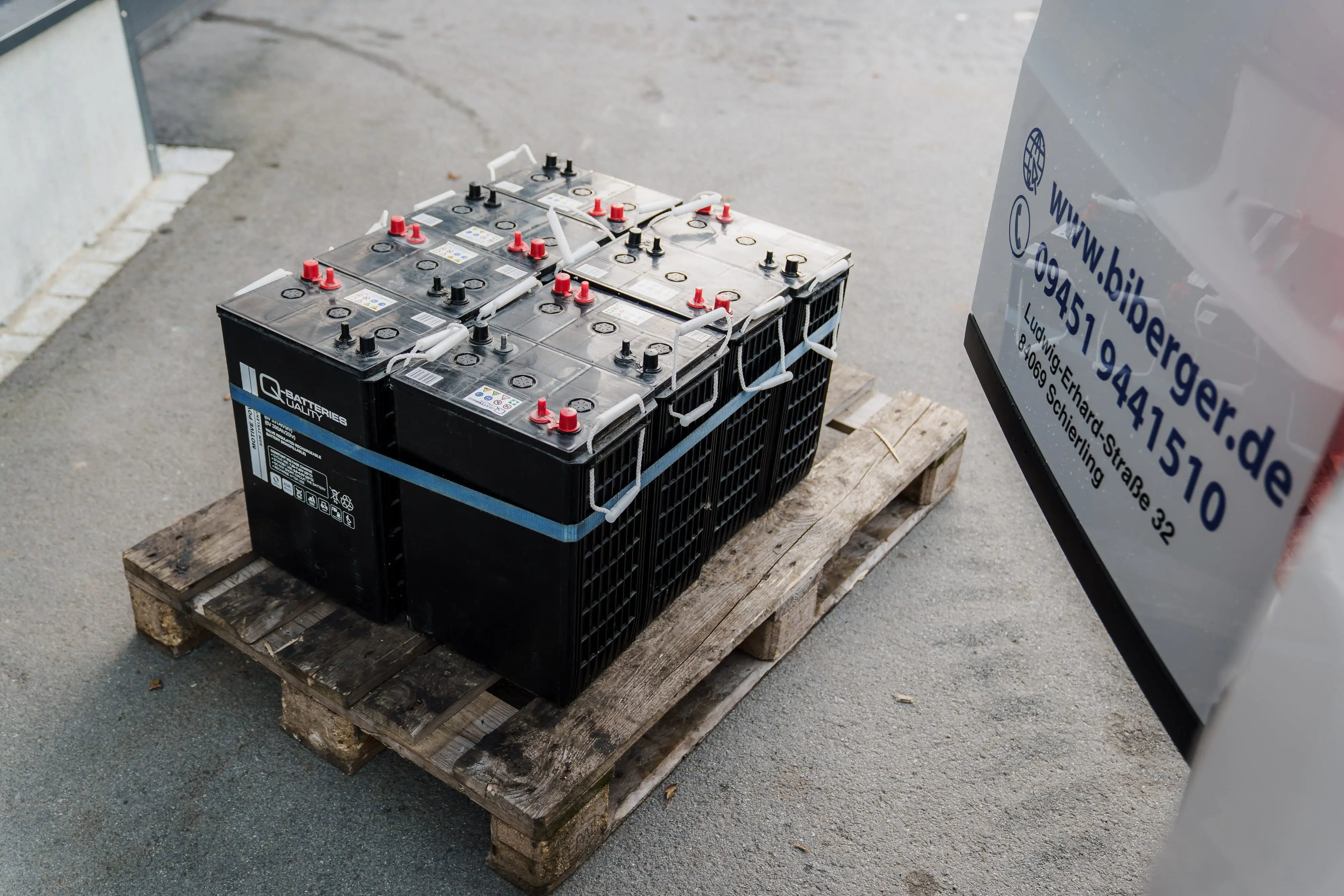
With proper maintenance, batteries have a lifespan of 5 to 8 years . Regeneration is possible for approximately 70–80% of batteries , restoring 70–95% of their original capacity . Regeneration costs between €200 and €800 , while purchasing a new battery can quickly cost €8,000–€15,000 – up to 40% of the machine's original price.

Consequence for the TCO

Regular battery maintenance (e.g., water level, charging voltage, temperature) can reduce the total cost per operating hour by up to 20% . Neglecting maintenance halves the battery's lifespan and significantly increases the total cost of ownership (TCO).

Current funding programs 2026

Bavaria

  • Charging infrastructure: Up to 50% funding for public charging points
  • E-freight transport: Promotion of non-public DC charging points

North Rhine-Westphalia (NRW)

  • progres.nrw: Up to €200,000 in funding for N2/N3 vehicles
  • Charging points: €1,500 subsidy per charging point under 50 kW

Nationwide programs

  • BAFA Module 6: 33% funding for electrification measures starting at €2,000
  • KfW 295: Climate protection initiative for companies
  • Agricultural program: Funding for electric tractors and mobile machinery

Residual value development and market trend

The market shows clear trends: Electric aerial work platforms saw a sales increase of around 3% in 2024 , while diesel models declined by about 3% . A further decline of around 3.5% is expected for 2026. This directly impacts residual value – electric equipment retains its value more stably, while diesel vehicles lose value more quickly due to environmental regulations.

Other TCO factors

  • Environmental zones: Electrical appliances can often be used without restrictions in city centers.
  • Noise protection: Between 10 pm and 6 am, often only electrical appliances are permitted.
  • Insurance: On average, electrical appliances are 5–10% cheaper to insure.
  • Service availability: For electrical appliances, the number of specialized workshops is lower – which necessitates regional planning.
  • Cold weather performance: Below 0 °C, the performance of electrical appliances can decrease by up to 30% .

Landlord's perspective: Risk mitigation is crucial

For landlords, TCO means more than just cost calculation; it means genuine risk management . Defects, incorrect operation, or unsuitable uses can quickly become expensive. Therefore, rental prices include not only energy and depreciation costs, but also reserves for repairs, insurance, and downtime.

This is an advantage for tenants: predictable costs instead of unforeseen breakdowns. The landlord takes care of maintenance, inspections, and risk mitigation – ensuring that the machine remains operational.

Practical example

A medium-sized craft business from Bavaria previously used diesel scissor lifts for indoor assembly work. After several breakdowns due to starting problems in winter and high maintenance costs, the company switched to electric lifts with a fixed charging station. The result: lower operating costs, less maintenance, and easier handling. The higher initial investment paid for itself after about two years.

Conclusion: Guidance yes – decision with consultation

Electric aerial work platforms are generally cheaper to operate, while diesel platforms are more advantageous for continuous use and outdoor applications. However, actual cost-effectiveness depends heavily on the application profile, service, and infrastructure. Total cost of ownership (TCO) tables can provide guidance, but they are no substitute for individual consultation.

Seeking advice saves money and stress in the long run: The right landlord knows the differences, realistically calculates risks and recommends the appropriate equipment for the respective use.

Benjamin_Biberger_f09df03b-780b-4e03-8991-ca3f20113b29 - BIBERGER
About the author

Benjamin Biberger

Managing Director

Benjamin is the founder and managing director of BIBERGER Arbeitsbühnen & Forklifts.

He is responsible for thecommercial and administrative areasof the company and, together with his team, ensures theOptimization of operational processesand theoptimal customer supportin their projects.

Through his many years of experience in the areas of organization andProject managementIt provides a stable foundation – in its own daily business, in sustainableFurther development of processesas well as in theCollaboration with partners and customers.

Our editorial quality standards

The subject content on biberger.de are editorially created, reviewed, and continuously updated. The basis is our daily work with aerial platforms, telehandlers, and industrial trucks – in rental, sales, operational planning, and technical support.

Each article draws on real-world experience and is editorially reviewed for clarity, accuracy, and practical relevance according to expert criteria. Technical statements are regularly compared against current industry standards and best practices.

The aim of our publications is to make reliable specialist knowledge accessible and to offer guidance to users, decision-makers and industry partners. BIBERGER sees itself as an independent information platform for safe, economical and modern height access technology – well-founded, comprehensible and free from advertising influence.

Leave a comment

Please note, comments need to be approved before they are published.

This site is protected by hCaptcha and the hCaptcha Privacy Policy and Terms of Service apply.

FAQ

Is AfA the same as depreciation?

Yes, in principle. "Depreciation" is the tax term for depreciation. Both describe the loss in value of an asset over the years.

How does depreciation work for work platforms?

The acquisition price is spread over the useful life. Example: A stage costs €22,000, useful life 11 years → annual depreciation = €2,000.

How long does it take to depreciate work platforms?

Depending on the type:mobile stages 11 years,inpatient 15 yearsIn multi-shift operation, the service life can be25–50% shortenedbecome.

Which depreciation table applies to work platforms?

The decisive factor isDepreciation table for general purpose fixed assetsof the Federal Ministry of Finance. Work platforms and lifting equipment are explicitly listed there.

What depreciation applies to rentals?

For commercially rented work platforms, the same depreciation applies as for self-operated platforms – i.e.11 or 15 years. Use by customers does not change the taxable useful life.

How do I find the appropriate depreciation table?

The official depreciation table is available on the website of theFederal Ministry of Finance (BMF)It provides a clear list of all fixed assets and their respective useful lives.

What does depreciation mean for the TCO calculation?

Depreciation determines how quickly a work platform wears out for tax purposes. A realistic depreciation basis is crucial tothe real cost per hour (TCO)to calculate correctly.

What is TCO?

TCO stands forTotal Cost of Ownership– so theTotal costs of a work tool over its entire life cycleThis includes not only the purchase or rental price, but alsoEnergy consumption, maintenance, wear and tear, insurance, financing, residual value and downtime costsThe TCO shows what a work platform or forklift really costs per hour or per year – not just on paper, but in practice.

How do you calculate the TCO?

The TCO is calculated from the sum of all ongoing and fixed costs, spread over the operating period. A simplified formula is:

TCO = (purchase price – residual value) / useful life + energy + maintenance + insurance + other costs per hour
Example:

An electric scissor lift costs €20,000, residual value 10%, useful life 4,000 hours.

→ Depreciation: (€20,000 – €2,000) / 4,000 hours = €4.50/hour

  • Energy (1.60 €) + Maintenance (2.00 €) + Wear (0.25 €) =€8.35/hour actual operating costs (TCO).

The TCO therefore showswhich machine is really cheaper in the long termis – regardless of the purchase price.

Relevant topics

View all

Höhenzugang auf Großflächen: So planst du Geräte, Logistik und Abläufe ohne Leerlauf

Accessing large areas at height: How to plan equipment, logistics and processes without downtime

What large-scale advertising is really about On large forecourts and long facades, you don't lose time at height, but on the ground. Repositioning, waiting times for transport, incorrect equipment width, restricted areas – all of that eats up hours. The...

Read more

DGUV 308-008, SYSTEM-CARD® oder IPAF: Welche Hubarbeitsbühnen-Schulung braucht dein Team wirklich?

DGUV 308-008, SYSTEM-CARD® or IPAF: Which mobile elevating work platform training does your team really need?

In Germany, several relevant training systems for mobile elevating work platform operators exist in practice: the DGUV principle 308-008 as the employers' liability insurance association basis, the SYSTEM-CARD® based on it as an association-organized quality system, and the international IPAF...

Read more

Typische Planungsfehler beim ersten Einsatz von Arbeitsbühnen – und wie du sie vermeidest - BIBERGER

Typical planning mistakes when using aerial work platforms for the first time – and how to avoid them.

Introduction Why errors occur even before deployment The safe operation of a work platform begins long before the basket lifts off. Mistakes don't happen during the lift itself, but in the preparation: assessing the ground conditions, selecting the right equipment,...

Read more

Wind und Arbeitsbühnen: Was Du für einen sicheren Einsatz unbedingt wissen musst - BIBERGER

Wind and aerial work platforms: What you absolutely need to know for safe use

Key problem: Why wind loads are so often underestimated Wind load is one of the most underestimated risks when using aerial work platforms. At ground level, wind force 6, with 12.5 m/s or around 45 km/h, often seems relatively harmless....

Read more

Arbeitsbühnen weltweit: Der internationale Vergleich von Märkten, Herstellern & Kosten - BIBERGER

Aerial work platforms worldwide: An international comparison of markets, manufacturers & costs

Aerial work platforms are indispensable on almost every construction site and in many industries. However, although the basic technology is similar worldwide, markets differ significantly in terms of regulation, manufacturing landscape, pace of innovation, and typical application profiles. Understanding international...

Read more

Arbeitsbühne Privat mieten – Was ist erlaubt? - BIBERGER

Renting a work platform for private use – what is allowed?

Aerial work platforms are primarily designed, standardized, and planned for commercial use. Typical applications include facade construction, plant and building technology, and industrial maintenance. Accordingly, equipment selection, insurance models, and rental procedures are geared primarily towards commercial users with trained...

Read more

Anschlagen von Lasten – Anschlagmittel richtig auswählen und sicher einsetzen - BIBERGER

Lifting loads – selecting and safely using lifting equipment

Safely attaching loads is one of the most demanding tasks when operating cranes , forklifts , and lifting equipment. Errors almost never occur during the lifting itself, but almost always result from misjudging the load capacity, type of attachment, or...

Read more

Staplerfahrer werden

Become a forklift driver: safely, trained and responsibly

A moment of inattention 7:15 a.m. A forklift driver begins his early shift. Routine. He only gives the forklift a cursory check – time pressure, the truck is waiting. On the third lift, the fork tine snaps at an old...

Read more