Reading now: Oktoberfest Munich: How to set up and dismantle with machines in 2025

The Oktoberfest in Munich is the largest folk festival in the world. It attracts millions of visitors every year – and requires enormous logistical efforts in advance. Setting up and dismantling the tents, rides, and supply systems would be unthinkable without modern machinery such as forklifts , rotating telehandlers , cranes, and work platforms .

In this guide, you'll learn how the setup works, which machines are used when, and why nothing works without efficient coordination.

How does the Oktoberfest get set up?

Construction begins in July , more than two months before the opening ceremony. First, the basic structures of the festival tents and halls are built, followed by interior work, rides, and infrastructure. Everything is ready for the opening in September .

Machines that can be used flexibly and work precisely are indispensable – from beer tent halls to Ferris wheels.

Machines at a glance

The following table shows which machines are particularly important in the individual construction phases and what tasks they perform.

Construction phase Machines used Tasks
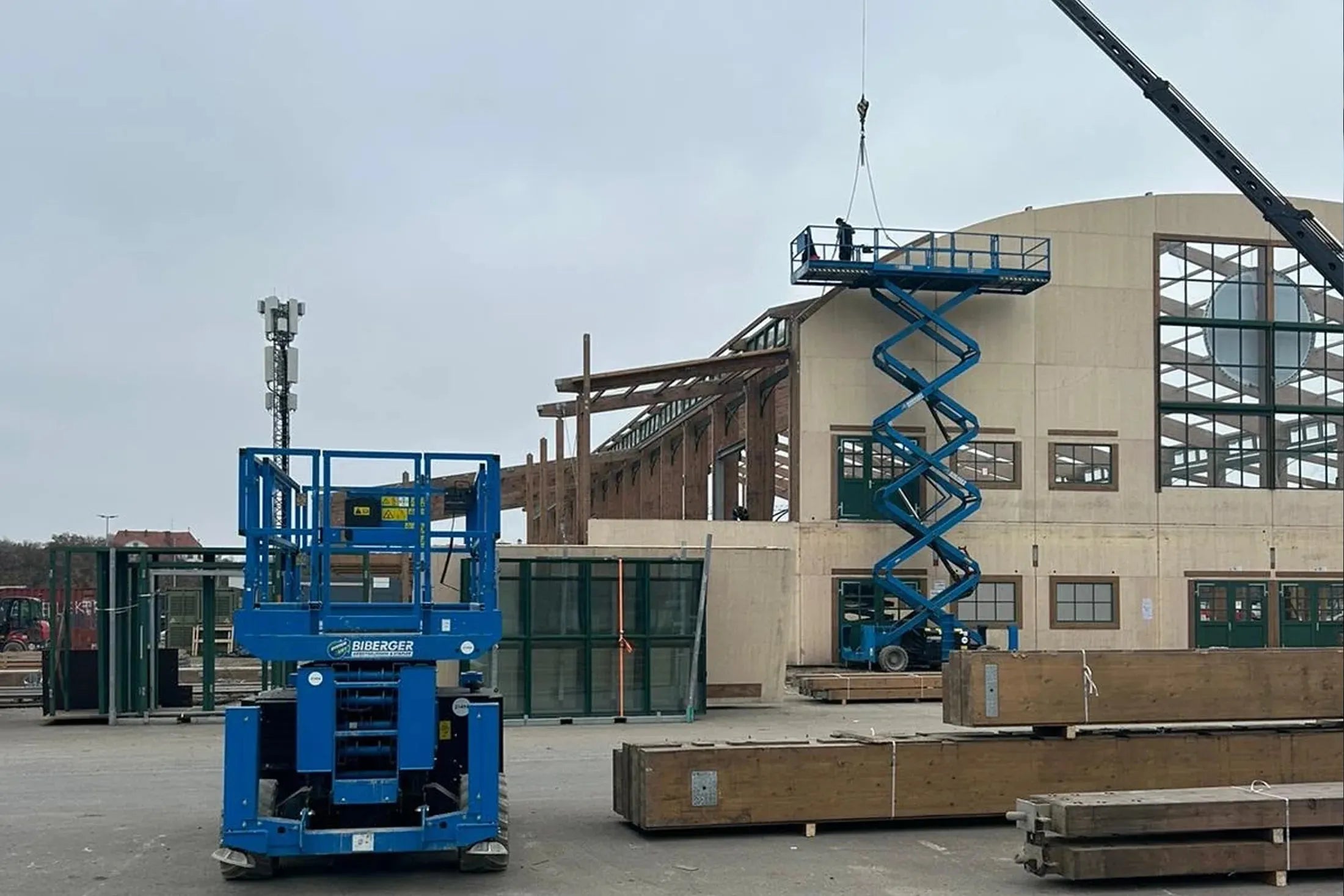
Marquees Cranes, telehandlers, work platforms Lifting roof structures, positioning supports, assembly work at height
rides Forklifts, roto stackers, special cranes Transport of heavy parts, precise lifting of carousels and Ferris wheel components
Infrastructure Forklifts, lifting platforms Laying of cables, construction of supply systems, transport of materials
Finishing work in September Work platforms, cherry pickers Decoration, interior fittings, final assembly at height
Dismantling in November Cranes, forklifts, work platforms Dismantling of tent structures, return of rides, clearing of the site
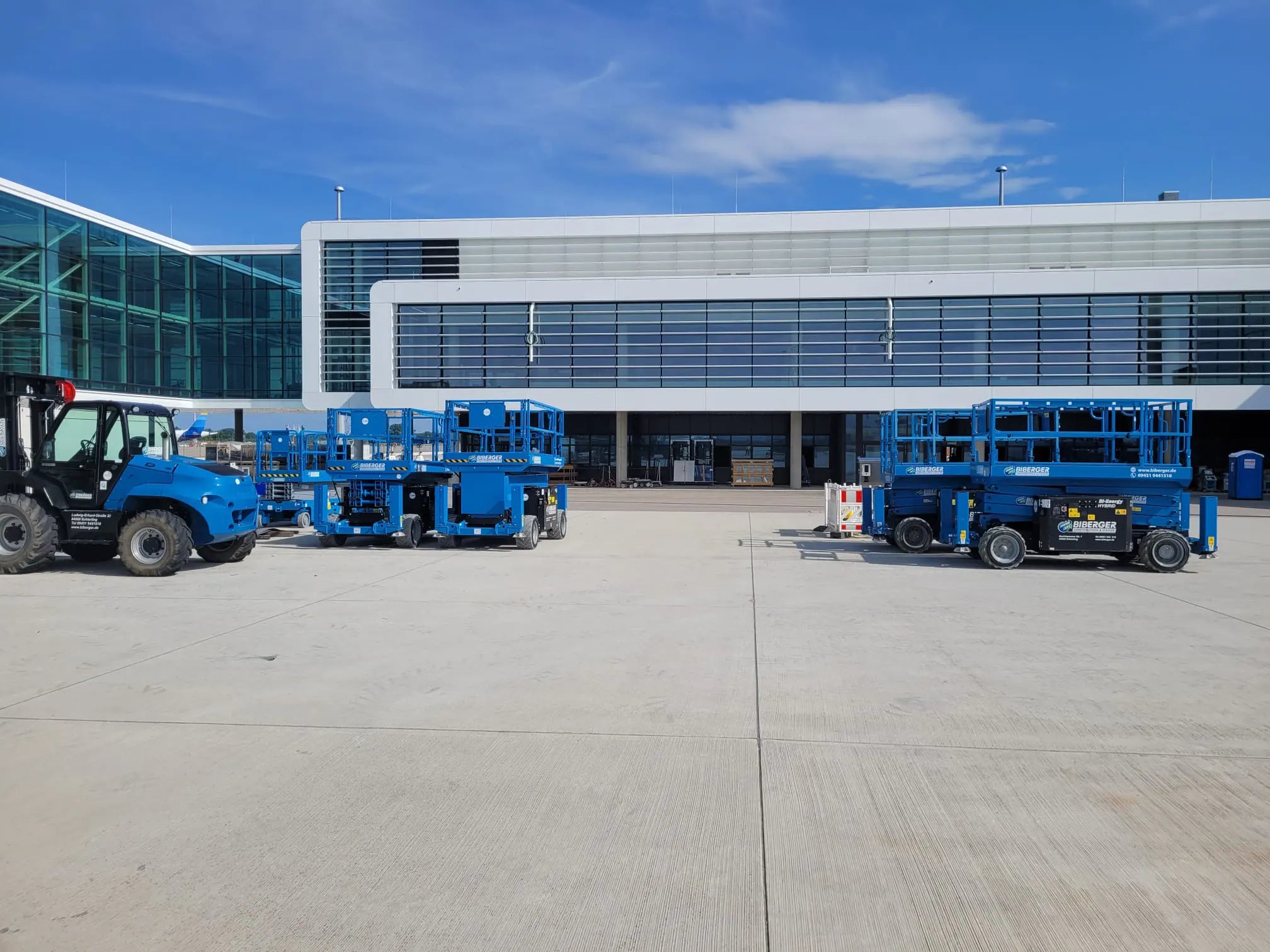
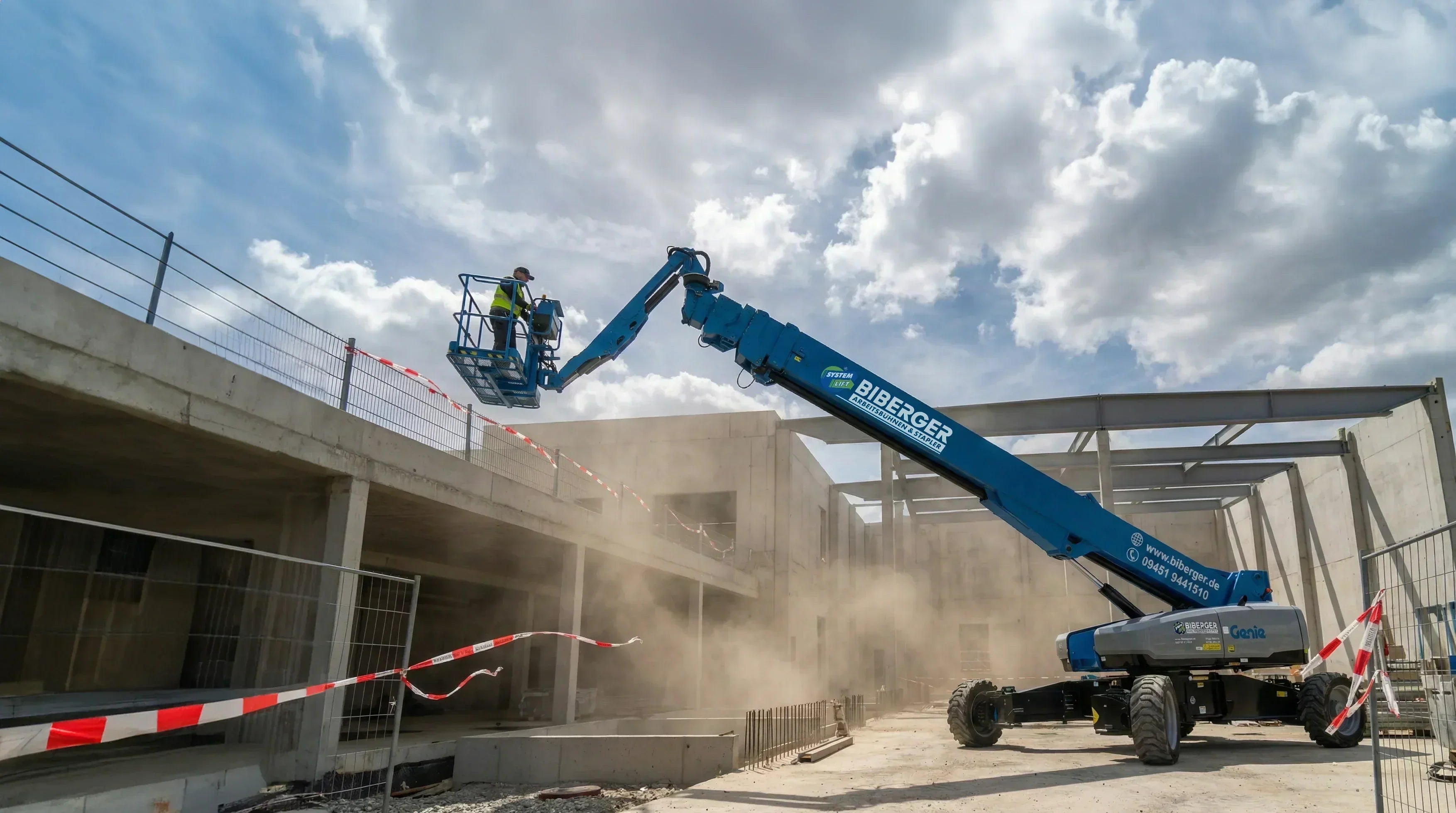
BIBERGRE telehandlers at the Oktoberfest 2024

Safety is our top priority

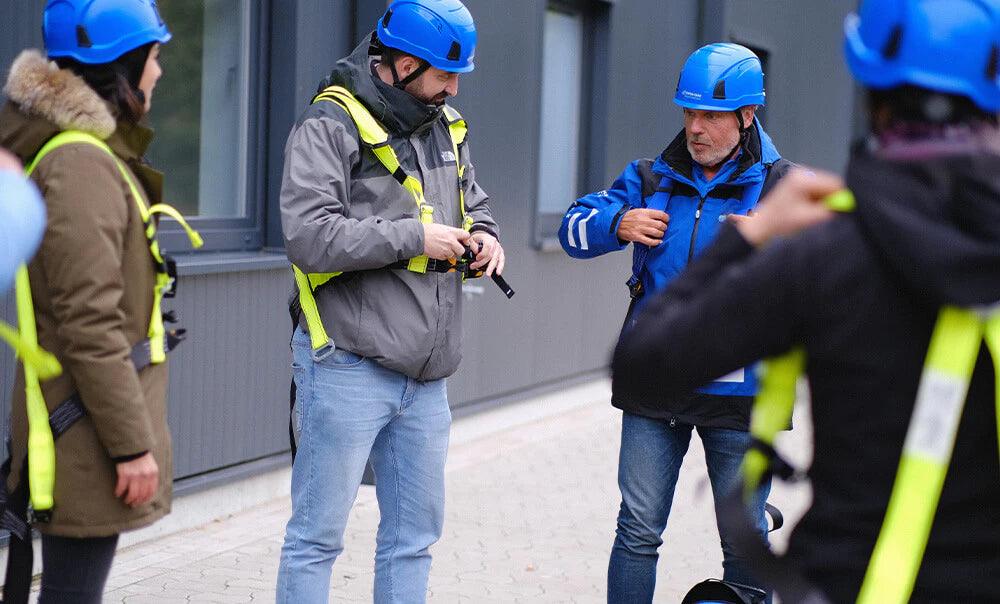
During setup and dismantling, large areas of Theresienwiese will be closed off. This is the only way to safely move heavy loads and work at heights. Machinery such as work platforms are indispensable because they allow safe access to hard-to-reach areas.

All machines must be inspected regularly, and operators require trained certificates . BIBERGER also offers on-site training in this area.

Dismantling and demolition: everything under time pressure

Immediately after the last day of the Oktoberfest, the dismantling process begins. Cranes lower steel and roof structures, forklifts transport materials, and work platforms secure the work at dizzying heights. Everything has to happen quickly so that the Theresienwiese can be used by the city again in just a few weeks.

Many showmen rely on BIBERGER's digital access control system . It protects machines from unauthorized use and keeps equipment ready for use at all times – a decisive advantage during dismantling.

Conclusion: No Oktoberfest without machines

Whether it's beer tents, the Ferris wheel, or infrastructure, Oktoberfest wouldn't be possible without forklifts, cranes, and work platforms . They ensure efficiency, safety, and punctuality – and ensure that the Wiesn can open in September every year.

With BIBERGER, showmen and event organizers have a reliable partner for rental equipment, training, and digital solutions at their side.

Benjamin_Biberger_f09df03b-780b-4e03-8991-ca3f20113b29 - BIBERGER
About the author

Benjamin Biberger

Managing Director

Benjamin is the founder and managing director of BIBERGER Arbeitsbühnen & Forklifts.

He is responsible for thecommercial and administrative areasof the company and, together with his team, ensures theOptimization of operational processesand theoptimal customer supportin their projects.

Through his many years of experience in the areas of organization andProject managementIt provides a stable foundation – in its own daily business, in sustainableFurther development of processesas well as in theCollaboration with partners and customers.

Our editorial quality standards

The subject content on biberger.de are editorially created, reviewed, and continuously updated. The basis is our daily work with aerial platforms, telehandlers, and industrial trucks – in rental, sales, operational planning, and technical support.

Each article draws on real-world experience and is editorially reviewed for clarity, accuracy, and practical relevance according to expert criteria. Technical statements are regularly compared against current industry standards and best practices.

The aim of our publications is to make reliable specialist knowledge accessible and to offer guidance to users, decision-makers and industry partners. BIBERGER sees itself as an independent information platform for safe, economical and modern height access technology – well-founded, comprehensible and free from advertising influence.

Leave a comment

Please note, comments need to be approved before they are published.

This site is protected by hCaptcha and the hCaptcha Privacy Policy and Terms of Service apply.

Relevant topics

View all

Höhenzugang auf Großflächen: So planst du Geräte, Logistik und Abläufe ohne Leerlauf

Accessing large areas at height: How to plan equipment, logistics and processes without downtime

What large-scale advertising is really about On large forecourts and long facades, you don't lose time at height, but on the ground. Repositioning, waiting times for transport, incorrect equipment width, restricted areas – all of that eats up hours. The...

Read more

DGUV 308-008, SYSTEM-CARD® oder IPAF: Welche Hubarbeitsbühnen-Schulung braucht dein Team wirklich?

DGUV 308-008, SYSTEM-CARD® or IPAF: Which mobile elevating work platform training does your team really need?

In Germany, several relevant training systems for mobile elevating work platform operators exist in practice: the DGUV principle 308-008 as the employers' liability insurance association basis, the SYSTEM-CARD® based on it as an association-organized quality system, and the international IPAF...

Read more

Typische Planungsfehler beim ersten Einsatz von Arbeitsbühnen – und wie du sie vermeidest - BIBERGER

Typical planning mistakes when using aerial work platforms for the first time – and how to avoid them.

Introduction Why errors occur even before deployment The safe operation of a work platform begins long before the basket lifts off. Mistakes don't happen during the lift itself, but in the preparation: assessing the ground conditions, selecting the right equipment,...

Read more

Wind und Arbeitsbühnen: Was Du für einen sicheren Einsatz unbedingt wissen musst - BIBERGER

Wind and aerial work platforms: What you absolutely need to know for safe use

Key problem: Why wind loads are so often underestimated Wind load is one of the most underestimated risks when using aerial work platforms. At ground level, wind force 6, with 12.5 m/s or around 45 km/h, often seems relatively harmless....

Read more

Arbeitsbühnen weltweit: Der internationale Vergleich von Märkten, Herstellern & Kosten - BIBERGER

Aerial work platforms worldwide: An international comparison of markets, manufacturers & costs

Aerial work platforms are indispensable on almost every construction site and in many industries. However, although the basic technology is similar worldwide, markets differ significantly in terms of regulation, manufacturing landscape, pace of innovation, and typical application profiles. Understanding international...

Read more

Arbeitsbühne Privat mieten – Was ist erlaubt? - BIBERGER

Renting a work platform for private use – what is allowed?

Aerial work platforms are primarily designed, standardized, and planned for commercial use. Typical applications include facade construction, plant and building technology, and industrial maintenance. Accordingly, equipment selection, insurance models, and rental procedures are geared primarily towards commercial users with trained...

Read more

Anschlagen von Lasten – Anschlagmittel richtig auswählen und sicher einsetzen - BIBERGER

Lifting loads – selecting and safely using lifting equipment

Safely attaching loads is one of the most demanding tasks when operating cranes , forklifts , and lifting equipment. Errors almost never occur during the lifting itself, but almost always result from misjudging the load capacity, type of attachment, or...

Read more

Staplerfahrer werden

Become a forklift driver: safely, trained and responsibly

A moment of inattention 7:15 a.m. A forklift driver begins his early shift. Routine. He only gives the forklift a cursory check – time pressure, the truck is waiting. On the third lift, the fork tine snaps at an old...

Read more