


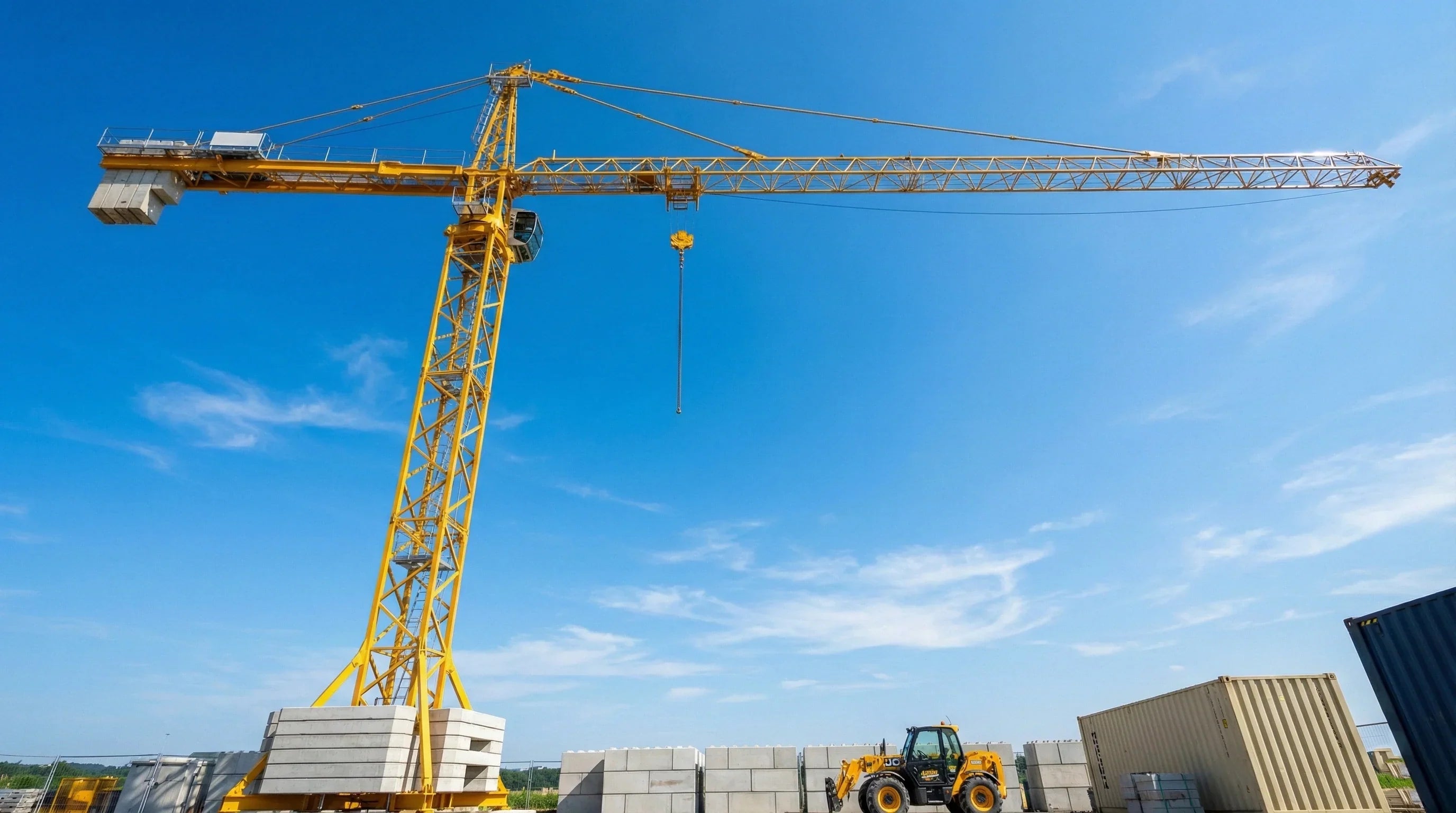
Reading now: How much load and height can a crane handle? Lifting capacity and reach of the largest cranes
Zusammenfassung What You Need to Know

A crane can only be used safely if youLoad capacity and maximum working heightHow much weight a crane can lift depends, among other things, on theBoom length, load distance and ballastThe further the load is from the pivot point, the lower the possible load-bearing capacity.Crawler cranesoffer enormous reserves – they are mobile, extremely load-bearing and reachHook heights of over 200 meters.

For smaller applications, standard mobile or tower cranes are sufficient, in large projects, however,Special cranes such as the Demag CC 8800-1 Twin or Liebherr LR 13000used – real heavyweights thatlift more than 3,000 tonsThe decisive factor is:It’s not the biggest crane that’s right for you – it’s the one that’s right for your construction site.

Zusammenfassung What You Need to Know

A crane can only be used safely if youLoad capacity and maximum working heightHow much weight a crane can lift depends, among other things, on theBoom length, load distance and ballastThe further the load is from the pivot point, the lower the possible load-bearing capacity.Crawler cranesoffer enormous reserves – they are mobile, extremely load-bearing and reachHook heights of over 200 meters.

For smaller applications, standard mobile or tower cranes are sufficient, in large projects, however,Special cranes such as the Demag CC 8800-1 Twin or Liebherr LR 13000used – real heavyweights thatlift more than 3,000 tonsThe decisive factor is:It’s not the biggest crane that’s right for you – it’s the one that’s right for your construction site.

A crane impresses with its sheer power – but what it can actually do is crucial: How much load can it lift? At what height does it remain stable? These questions are central to any construction site planning – from the assembly of a wind turbine to the construction of bridges, industrial plants, or large-scale projects at lofty heights.

In this article, you will learn which factors limit crane performance , when standard models are sufficient – ​​and when you need the most powerful cranes in the world , from flexible mobile cranes to giant crawler cranes with twin booms .

What influences the lifting capacity of a crane?

The load capacity of a crane results from the interaction of several physical and technical parameters. The following applies: the larger the boom and the farther the load center , the lower the maximum possible load. This dependency is particularly noticeable in crawler cranes with long booms .

Typical influencing factors:

  • Crane type (e.g. mobile crane, tower crane, crawler crane, floating crane)
  • Position of the load in relation to the slewing ring
  • Ballast and counterweight system
  • Subsurface conditions on the construction site
  • Wind loads at high altitudes

The world's most powerful cranes achieve lifting capacities that could move more than 100 fully loaded trucks simultaneously – sometimes over a distance of 200 meters . Giants such as the Demag CC 8800-1 Twin or the Liebherr LR 13000 are among the world's best and are primarily used in the construction of refineries, power plants, or offshore facilities.

How high can a crane actually work?

The working height of a crane is closely linked to the boom system. With telescopic booms or lattice boom extensions, modern crawler cranes can reach hook heights of over 200 meters —sometimes higher than the world's tallest church steeple , Ulm Minster , at 162 meters.

However, not every crane is built for such heights. In practice, the following crane types are used:

  • Tower cranes on inner-city construction sites or high-rise buildings
  • Crawler cranes with special booms for wind power projects
  • Mobile cranes for flexible applications with limited space requirements
  • Floating cranes in port facilities and on offshore construction sites

The world's tallest crawler cranes, in particular, tower above everything else – not only in terms of their height, but also in their ability to move loads far beyond the pivot point , for example when erecting wind turbines with rotor diameters of over 90 metres.

What types of cranes are there – and how do they differ?

An overview of common models

Crane type Model Manufacturer Max. load capacity Reach / lifting height Typical application area
Tower crane (luffing crane top-slewing) Potain MCR 815 (Luffing Jib) Manitowoc (Potain) 64 tons Outreach up to 70 m Major building construction projects
Mobile crane (all-terrain truck crane) Liebherr LTM 1650-8.1 Liebherr 700 tons 80 m boom (up to ~152 m lifting height) Heavy-duty lifting on construction sites
Crawler crane (tracked chassis) Liebherr LR 11000 Liebherr 1,000 tons Hook height up to 220 m Wind power and industrial development
Mobile harbor crane (gantry crane on tires) Liebherr LHM 800 Liebherr 308 tons Outreach up to 64 m Container/RoRo terminals
Container gantry crane (STS crane) Liebherr STS P167L Liebherr 65 t (twin lift) ~51 m range Container handling
Truck loading crane (knee-lift crane) Palfinger PK 200002 L SH Palfinger 40 tons 25.6 m (up to 47.9 m with fly jib) Assembly/loading inserts

These smallest and largest crane giants dominate the world

Here is your planned table with technical data of the largest and most powerful cranes in the world – including manufacturer, type, maximum load, hook height and area of ​​application.

Name/Model Crane type Max. load capacity Special features
Liebherr LR 13000 Crawler crane (chain) 3,000 tons Tallest crane in the world (246 m high)
Sarens SGC-250 “Big Carl” Heavy-duty ring crane 5,000 tons Largest land crane, rail-guided, 275 m radius
Kroll K-10000 tower crane 240 tons Freestanding 84 m hook height, comfort cab
Liebherr LTM 11200-9.1 Mobile crane (truck crane) 1,200 tons 100 m boom, 188 m lifting height
SSCV Sleipnir Floating crane (semi-submersible vessel) 20,000 tons Two 10,000-t cranes, offshore assembly
UNIC URW-095 Mini crawler crane ~1 t 0.6 m wide, fits through doors

Why crawler cranes are the first choice on large construction sites

The crawler crane is the king of construction site cranes. It combines maximum lifting capacity with high off-road mobility . Crawler cranes demonstrate their advantages particularly on unpaved surfaces or long travel distances – for example, during the construction of wind farms or industrial facilities .

Powerful brands like Liebherr and Terex Demag supply cranes like the LR 11000 , the CC 8800-1 Twin , and the world's most powerful: the Liebherr LR 13000. These machines tower over entire cityscapes and, with hook heights of over 230 meters , are among the top five largest cranes in the world .

Also particularly impressive: the Hyundai Samho crane from South Korea – a semi-submersible floating crane that can lift more than 14,000 tons . For comparison: That's equivalent to the weight of over 100 semi-trailer trucks .

Crane selection is a project decision – not a gut decision

When choosing a crane, it's less about superlatives and more about the specific needs . A smaller mobile crane with a short setup time can be more cost-effective than a huge crawler crane if only specific lifting operations are required. Conversely, for complex industrial projects, cranes with modular boom systems and extreme lifting capacities are usually used – because every centimeter of reach and every additional ton determines the success or delay of a project.

Conclusion: The world’s largest cranes are fascinating – but the right choice counts

Whether Demag CC , Liebherr Twin , tower crane , or world-class crawler crane – the variety of cranes is enormous. However, only precise knowledge of load limits and lifting heights makes for reliable planning. Choosing cranes based on technical requirements rather than superlatives saves time, money, and risk.

Rectangle_1 - BIBERGER
About the author

Martin Biberger

Managing Director

Martin is the founder and managing director of BIBERGER Arbeitsbühnen & Forklifts.

He is responsible for thetechnical areaTogether with his team, he is responsible for thetechnical purchasingthe machines thatFurther development of the machine inventoryand the smooth operation of over 1,500 BIBERGER rental devices.

From many years of experience he knows theStrengths and weaknesses of all device classes, the possibleAreas of applicationand thetechnical possibilities– always with a view to theDevelopment of the entire industryand future innovations.

Our editorial quality standards

The subject content on biberger.de are editorially created, reviewed, and continuously updated. The basis is our daily work with aerial platforms, telehandlers, and industrial trucks – in rental, sales, operational planning, and technical support.

Each article draws on real-world experience and is editorially reviewed for clarity, accuracy, and practical relevance according to expert criteria. Technical statements are regularly compared against current industry standards and best practices.

The aim of our publications is to make reliable specialist knowledge accessible and to offer guidance to users, decision-makers and industry partners. BIBERGER sees itself as an independent information platform for safe, economical and modern height access technology – well-founded, comprehensible and free from advertising influence.

Leave a comment

Please note, comments need to be approved before they are published.

This site is protected by hCaptcha and the hCaptcha Privacy Policy and Terms of Service apply.

FAQ

Where is the largest crane in the world?

The world's largest land-based crane, the Sarens SGC-250 ("Big Carl"), has been on site at the Hinkley Point C nuclear power station in Somerset, southwest England, since 2019.

What is the smallest crane in the world?

TheUNIC URW-095is currently considered the smallest mobile crawler crane:

  • Width: only 0.6 m – fits through standard doors
  • Dead weight: ~ 1 t
  • Load capacity: up to 0.98 t
  • Special feature: can be used remotely and is ideal for assembly and maintenance work in confined indoor spaces

This enables lifting work that would otherwise only be possible with hand pallet trucks – a clear advantage in confined spaces.

How tall is the smallest crane in the world?

The mini crawler crane UNIC URW-095, currently the smallest crane in use, reaches a maximum hook height of 8.8 m.

  • With the optional fly jib, the hook height increases to 9.8 m.
  • With the searcher hook, even 10.47 m is possible.

It combines compact dimensions (only 0.6 m wide) with a surprisingly large lifting height – ideal for tight interior spaces and limited construction sites.

How many tons can a “normal” crane lift?

A commonmobile crane(All-Terrain) is located inmiddle segmentat aLoad capacity of 50–100 t.

  • Small truck loading cranes often only lift 3–20 t.
  • Standard tower cranes typically have a lifting capacity of 10–20 t at medium outreach.

This means that “normal” crane operation covers lifting tasks fromseveral tons(e.g. material delivery) up toHeavy loads in the medium range(e.g. machine assembly).

What is the largest crane in Germany?

The Liebherr LR 13000 is considered the most powerful and largest crawler crane used in Germany:

  • Load capacity: 3,000 t
  • Max. hook height: 246 m
  • Manufacturer & Location: Liebherr plant in Ehingen (Donau)
  • Use: Heavy-duty special transports and building construction or power plant projects
  • Special feature: largest series-produced crane worldwide, modularly dismantled for road transport

This sets standards in Germany and worldwide in terms of load capacity and lifting height.

Is there a crane that can lift 20,000 tons?

Yes – the semi-submersible vessel SSCV Sleipnir has two 10,000-tonne crane boxes that can together lift 20,000 t.

  • Type: Floating crane / semi-submersible crane vessel
  • Application area: Offshore installations (e.g. platform assemblies)
  • Special feature: dynamic positioning system (DP 3) for high sea comfort and precision

This makes the Sleipnir the only crane in the world with a combined lifting capacity of 20,000 t.

What is Mammoet's largest crane?

Mammoet's in-house jib crane is the SK6000 ring crane with a maximum lifting capacity of 6,000 t.

  • Type: modular ring crane (land-based)
  • Lifting height: up to 274 m mast length
  • Application: Heavy-duty projects such as offshore wind energy and large-scale plant components

Note: Through the acquisition of ALE, Mammoet also operates the Mega Jack systems with up to 52,000 t lifting capacity in special superstructures – however, in the classic industrial ring crane segment, the SK6000 remains its largest crane.

Which crane company is the largest in the world?

The current leader according toCrane salesis the Chinese companyXuzhou Heavy Machinery Co., Ltd. (XCMG)with a crane turnover ofUSD 5.66 billionand thus leads the global ranking. Zoomlion (USD 5.45 billion) and Liebherr (approximately USD 4.33 billion) follow.

What is the largest crane hook in the world?

The largest single crane hook is found on the semi-submersible floating craneSSCV SleipnirEach of its two main crane hooks has aSafe Working Load (SWL) of 10,000 t– together they enable a combined lifting capacity of 20,000 t.

Relevant topics

View all

Höhenzugang auf Großflächen: So planst du Geräte, Logistik und Abläufe ohne Leerlauf

Accessing large areas at height: How to plan equipment, logistics and processes without downtime

What large-scale advertising is really about On large forecourts and long facades, you don't lose time at height, but on the ground. Repositioning, waiting times for transport, incorrect equipment width, restricted areas – all of that eats up hours. The...

Read more

DGUV 308-008, SYSTEM-CARD® oder IPAF: Welche Hubarbeitsbühnen-Schulung braucht dein Team wirklich?

DGUV 308-008, SYSTEM-CARD® or IPAF: Which mobile elevating work platform training does your team really need?

In Germany, several relevant training systems for mobile elevating work platform operators exist in practice: the DGUV principle 308-008 as the employers' liability insurance association basis, the SYSTEM-CARD® based on it as an association-organized quality system, and the international IPAF...

Read more

Typische Planungsfehler beim ersten Einsatz von Arbeitsbühnen – und wie du sie vermeidest - BIBERGER

Typical planning mistakes when using aerial work platforms for the first time – and how to avoid them.

Introduction Why errors occur even before deployment The safe operation of a work platform begins long before the basket lifts off. Mistakes don't happen during the lift itself, but in the preparation: assessing the ground conditions, selecting the right equipment,...

Read more

Wind und Arbeitsbühnen: Was Du für einen sicheren Einsatz unbedingt wissen musst - BIBERGER

Wind and aerial work platforms: What you absolutely need to know for safe use

Key problem: Why wind loads are so often underestimated Wind load is one of the most underestimated risks when using aerial work platforms. At ground level, wind force 6, with 12.5 m/s or around 45 km/h, often seems relatively harmless....

Read more

Arbeitsbühnen weltweit: Der internationale Vergleich von Märkten, Herstellern & Kosten - BIBERGER

Aerial work platforms worldwide: An international comparison of markets, manufacturers & costs

Aerial work platforms are indispensable on almost every construction site and in many industries. However, although the basic technology is similar worldwide, markets differ significantly in terms of regulation, manufacturing landscape, pace of innovation, and typical application profiles. Understanding international...

Read more

Arbeitsbühne Privat mieten – Was ist erlaubt? - BIBERGER

Renting a work platform for private use – what is allowed?

Aerial work platforms are primarily designed, standardized, and planned for commercial use. Typical applications include facade construction, plant and building technology, and industrial maintenance. Accordingly, equipment selection, insurance models, and rental procedures are geared primarily towards commercial users with trained...

Read more

Anschlagen von Lasten – Anschlagmittel richtig auswählen und sicher einsetzen - BIBERGER

Lifting loads – selecting and safely using lifting equipment

Safely attaching loads is one of the most demanding tasks when operating cranes , forklifts , and lifting equipment. Errors almost never occur during the lifting itself, but almost always result from misjudging the load capacity, type of attachment, or...

Read more

Staplerfahrer werden

Become a forklift driver: safely, trained and responsibly

A moment of inattention 7:15 a.m. A forklift driver begins his early shift. Routine. He only gives the forklift a cursory check – time pressure, the truck is waiting. On the third lift, the fork tine snaps at an old...

Read more