Reading now: Machinery Breakdown Insurance: Scope, Costs and Benefits
Zusammenfassung What You Need to Know

Machinery breakdown insurance protects stationary and mobile machines against damage caused by operating errors, technical defects, external influences or transport accidents.It covers repair costs or replacement in the event of a total loss.

Especially for rental machines such as work platforms or forklifts, insurance through the rental company is essential.Pay attention to the insurance coverage included and the amount of the deductible – this will minimize your risk in the event of a claim.

Zusammenfassung What You Need to Know

Machinery breakdown insurance protects stationary and mobile machines against damage caused by operating errors, technical defects, external influences or transport accidents.It covers repair costs or replacement in the event of a total loss.

Especially for rental machines such as work platforms or forklifts, insurance through the rental company is essential.Pay attention to the insurance coverage included and the amount of the deductible – this will minimize your risk in the event of a claim.

Machinery and equipment are indispensable in industry and construction – whether in production, on construction sites, or when renting work platforms or other construction equipment. However, unexpected damage can result in high costs .

This is where machinery breakdown insurance comes into play: It protects against the financial consequences of damage and ensures that operations can be resumed quickly – particularly important for rented machinery.

Briefly explained: What is machinery breakdown insurance?

Machinery breakdown insurance covers operational and material damage to machinery and equipment caused by operating errors, short circuits, explosions, or other unforeseen events.

It covers the costs of repairs or, in the worst case, the replacement of the insured machinery. Unlike comprehensive insurance, it also protects against damage that occurs during operation.

Which machines and equipment can be insured?

Machinery insurance covers stationary and mobile machinery. These include:

  • Stationary machines: e.g., production plants or permanently installed construction machinery.
  • Mobile and transportable machinery: including work platforms , forklifts and excavators.

Portable equipment such as mobile generators can also be insured to cover risks such as tipping or total loss. The choice of appropriate coverage depends on the area of ​​use and the respective risks.

What damage does machinery breakdown insurance cover?

In the event of damage , different types of damage may be covered depending on the type and scope of the insurance. It is important to consider whether it is a standalone machinery breakdown insurance policy or coverage provided by the landlord.

Private insurance policies usually offer more comprehensive coverage and can be tailored to the individual business. Coverage through landlords is often limited to basic risks.

Typical covered damages include:

  • Operator error: Damage caused by human error.
  • Internal operational damage: Defects in engines, transmissions or central components.
  • Failure of measuring, control, or safety devices: e.g., defective sensors or control units.
  • Lack of operating materials: Damage caused by a lack of water, oil or lubricant.
  • Fire, lightning, explosion: Damage caused by fire or electrical incidents.
  • Natural damage: flooding, high water or similar environmental influences.
  • Repair costs for spare parts , e.g. a hydraulic control unit.
  • Theft, burglary, robbery: protection against loss by third parties.
  • Transport damage: Damage during loading or transport.
  • Total loss: Coverage of costs for replacement.

Optional additional services

In addition, other costs can be covered, for example:

  • Cleanup and disposal costs: Removal of debris or damaged machine parts.
  • Soil remediation: Costs of contamination by pollutants.
  • Rescue costs: e.g., after an accident or tipping over.
  • Movement and protection costs: Expenses to secure machinery or prevent further damage.

This reduces financial consequences and ensures the operational readiness of the machines.

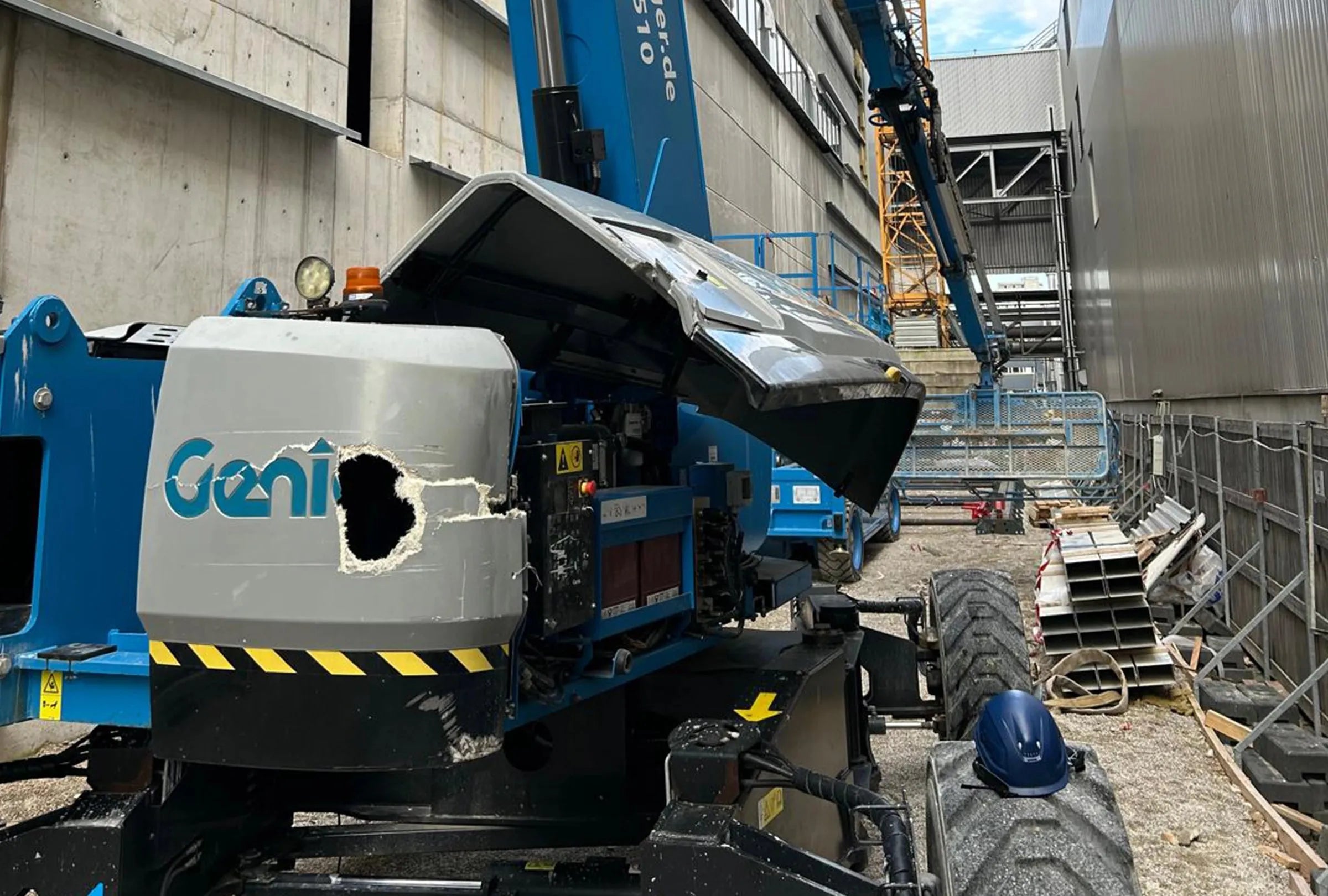
Damage to a work platform: Machinery breakdown insurance pays

Damage to the work basket of an articulated telescopic work platform .

Typical exclusions

Machinery breakdown insurance applies in many cases, but excludes certain risks:

  • Damage caused by wear and tear or lack of maintenance
  • Damage caused by improper use, e.g., use on unsuitable terrain
  • Minor damages below the deductible

How much does machinery breakdown insurance cost?

The cost of machinery breakdown insurance depends on the type of machine, its replacement value, and the deductible chosen. The following overview provides rough guidelines for annual premiums. Exact premiums vary depending on the insurer, plan, and additional modules.

Machine type New value (€) Deductible (€) Annual premium (approx.)
mini excavator 25,000 500 approx. 250 €
steamroller 30,000 500 approx. 325 €
excavator 50,000 500 approx. 445 €
Work platform (scissor lift or aerial work platform) 75,000 500 approx. 670–750 €
Telehandler 60,000 500 approx. 530–600 €
printing press 100,000 500 approx. €500–1,440
Forklift 100,000 500 approx. 1,040–1,200 €
tower crane 100,000 500 approx. 800–900 €

Note: The premiums listed are guidelines only. They vary depending on the insurer, plan, deductible, and additional modules. For an exact calculation, we recommend requesting a personalized quote from your insurer.

Rental equipment insurance for rented equipment

This rental equipment insurance is particularly relevant for renters and lessors of aerial work platforms or forklifts. Mobile machinery on construction sites is often subject to high levels of stress and is sometimes operated by inexperienced personnel.

The rental company's machinery breakdown insurance provides the necessary protection. Important: In most cases, it is included in the rental price or listed separately in the offer. If this information isn't provided, be sure to inquire before renting.

Depending on the contract, a deductible may apply in the event of damage, the amount of which depends on the landlord.

Conclusion: Why machine insurance is important

Whether stationary or mobile, machinery breakdown insurance is essential protection against high repair costs, breakdowns, and unforeseen risks. It ensures that machinery can be repaired or replaced quickly. For both tenants and lessors of construction equipment, it is an essential component of a reliable calculation.

Benjamin_Biberger_f09df03b-780b-4e03-8991-ca3f20113b29 - BIBERGER
About the author

Benjamin Biberger

Managing Director

Benjamin is the founder and managing director of BIBERGER Arbeitsbühnen & Forklifts.

He is responsible for thecommercial and administrative areasof the company and, together with his team, ensures theOptimization of operational processesand theoptimal customer supportin their projects.

Through his many years of experience in the areas of organization andProject managementIt provides a stable foundation – in its own daily business, in sustainableFurther development of processesas well as in theCollaboration with partners and customers.

Our editorial quality standards

The subject content on biberger.de are editorially created, reviewed, and continuously updated. The basis is our daily work with aerial platforms, telehandlers, and industrial trucks – in rental, sales, operational planning, and technical support.

Each article draws on real-world experience and is editorially reviewed for clarity, accuracy, and practical relevance according to expert criteria. Technical statements are regularly compared against current industry standards and best practices.

The aim of our publications is to make reliable specialist knowledge accessible and to offer guidance to users, decision-makers and industry partners. BIBERGER sees itself as an independent information platform for safe, economical and modern height access technology – well-founded, comprehensible and free from advertising influence.

Leave a comment

Please note, comments need to be approved before they are published.

This site is protected by hCaptcha and the hCaptcha Privacy Policy and Terms of Service apply.

FAQ

What is covered by machinery breakdown insurance?

Machinery breakdown insurance covers damage to stationary and mobile machines caused by operating errors, material defects, short circuits, explosions or external influences.

What does machinery breakdown insurance pay for?

It covers repair costs, costs for restoration or, in the event of a total loss, the replacement of the insured machines.

How expensive is machinery breakdown insurance?

The cost of machine breakdown insurance varies depending on the scope of insurance, tariff, condition and type of machine. Premiums usually start at around €250 per year per machine, depending on individual requirements and risks.

When does machinery breakdown insurance make sense?

It is useful when unforeseen damage could cause high costs or downtime, especially for landlords and operators who use machinery and equipment intensively.

When does machinery breakdown insurance apply?

Machinery breakdown insurance applies when machines are damaged byunforeseen damagesuch as operating errors, short circuits, explosions, fire or external influences, resulting in repair or replacement costs.

What is not covered by machinery breakdown insurance?

Not insured areWear, lack of maintenance, incorrect operation outside the specificationsas well as minor damages below the deductible.

What is the minimum deductible for machinery breakdown insurance?

The minimum deductible is usuallyapprox. €250–500 per claim, depending on the insurer and tariff.

Is machinery breakdown insurance mandatory?

No, machinery breakdown insurance isnot required by lawIt is voluntary, but often very useful for businesses, landlords, and machine owners to protect themselves against high repair or downtime costs.

Relevant topics

View all

Typische Planungsfehler beim ersten Einsatz von Arbeitsbühnen – und wie du sie vermeidest - BIBERGER

Typical planning mistakes when using aerial work platforms for the first time – and how to avoid them.

Introduction Why errors occur even before deployment The safe operation of a work platform begins long before the basket lifts off. Mistakes don't happen during the lift itself, but in the preparation: assessing the ground conditions, selecting the right equipment,...

Read more

Wind und Arbeitsbühnen: Was Du für einen sicheren Einsatz unbedingt wissen musst - BIBERGER

Wind and aerial work platforms: What you absolutely need to know for safe use

Key problem: Why wind loads are so often underestimated Wind load is one of the most underestimated risks when using aerial work platforms. At ground level, wind force 6, with 12.5 m/s or around 45 km/h, often seems relatively harmless....

Read more

Arbeitsbühnen weltweit: Der internationale Vergleich von Märkten, Herstellern & Kosten - BIBERGER

Aerial work platforms worldwide: An international comparison of markets, manufacturers & costs

Aerial work platforms are indispensable on almost every construction site and in many industries. However, although the basic technology is similar worldwide, markets differ significantly in terms of regulation, manufacturing landscape, pace of innovation, and typical application profiles. Understanding international...

Read more

Arbeitsbühne Privat mieten – Was ist erlaubt? - BIBERGER

Renting a work platform as a private individual – What is allowed?

Aerial work platforms are primarily designed, standardized, and planned for commercial use. Typical applications include facade construction, plant and building technology, and industrial maintenance. Accordingly, equipment selection, insurance models, and rental procedures are geared primarily towards commercial users with trained...

Read more

Anschlagen von Lasten – Anschlagmittel richtig auswählen und sicher einsetzen - BIBERGER

Lifting loads – selecting and safely using lifting equipment

Safely attaching loads is one of the most demanding tasks when operating cranes , forklifts , and lifting equipment. Errors almost never occur during the lifting itself, but almost always result from misjudging the load capacity, type of attachment, or...

Read more

Staplerfahrer werden

Become a forklift driver: safely, trained and responsibly

A moment of inattention 7:15 a.m. A forklift driver begins his early shift. Routine. He only gives the forklift a cursory check – time pressure, the truck is waiting. On the third lift, the fork tine snaps at an old...

Read more

CAN-Bus und J1939-Diagnose bei Baumaschinen - BIBERGER

CAN bus and J1939 diagnostics in construction machinery

Modern construction machinery is now highly networked systems. Sensors, control units and safety modules communicate with each other constantly – and this happens via the so-called CAN bus . The CAN bus is essentially the nervous system of every modern...

Read more

Magni Diagnose-Leitfaden: Fehlermeldungen richtig deuten - BIBERGER

Magni Diagnostic Guide: How to correctly interpret error messages

If your Magni telehandler (RTH / HTH series) suddenly displays a warning, it's rarely a total breakdown. Usually, a safety or protective function is being activated. This guide explains the most important error codes, their meaning, and how to react...

Read more