







 What You Need to Know
Do you want to save time, work more precisely, and move your pallets without having to move the entire forklift? Then a sideshifter is exactly what you need.
What sounds like an accessory is actually a crucial efficiency factor – especially in narrow shelf aisles or when loading with limited space.
In this article, you will learn what a sideshift on a forklift actually does, what advantages it offers, and when its use really makes sense.
What does a sideshifter do on a forklift?
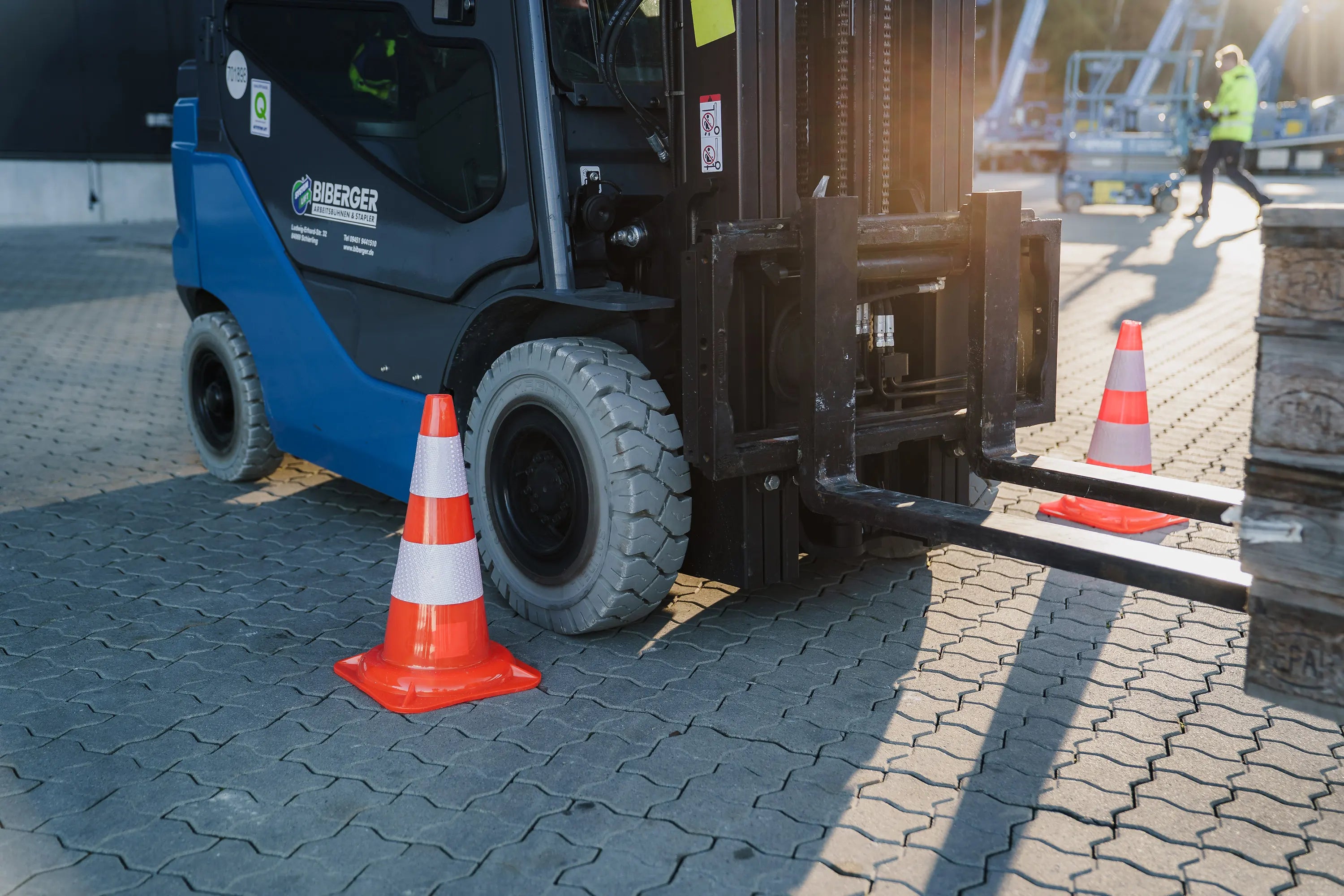
A sideshifter is a hydraulic attachment that allows you to move the forks sideways – without moving the forklift.
Sounds simple, but in practice, it saves a tremendous amount of time. Instead of having to maneuver, you can slide the fork to the left or right – usually by plus or minus 100 to 150 mm per side .
Function and displacement path
Hydraulic cylinders move the entire pair of tines, including the load. Control is conveniently performed from the driver's seat via the forklift's hydraulics.
Depending on the model, ±100–160 mm is common; special versions can achieve up to ±175 mm . This enables precise positioning even without centimeter-precise positioning.
| feature | Typical value | Practical benefits |
|---|---|---|
| Displacement path | ±100–160 mm | Precisely place pallets despite offset |
| Operation | Hydraulics via joystick/switch | Fast, ergonomic process |
| Assembly | Suspended or integrated | Flexibility vs. visibility/residual load-bearing capacity |
When do you need a side shifter?
Whenever things get tight or things need to happen “quickly”.
The use of a side shift is particularly useful in the following cases:
- Loading and unloading of trucks
- Warehouse work in narrow aisles
- Placing pallets in tight spaces
- Block storage with dense stacking
- Load pickup if you can't drive 100% centrally
Even on uneven floors, tilted pallets or asymmetrical load distribution, the sideshifter helps you to compensate for the position – without having to stop or start again.
What specific advantages does a side shifter offer you?
The biggest advantage is clear: time savings.
You no longer have to align the forklift precisely – a small slider handle and the fork is where it needs to be.
Second, less maneuvering means less damage. Especially when loading and unloading trucks or containers, the risk to pallets, goods, and vehicle walls is reduced.
Third: efficiency and ergonomics. You stay in your seat, the process becomes smoother—this improves the overall material flow.
And last but not least: more flexibility. Even if pallets aren't perfectly positioned or shelves are slightly offset, you can still work precisely.
Are there any disadvantages?
Not many – but there are a few points you should know:
A sideshift increases the overall height and dead weight . This slightly reduces the residual load capacity , depending on the model and attachment type.
In addition, the sideshifter requires a hydraulic connection on the forklift – if this is not available, it must be retrofitted.
| Disadvantages / limitations | What's it about? | What to do? |
|---|---|---|
| Reduced residual load-bearing capacity | Additional weight and stem dimensions | Check load diagram , select appropriate ISO/FEM class |
| More height | Device becomes higher | Check height limits during use |
| Hydraulics required | Additional supply line required | Have the hydraulic connection retrofitted |
Technical specifications and variants
Sideshifters are differentiated into ISO/FEM classes and are available as suspended or integrated designs.
The right choice depends on the forklift type, load capacity and visibility requirements.
ISO/FEM classes at a glance
| ISO/FEM class | Fork carriage height (typical) | Typical load ranges | Instructions for use |
|---|---|---|---|
| FEM 1 / ISO 1 | approx. 331 mm | up to approx. 2.0 t | Compact warehouse forklifts |
| FEM 2 / ISO 2 | approx. 407 mm | up to approx. 2.5 t | All-rounder in the warehouse |
| FEM 3 / ISO 3 | approx. 508 mm | up to approx. 3.5 t | Industry and loading |
| FEM 4 / ISO 4 | approx. 635 mm | up to approx. 5.0 t and more | Heavy-duty / outdoor |
Types: suspended vs. integrated
Front-mounted sideshifters are mounted on the fork carriage. They are flexibly interchangeable and ideal if you frequently change attachments.
Integrated sideshifters are built into the beam. Advantages: smaller frontal dimensions , better visibility , often higher residual load capacity .
Manufacturers and market overview
On the market, you'll find established providers with varying strengths. Frequently mentioned are Kaup , Cascade , Bolzoni-Auramo , CAM , Meyer , and Stabau .
Innovations include end-of-stroke damping , optimized roller guides and compact stem dimensions , which noticeably improve operation.
Prices and profitability
Costs depend on load capacity, class, and model. Used equipment is often a cost-effective alternative.
For orientation, the usual ranges:
| category | Price range | Example | Notice |
|---|---|---|---|
| New | approx. €630–€4,000 | FEM 3/4, integrated design | More comfort, usually smaller stem size |
| Needed | approx. €200–2,500 | FEM 2/3, suspended | Check maintenance status, check play/sliding pieces |
| Beginner FEM 2 | from approx. 385–700 € | up to ~2.5 t | Sufficient for typical storage applications |
Maintenance and repair
Regular maintenance ensures mileage, precision, and safety . Many tasks involve simple visual and functional checks.
Important: Pay attention to the sliding surfaces and rollers – they determine the smooth running of the sideshift.
Recommended maintenance intervals
| interval | Work | Notice |
|---|---|---|
| Every 100 hours | Check screws/hooks, check hydraulic hoses, adjust hook play | Visual and functional inspection |
| Every 500 hours | Grease upper sliding pieces, check roller run | Do not grease the lower profile |
| Every 1,000 hours | Measure the sliding piece thickness, check the rollers in detail | Under 1.5 mm = replace |
| Every 2,000 hours | Replace all sliding pieces preventively | Prevent downtimes |
Keep an eye on residual load-bearing capacity
A sideshift adds weight and front end dimension , both of which reduce the residual load capacity of your forklift.
Check the load capacity diagram after modification and document the change – especially relevant for testing and safe operation.
Common problems and solutions
Many problems can be quickly resolved with just a few checks. The following table will help you troubleshoot.
| symptom | Causes | Measures |
|---|---|---|
| No sideshift | No hydraulic pressure, defective cylinder, valve malfunction | Check oil level, check leaks, test cylinder/valve |
| Sideshift jerky/slow | Air in the system, worn sliding parts, dirty rollers | Bleed the system, replace sliding pieces, clean/grease |
| Tilt under load | Uneven wear, play on hooks | Adjust hook play, replace wearing parts |
Popularity and standard equipment
Sideshifters are the most important and frequently used attachment for forklifts. Many rental trucks come factory-equipped with them.
The sideshift is part of the standard equipment used in logistics, industry and construction site deliveries in particular .
Special features and technical innovations
Modern systems rely on end-of-stroke cushioning for smooth braking and optimized roller guides for jerk-free movement – even in dusty environments.
Other features include quickly replaceable seal sets and low-wear sliding pieces that shorten maintenance times.
Future outlook
With increasing automation, the need for precise positioning functions increases. Intelligent controls and digital fleet connectivity are becoming more important.
New materials reduce wear and tear and stem dimensions – this improves residual load-bearing capacity and visibility in everyday life.
Conclusion: When is a side shift worthwhile?
A sideshift doesn't make your forklift more powerful – but it does make it significantly smarter.
If you work in tight spaces, want to load more efficiently, or need to maneuver more precisely, this attachment is a real plus.
And the best part: You save time, reduce risk – and don’t have to constantly start over.
Rent a forklift with sideshift from BIBERGER
At BIBERGER, you can rent forklifts with sideshifters directly – ready for your use, with training on request and tailored to your requirements.
Want advice or to get started right away? Check out our forklift selection or contact us for a suitable quote.




Share:
Crawler Tracks: The Complete Guide to Selection, Use, and Cost
The platform extension: More reach without moving
Our editorial quality standards
The subject content on biberger.de are editorially created, reviewed, and continuously updated. The basis is our daily work with aerial platforms, telehandlers, and industrial trucks – in rental, sales, operational planning, and technical support.
Each article draws on real-world experience and is editorially reviewed for clarity, accuracy, and practical relevance according to expert criteria. Technical statements are regularly compared against current industry standards and best practices.
The aim of our publications is to make reliable specialist knowledge accessible and to offer guidance to users, decision-makers and industry partners. BIBERGER sees itself as an independent information platform for safe, economical and modern height access technology – well-founded, comprehensible and free from advertising influence.