







 What You Need to Know
Choosing the right forklift is an investment that has long-term implications for efficiency, costs, and sustainability. The crucial question often arises: Should it be a diesel or an electric forklift?
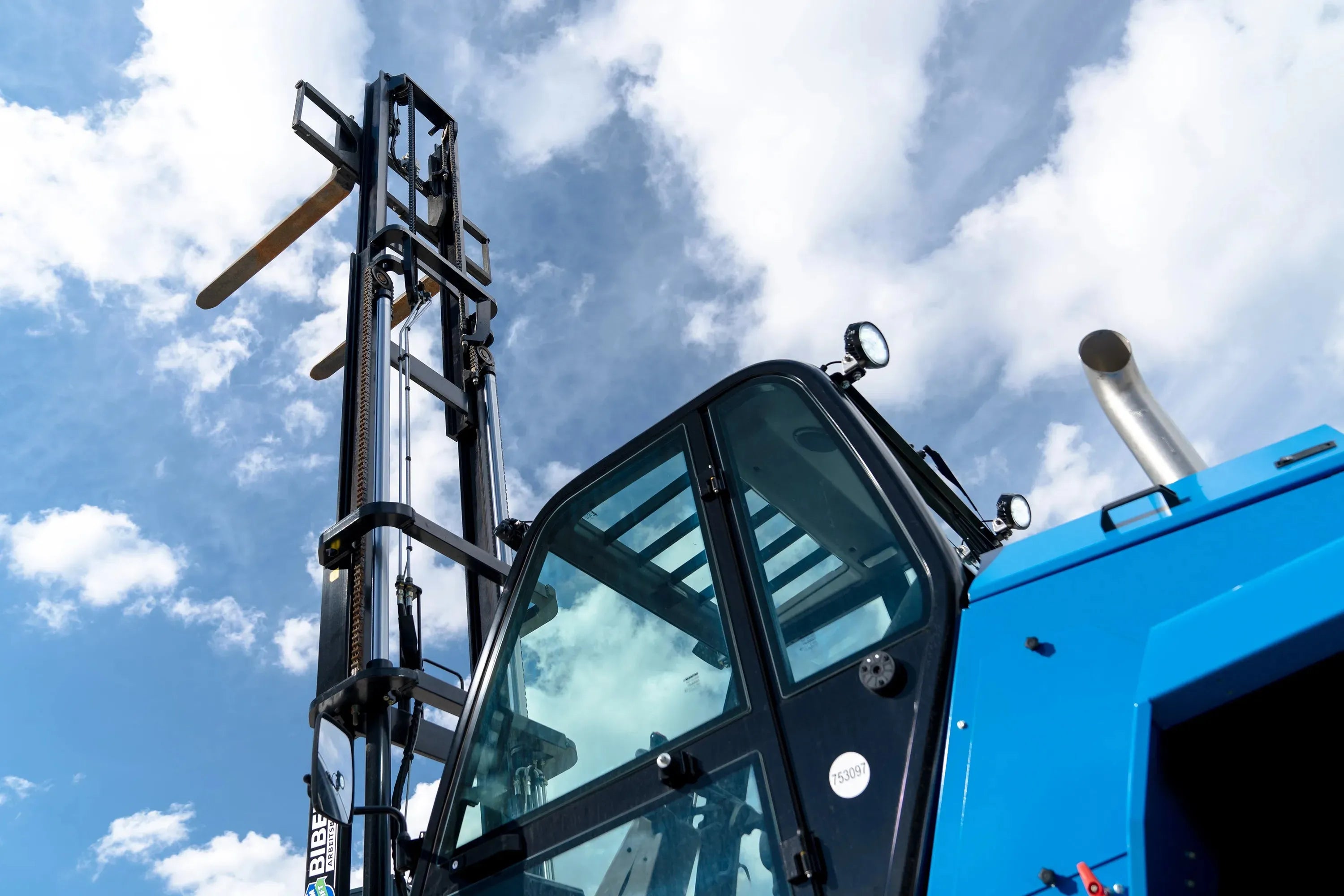
Diesel forklifts boast powerful combustion engines, high load capacity, and maximum performance for outdoor use – ideal for construction sites, warehouses, or industrial areas where heavy loads need to be moved and long distances covered.
Electric forklifts, on the other hand, are the first choice for indoor use : They operate emission-free , quietly, and offer impressively low operating costs. Perfect for warehouses, production facilities, or logistics centers where clean air and quiet operation are important.
In this guide you will learn:
- The main advantages and disadvantages of both types of forklifts
- Which drive type is optimal for which application
- What acquisition, maintenance and service life really cost
This allows you to make an informed decision as to whether a high-emission powerhouse or a quiet, efficient electric motor better meets your needs – and thus saves you time, money, and resources in the long run.
diesel forklifts
Advantages
Diesel forklifts are true power and endurance specialists . Their robust combustion engines enable them to lift heavy loads effortlessly and operate reliably even during long shifts – without breaks for charging. Thanks to their long service life and low susceptibility to downtime, they are perfectly suited for intensive use on construction sites, in large warehouse areas, or in outdoor industrial areas.
Another advantage: complete independence from charging stations . Powered by conventional fuel, diesel forklifts can be used flexibly anywhere – even where there is no adequate power supply. Even on uneven or difficult-to-access terrain, the simple mobile fuel supply ensures that the forklift remains ready for use at all times.
Disadvantages
Despite their power, diesel forklifts also face some challenges . They are often more expensive to purchase and incur higher maintenance costs than electric forklifts. Regular inspections, oil and filter changes are mandatory and require additional time and expense.
Another disadvantage is the exhaust emissions , which severely limit their use in enclosed spaces. Where diesel forklifts are used indoors, very good ventilation is necessary, and in some work areas, there are even legal restrictions . Furthermore, the noise level is significantly higher than that of electric forklifts – a clear disadvantage in noise-sensitive environments such as warehouses with office operations or in event spaces.
Areas of application
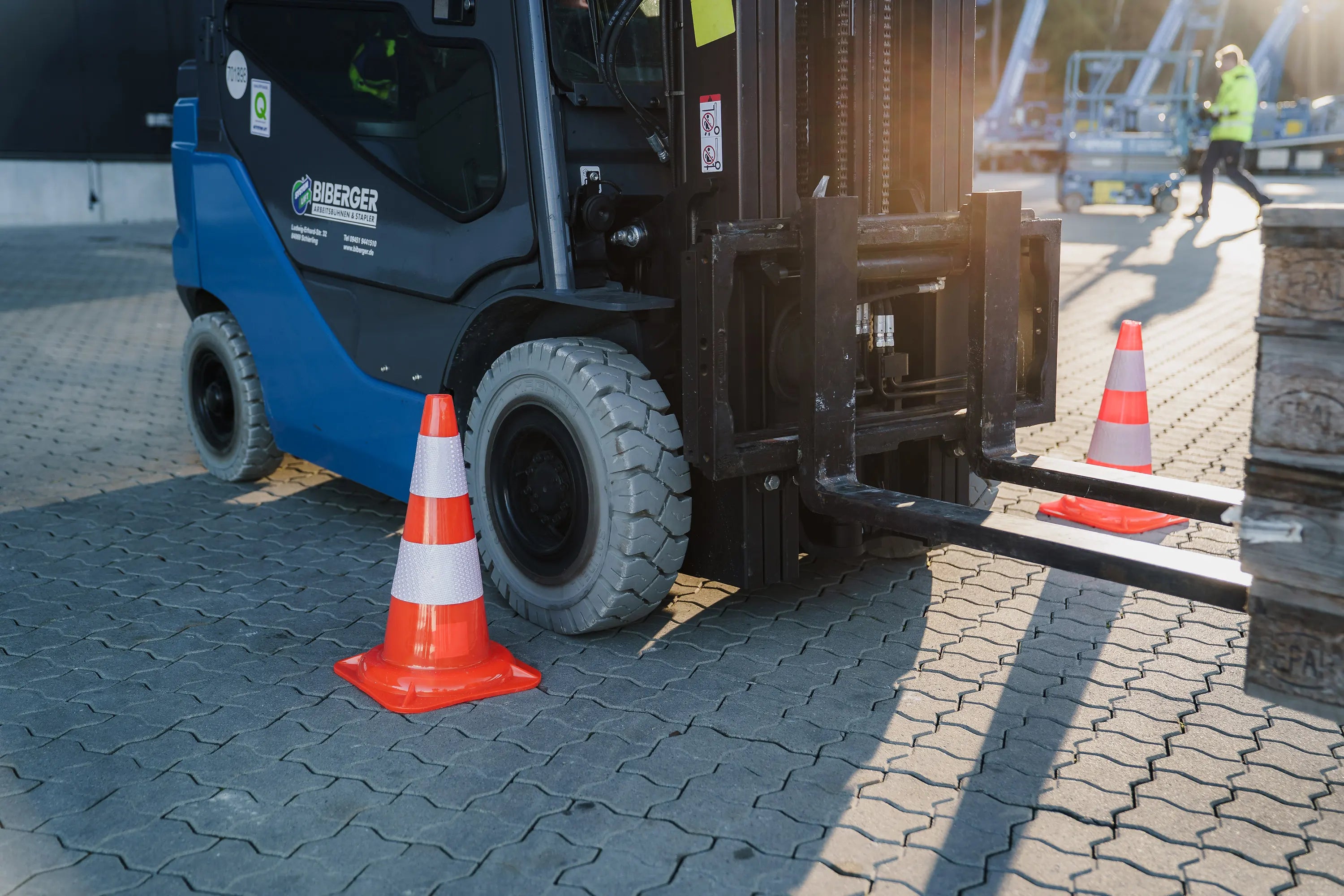
Diesel-powered forklifts are particularly effective outdoors —for example, on construction sites , in ports , or on large industrial premises . There, they impress with their high load capacity , long service life, and reliable performance, even under difficult ground conditions .
Unlike electric forklifts, which are primarily used in enclosed spaces or for internal transport, diesel forklifts are ideal when heavy loads need to be moved over long distances . However, exhaust emissions and noise levels make them less suitable for indoor use. In such cases, emission-free alternatives such as electric forklifts or gas-powered forklifts clearly have the advantage.
Electric forklifts
Advantages
Electric forklifts score highly with their emission-free operation and whisper-quiet operation . This makes them the first choice for use in enclosed spaces , warehouses, and internal areas where clean air and low noise levels are crucial.
Powered by powerful batteries instead of combustion engines, electric forklifts incur lower maintenance costs and offer efficient, uninterrupted operation . Furthermore , long-term operating costs are significantly lower , making them a cost-effective solution . Especially for used models , the purchase price is often lower than that of diesel forklifts .
Disadvantages
A major disadvantage of electric forklifts is the limited operating time per battery charge . This makes a reliable charging infrastructure and precise deployment planning essential to avoid unnecessary downtime.
Over time, forklift batteries noticeably lose capacity , resulting in more frequent charging cycles and a shorter service life. Older batteries, in particular, can prevent the forklift from lasting a full shift and lose performance sooner .
Regular battery replacement is therefore an integral part of maintenance and incurs additional costs and resource expenditure . Companies should therefore carefully consider whether the benefits such as low operating costs and zero-emission operation outweigh the long-term limitations caused by charging requirements and capacity loss .
Tip: Instead of a new forklift battery, you can also use a used forklift battery .
Areas of application
Electric forklifts are ideal for in-house use – whether in warehouses, production facilities or other enclosed spaces where emission-free operation and low noise levels are crucial.
They are the first choice for sensitive areas such as food warehouses or pharmaceutical companies , where freedom from harmful substances is essential. Thanks to modern lithium-ion batteries, many models are even ready for use around the clock with the appropriate charging infrastructure.
Their compact design gives them advantages in tight work spaces and makes them more maneuverable than many combustion-engine forklifts. In terms of environmental friendliness and energy efficiency, electric forklifts are also a future-proof investment – especially for companies that want to reduce operating costs while operating sustainably .
Rules of thumb for initial TCO calculation: Electric vs. diesel forklifts
Key message: For two-shift indoor use with occasional short outdoor cycles, we recommend initially using an electric fleet indoors and, if necessary, a diesel forklift for outdoor use . The following values of thumb help with a rough TCO comparison before selecting specific models.
1. Energy or fuel costs
- Electric: consumption approx. 15 kWh/hour. × 0.20 €/kWh = 3.00 €/hour.
- Diesel: Consumption approx. 4 L/h × 1.50 €/L = 6.00 €/h
2. Tire wear
- Smooth tread tires (industrial halls): approx. €0.30/hour
- Treaded tires (outdoor/yard): approximately €0.50–€0.70/hour (typically diesel)
3. Maintenance and wear
- Electrical: approx. €0.05/hour maintenance + €0.10/hour wear and tear = €0.15/hour.
- Diesel: approx. €0.15/hour maintenance + €0.20/hour wear and tear = €0.35/hour.
4. Residual value after 5 years / 10,000 hours
- Electric: approx. 40% of the new price
- Diesel: approx. 30% of the new price
5. Summary of annual TCO components
| Cost drivers | Electric (€/hour) | Diesel (€/hour) |
|---|---|---|
| Energy/Fuel | 3.00 | 6.00 |
| Tire wear | 0.30 | 0.60 |
| Maintenance/Wear and tear | 0.15 | 0.35 |
| Depreciation (including residual value) | 2.00 (new price €50,000) | 2.80 (new price €45,000) |
| Total (ongoing) | 5.45 €/hour | 9.75 €/hour |
Assumption: 5 years of service life, 10,000 hours
Recommendation: For predominantly indoor operations with two shifts, a fully electric fleet results in significantly lower operating costs (approximately 45% cheaper). An additional diesel forklift for outdoor cycles can reduce investment costs if the proportion of outdoor use is less than 20%.
The alternative: LPG forklifts
LPG forklifts offer an ideal intermediate solution between diesel and electric forklifts. Equipped with a clean combustion engine, they boast low-emission operation and can be used both outdoors and in well-ventilated indoor spaces .
Compared to diesel forklifts, they are often more compact , cause less wear , and are therefore easier to maintain . At the same time, companies benefit from easy refueling : gas cylinders can be changed in just a few minutes – without the charging times required for electric forklifts.
These forklifts offer a perfect balance of performance, flexibility, and versatility . They combine the robustness of a combustion engine with the lower emissions and quiet operation of electric models. LPG forklifts are particularly suitable for businesses that alternate indoor and outdoor operations and require continuous availability .
Decision-making aid: electric or diesel
The decision between electric and diesel forklifts depends largely on your area of application and operational requirements .
- Electric forklifts are the first choice for indoor applications where emission-free and soot-free operation are crucial. Their compact design makes them ideal for narrow access routes and sensitive flooring. However, they require a suitable charging station and must be recharged after a certain period of use.
- Diesel forklifts boast powerful combustion engines , high load capacity , and continuous operational readiness —without recharging. They are ideal for outdoor use , moving heavy loads , and operating on uneven terrain . However, they require more maintenance and produce higher emissions .
Conclusion: For emission-free and quiet operations in warehouses, the electric forklift is unbeatable. For heavy-duty outdoor work requiring maximum performance, the diesel forklift remains the best choice.
If you're still unsure which industrial trucks are best suited to your needs, we'd be happy to advise you. At BIBERGER , you can rent both electric and combustion-engine-powered forklifts to help you make the best decision for your specific needs.
Do you have further questions about forklift drives or other topics such as load charts or floor conditions? Contact us.



Share:
Troubleshooting work platforms - What to do if the work platform stops working?
Work platforms on the construction site: The possible uses
Our editorial quality standards
The subject content on biberger.de are editorially created, reviewed, and continuously updated. The basis is our daily work with aerial platforms, telehandlers, and industrial trucks – in rental, sales, operational planning, and technical support.
Each article draws on real-world experience and is editorially reviewed for clarity, accuracy, and practical relevance according to expert criteria. Technical statements are regularly compared against current industry standards and best practices.
The aim of our publications is to make reliable specialist knowledge accessible and to offer guidance to users, decision-makers and industry partners. BIBERGER sees itself as an independent information platform for safe, economical and modern height access technology – well-founded, comprehensible and free from advertising influence.