







 What You Need to Know
Do you want to drive an excavator? Or operate a wheel loader? Then remember: construction machine is not just any construction machine – and a driver's license is not just any driver's license.
What really matters is the question: Who is actually allowed to drive what – and under what conditions? We'll clarify exactly that here: practical, understandable, and in a way that you'll know when you can start – and when it's not possible without training, instruction, and authorization.
Construction Machines: What counts as one?
Construction machines is a collective term. In practice, this particularly includes earthmoving machines such as excavators and wheel loaders within the meaning of DGUV Rule 100-500 and DGUV Principle 301-005, as well as other work equipment with their own risk and regulatory framework.
- Excavators (crawler excavators, wheeled excavators, mini excavators, hydraulic excavators, tracked excavators)
- Wheel loaders, telescopic handlers and telescopic machines
- Dozers, rollers, graders and other earthmoving machines
- Earthmoving machines with higher speeds (relevant for road traffic and driver's license classes)
- Work platforms and telehandlers (own regulations – see section below)
Whether it's a construction site, company yard, or public road: Place of use, design, and speed determine what you need.
Driver's License for Construction Machines: Driving Permit vs. Proof of Qualification
Many say "excavator driver's license" or "construction machine driver's license." This is acceptable in colloquial speech – but legally, the distinction is important:
Driving Permit (Road Traffic)
As soon as you are operating a work machine on public roads, it's about a driving permit (e.g., class L, B, C1, C) and what is stated in the documents (e.g., registration/classification as a self-propelled work machine).
Proof of Qualification / Operator's License (Company Operations)
Within company operations, the proof of qualification is what counts: You must be qualified, you must be instructed, and you need a written authorization. This is not an "official driver's license," but a personal proof (e.g., operator's license/operator's card) that documents your theoretical and practical qualification.
Legal Basis: DGUV, BetrSichV and TRBS
In a commercial environment, occupational health and safety apply. For earthmoving machines and other construction machines, these levels are particularly relevant:
-
DGUV Rule 100-500 (Chapter 2.12 "Operation of Earthmoving Machines" – Requirements for selection, instruction, and use)
-
DGUV Principle 301-005 "Qualification and Authorization of Operators of Hydraulic Excavators and Wheel Loaders"
-
Industrial Safety Ordinance (BetrSichV: work equipment, risk assessment, safe use)
-
TRBS (Technical Rules for Industrial Safety: practical interpretation depending on work equipment/activity)
Note: DGUV 301-005 specifies the qualification and authorization for excavator and wheel loader operators and supplements the general requirements of DGUV Rule 100-500.
Training, Instruction, and Briefing: What is needed when?
If you use construction machines commercially, you will almost always need three components in practice. They build on each other.
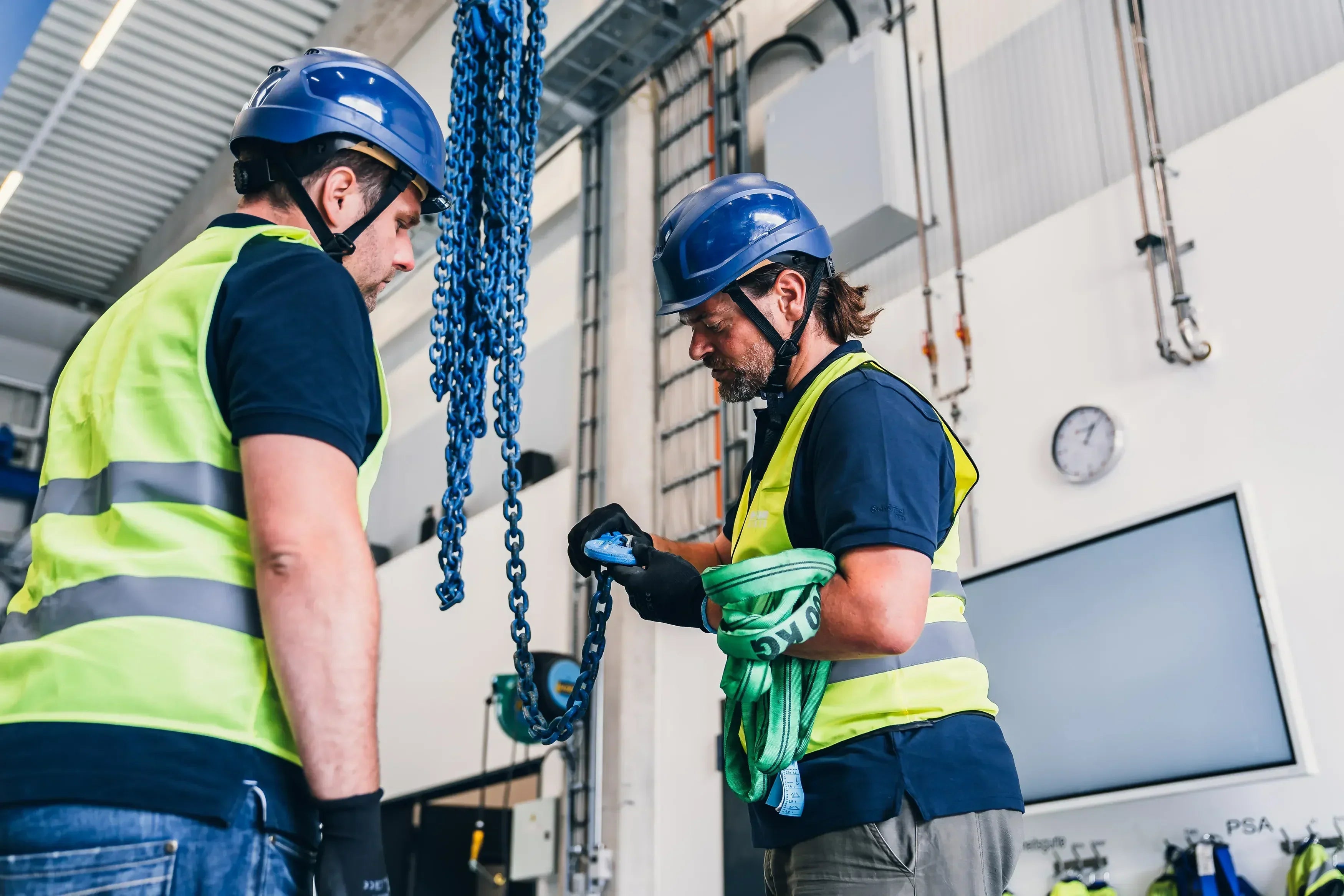
1) Training (Qualification) – Theory and Practice
Training provides the basics for proof of qualification: machine structure, stability, hydraulics, hazard areas, signals, safe working methods, and typical accidents.
At the end, there is a proof (certificate/operator's license). Often, there is a theory test plus a practical individual test with driving exercises and work tasks (e.g., loading, leveling, digging, working with grapples/attachments).
2) Instruction (on the specific work equipment)
The instruction is the equipment introduction: controls, operating instructions, machine specifics, attachments, emergency stop, daily checks.
Important: Instruction is practical – but does not replace the overall qualification if you are new.
3) Briefing and Authorization (operational)
The briefing takes place within the company and must match the risk assessment, the place of use, and the activity (e.g., company yard vs. construction site, passenger traffic, narrow passages).
Additionally, you need a written authorization from the employer according to DGUV Rule 100-500 and BetrSichV. Only then are you legally employed as operating personnel within the company.
Annual briefing: mandatory and non-negotiable
Many people take a course once and think "done." In occupational safety, this is wrong: The annual briefing is mandatory – and must be documented.
In addition, a briefing is due if something changes: new work equipment, new technology, new construction site conditions, new tasks, or after an accident.
Proof and Documentation of Instruction
Without documentation, you practically have no proof in an emergency. Therefore, every instruction should at least contain:
- Date, place, duration
- Work equipment / activities (e.g., wheeled excavator, wheel loader, attachments)
- Contents (hazards, protective measures, rules of conduct)
- Name of the instructing person
- Participant list with signature
This is not a bureaucracy fetish, but rather protection when the professional association, supervisor, or insurer inquire.
Requirements: Age, suitability, responsibility
For operation within a company, the practical requirements are: 18 years old, reliable, mentally capable, instructed, authorized.
Depending on the application and risk, an occupational health check-up may be advisable or required. A G25 examination (eyesight, reaction time, etc.) is often used as a standard – but the demonstrably physical and mental suitability for the respective task is legally decisive.
Driver's License Classes in Road Traffic: Class L, B, C1, C
For driving on public roads, classification, speed, mass, and use are important. This table provides a rough orientation:
| Typical Case | What matters | Usual Driving Permit | Practical Tip |
|---|---|---|---|
| Slow work machine (e.g., yard/short distances) | Classification + Speed | Class L (automatically issued with Class B for many car drivers – check entry in driver's license) | Check documents: Classification/registration decides |
| Self-propelled work machine faster / heavier | Total mass + registration | B, possibly C1 or C | C1/C quickly becomes relevant for >3.5 t |
| Transport on trailer | Towing vehicle + trailer + total weight | B/BE or C1E/CE | Here, it's often not about the machine, but about the towing vehicle |
Important: A driving permit only regulates road traffic. For operation, you still need qualification, instruction, and authorization.
Driver's license for earthmoving machines: What does DGUV 301-005 specifically require?
The DGUV Principle 301-005 "Qualification and Authorization of Drivers of Excavators, Wheel Loaders, and Backhoe Loaders" describes the content and modalities of qualification (theory and practice), instruction, and authorization. It serves as a guideline for training centers and companies that wish to issue a recognized proof of qualification.
In practice, this means: training with theory and practice, proof (e.g., operator's license/operator's card), plus operational instruction and authorization. This is how "can operate" becomes a legally sound deployment.
Costs, Duration, Prerequisites: short and concise
The costs depend heavily on the scope, provider, region, machine, and number of participants. For beginners, the effort is higher, while experienced operators can often be trained more compactly.
| Training / Course | For whom? | Duration | Reference Value | Result |
|---|---|---|---|---|
| Express / Professional Course (with prior knowledge) | Experienced operators | 1 Day | often approx. €190–€490 | Certificate/Operator's License + Practical Check |
| Standard Training (Beginner) | New or little practice | 2–3 Days | typically approx. €700–€1,200 | Qualification Theory and Practice |
| Intensive Course (e.g., DEKRA / TÜV / Construction Academy) | Extensive Qualification | up to approx. 5–10 Days | often approx. €1,000–€1,900 | Broad proof, depending on the program |
| In-house Training | Teams within the company | individual | often cheaper per person in groups | Tailored to the risk assessment |
Note: Prices are approximate values from 2025/2026 – depending on region, provider, machine type, and funding opportunities (e.g., training vouchers, employer subsidies), conditions can vary significantly. Crucially, the training must match your earthmoving machines, and you must receive a recognized proof of qualification.
Where can you get the training? DEKRA, TÜV, Construction Academies and In-house Training
If you want it done properly and recognized, choose providers with a clear structure (theory, practice, examination, documentation). Common points of contact are:
- DEKRA / TÜV / Construction Academies / Specialized Centers
- SYSTEM-CARD from SYSTEM LIFT (for aerial work platforms, forklifts, and other qualifications)
For businesses, in-house training is often worthwhile: same content, but directly with your machines, routes, loads, and hazards.
What about forklifts, telehandlers, and aerial work platforms?
Good question – because these are also technically considered work equipment with risks. However, they have their own regulations and qualifications.
- For forklifts and many industrial trucks, you need a forklift license (operator's card)
- For telehandlers, additional requirements apply depending on the design (training + operational level/instruction)
- For mobile elevating work platforms, instruction according to DGUV is mandatory
You can find both topics here:
Conclusion: Safely operating construction machines means qualifying, instructing, authorizing
Whether it's an excavator, wheel loader, or other earthmoving machines: In operations, it's not about "I can somehow drive it," but about qualification and authorization.
If you do three things properly – training (theory and practice), instruction (annually and as needed), and written authorization – you are on the safe side: for occupational safety, proof, professional association, and liability.





Share:
Work platforms for municipal construction yards: efficient use in road and green space maintenance
How much load and height can a crane handle? Lifting capacity and reach of the largest cranes
Our editorial quality standards
The subject content on biberger.de are editorially created, reviewed, and continuously updated. The basis is our daily work with aerial platforms, telehandlers, and industrial trucks – in rental, sales, operational planning, and technical support.
Each article draws on real-world experience and is editorially reviewed for clarity, accuracy, and practical relevance according to expert criteria. Technical statements are regularly compared against current industry standards and best practices.
The aim of our publications is to make reliable specialist knowledge accessible and to offer guidance to users, decision-makers and industry partners. BIBERGER sees itself as an independent information platform for safe, economical and modern height access technology – well-founded, comprehensible and free from advertising influence.