








 What You Need to Know
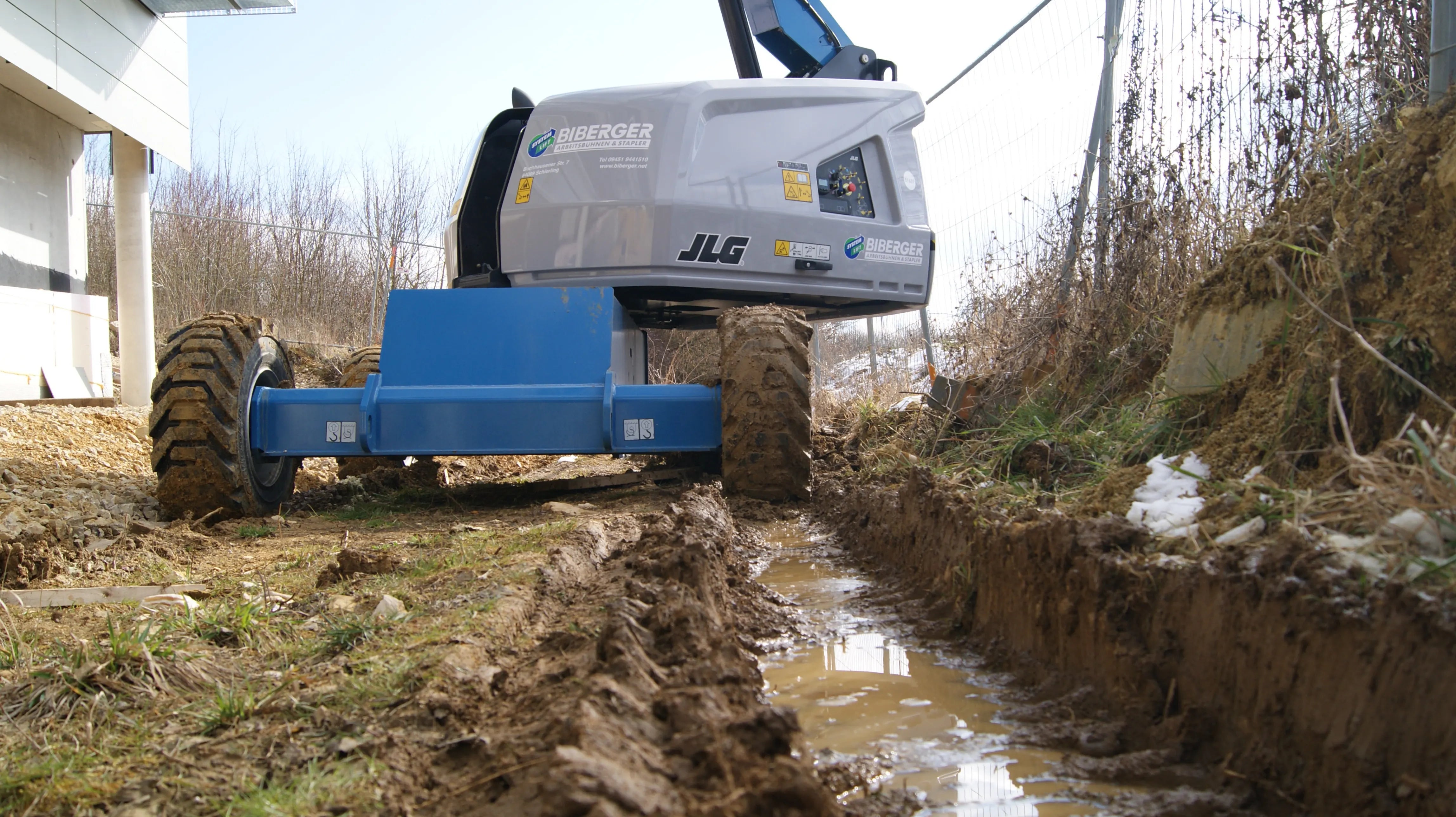
Whether on construction sites, in agriculture, or during soil investigations – the condition of the soil plays a crucial role. Cohesive soils, in particular, pose a challenge, as their properties can change significantly depending on moisture content. A precise assessment is therefore essential for the safe use of work platforms, forklifts, and construction machinery.
Basics and properties
What is cohesive soil?
Cohesive soil consists of fine-grained material such as clay or silt. It is called cohesive soil because the fine particles retain water and thus hold it together. Unlike non-cohesive soils , which consist of coarse-grained material such as sand or gravel and drain water quickly, cohesive soil can absorb large amounts of moisture. This causes it to become soft and mushy in wet conditions, while during dry periods it shrinks, hardens, and cracks—leading to a loss of bearing capacity on construction sites.
Cohesive vs. non-cohesive soil – The most important differences
| Characteristic | Cohesive soil (clay, silt) | Non-cohesive soil (sand, gravel) |
|---|---|---|
| Grain structure | Very fine-grained, high density | Coarse-grained, loose structure |
| Water absorption | Stores a lot of water, swells | Allows water to pass through quickly, remains stable |
| Load capacity | Low, risk of sinking | High, carries heavy loads well |
| Behavior in wet conditions | Muddy, slippery, difficult to navigate | Remains dimensionally stable, drains quickly |
| Behavior in dry conditions | Shrinks, forms cracks | Remains largely unchanged |
| Compactability | Can be compacted well, but difficult to loosen again | Difficult to compact, but stable after compaction |
Geotechnical parameters of cohesive soils
Geotechnical parameters are crucial for the technical assessment of cohesive soils. These include the plasticity index (PI) and the consistency limits – liquid limit (LL) and plastic limit (PL) – which indicate how much the soil deforms when moisture changes. A high PI value indicates highly plastic behavior, typical of clay-rich soils.
California Bearing Ratio (CBR) values or Proctor density tests are often used to determine bearing capacity. These indicators determine how strong and compactable the soil is under real-world loads—essential for planning access roads and machine locations.
Standards and classification
Cohesive and cohesive soils are classified according to DIN 18196 , while DIN EN ISO 14688 regulates the description and classification according to grain size and plastic behavior. For construction projects, DIN 1054 is also relevant, defining the requirements for geotechnical reports and soil assessments .
A geotechnical report should be obtained before using heavy machinery to reliably assess the bearing capacity and settlement tendency of the soil. This is the only way to identify risks such as subsidence or instability at an early stage.
Impact on construction sites
What does this mean for construction sites?
- Cohesive soil is problematic for heavy machinery because it deforms when wet and offers little stability.
- Non-cohesive soil is more suitable for the use of work platforms and forklifts because it is more load-bearing and resistant to deformation.
Problems with cohesive soil in construction
On construction sites, cohesive soils often lead to:
- Sinking of machines such as aerial work platforms or telescopic forklifts.
- Instability in buildings because the ground expands when wet and shrinks when dry.
- Difficult to navigate , especially after rainfall or freeze-thaw cycles.
Solutions and measures
Soil improvement on the building site
To increase the load-bearing capacity of cohesive soils, base layers of crushed stone or gravel are often introduced. These should be at least 20–30 cm thick to distribute the loads over a large area. Geogrids or geotextiles with a distributed load capacity of 20–40 kN/m² further stabilize the subsoil.
For permanently moist soils, a drainage system with a minimum gradient of 1.5% can be used to ensure water drainage. This controls the moisture content and maintains a constant load-bearing capacity.
Choosing the right machine
On cohesive soils, low-impact machines should be used. These include:
- Crawler work platforms with low ground pressure and even load distribution.
- Off-road telehandlers with all-wheel drive and differential lock.
- Work platforms with hydraulic support systems for additional support.
The selection depends not only on the load-bearing capacity but also on the soil structure and moisture content . A prior soil test according to DIN 18196 is therefore always recommended.
Pay attention to the weather
- Adjust application times to avoid extreme humidity or dryness.
- Before starting work, conduct a soil test to ensure stability.
Economic efficiency and sustainability
The choice of soil improvement measure influences not only safety but also cost-effectiveness. Gravel base layers are cost-effective and effective, while cement stabilization incurs higher material costs but lower maintenance costs in the long run. The additional expenditure is often offset by fewer machine downtimes.
Sustainable solutions are increasingly relying on recycled aggregate (recycled gravel), which conserves resources and reduces the carbon footprint. All measures must be taken to ensure that groundwater and soil ecosystems are not impacted.
Practice and safety
Practical experience and case studies
Practical projects show that construction sites with soil improvement using geogrids and gravel base layers experience up to 60% less machine sinking. In a construction project in the marshy area of northern Germany, the failure rate of platforms and forklifts was reduced by a third through targeted subsoil improvement.
Safety and occupational health
Working on cohesive soil requires a risk assessment according to DGUV Regulation 1. The most important measures:
- Wear non-slip footwear and PPE on wet surfaces.
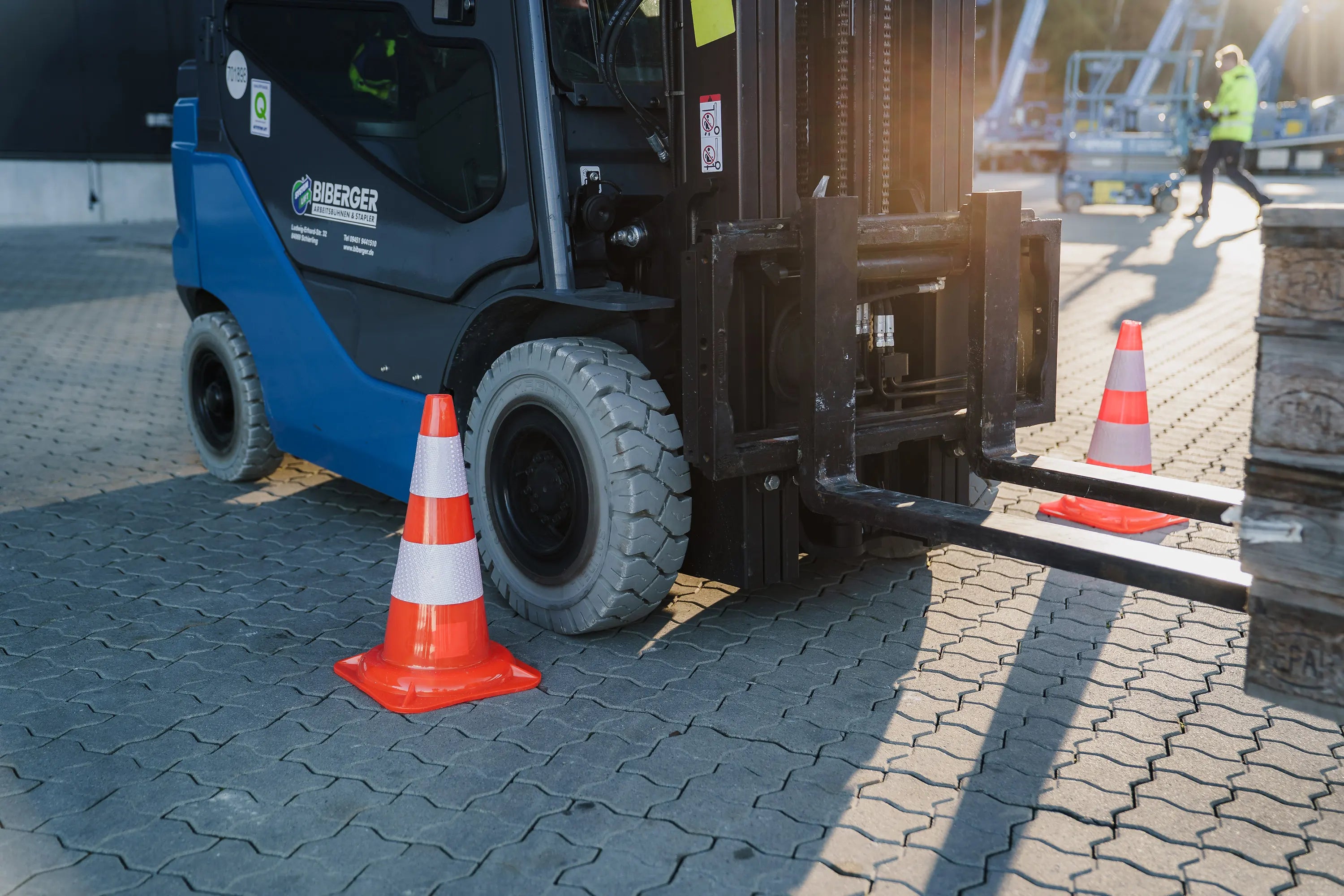
- Securing work areas with risk of falling using traffic cones and warning signs.
- Prohibition of staying under raised machinery on unstable ground.
Modern subsoil analysis
Modern construction site planning uses 3D ground scans and ground-penetrating radar (GPR) to digitally map bearing capacity zones. The integration of geotechnical data into BIM models enables precise simulations of the loads exerted by machinery and structures, thus minimizing risks in advance.
Conclusion
Cohesive soils pose a particular challenge in construction. Geotechnical analysis, soil improvement, and the use of suitable machinery can significantly increase safety. By adhering to the relevant standards (DIN 18196, DIN EN ISO 14688, DIN 1054) and using digital planning tools, construction projects can be implemented efficiently and sustainably, even on difficult soils.






Share:
Aerial platform leasing or rental?
Slope angle in construction – definition, calculation and practical tips
Our editorial quality standards
The subject content on biberger.de are editorially created, reviewed, and continuously updated. The basis is our daily work with aerial platforms, telehandlers, and industrial trucks – in rental, sales, operational planning, and technical support.
Each article draws on real-world experience and is editorially reviewed for clarity, accuracy, and practical relevance according to expert criteria. Technical statements are regularly compared against current industry standards and best practices.
The aim of our publications is to make reliable specialist knowledge accessible and to offer guidance to users, decision-makers and industry partners. BIBERGER sees itself as an independent information platform for safe, economical and modern height access technology – well-founded, comprehensible and free from advertising influence.