






 What You Need to Know
The whiplash effect – also known as the catapult effect – is one of the most dangerous dynamic effects when working with aerial work platforms. It occurs when vibrations build up uncontrollably – triggered by abrupt movements, uneven ground, or incorrect load distribution. The result: dangerous accelerations, loss of control, and in the worst case, a fall.
Here you will learn what happens physically, what the typical causes are , and how to consistently avoid the effect – with clear practical rules and checklists from the BIBERGER training system.
What is the whiplash effect?
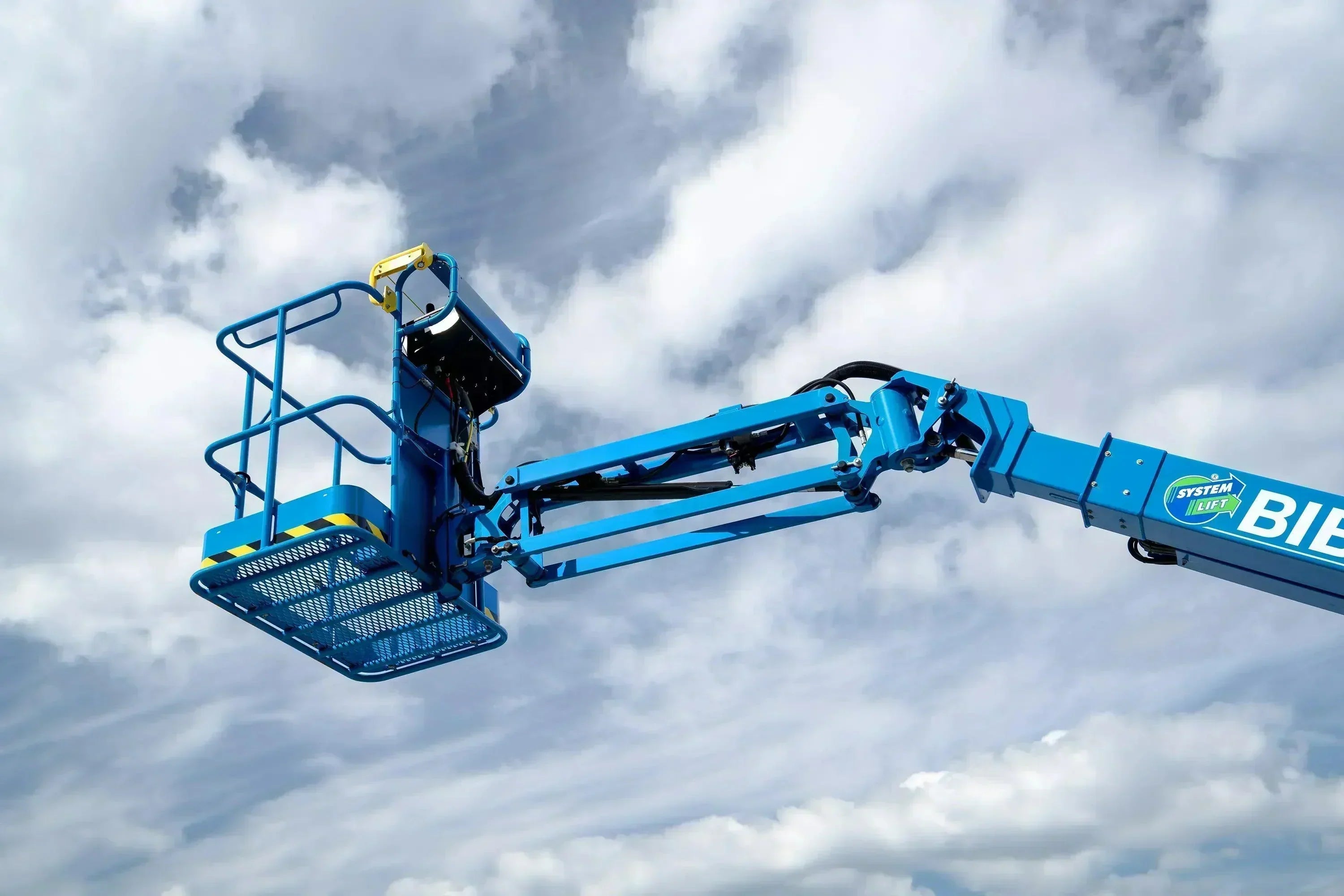
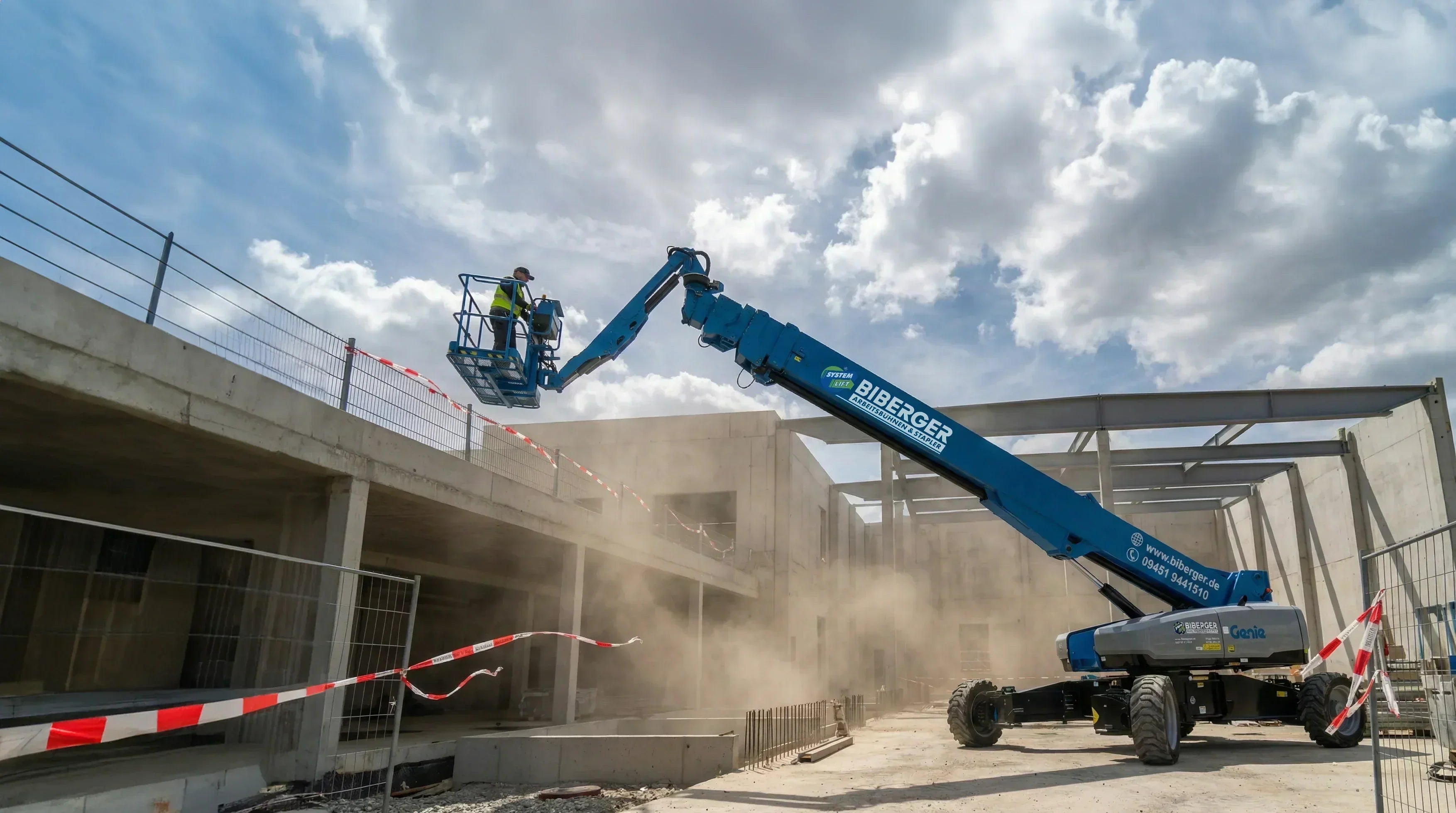
The whiplash effect describes a combination of pendulum motion and leverage . Small movements of the undercarriage are transmitted via the boom – resulting in large deflections at its tip, the work platform. The further the boom is extended, the stronger even minimal impulses become.
Physically, this results in a loss of momentum and damping : kinetic energy is not dissipated, but amplified. This dynamic can catapult the operator and material – hence the name.
Typical triggers in practice
- Hard braking or abrupt changes of direction.
- Driving with the boom extended or the basket raised.
- Changing edges over gullies, thresholds or uneven ground.
- Overloading or laterally displaced load in the basket.
- Cornering at excessive speed or swerving while driving.
- Gusts of wind near large projection surfaces or extensions.
Risks and consequences
An uncontrolled whiplash effect can lead to serious accidents. There is a risk of falls if operators are thrown from the basket. At the same time, structural loads are generated that can damage joints, hydraulics, and basket connections.
Collisions with buildings, pipes, or supports are also frequent consequences. Each incident usually leads to project delays, repair costs , and safety inspections.
Practical rule: How to avoid the catapult effect
1. Smooth control
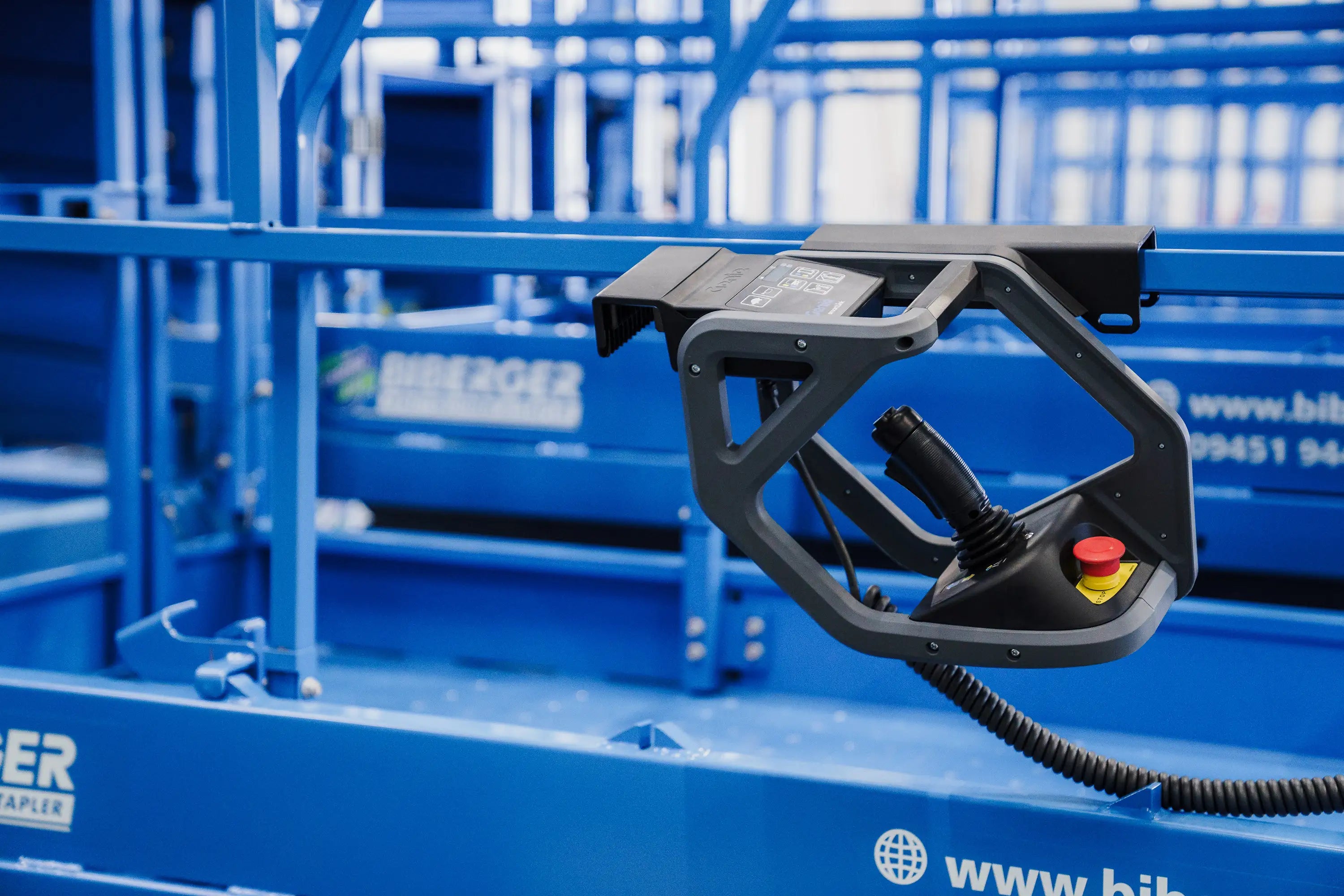
Move the joystick slowly. Avoid abrupt changes of direction or full braking. When braking, release the joystick early and let the car coast.
2. Maneuvering with the boom retracted
Only travel with the telescopic boom retracted and the basket low. Extend the boom only at the work site – never while driving.
3. Check edges and bottom
Check or secure any unevenness, manhole covers, and edges beforehand. Avoid driving diagonally over them ; instead, drive at a right angle and at low speed.
4. Observe the load diagram
Avoid overloading. Position the load in the center and secure moving parts. Always keep the device's reach within the manufacturer's specifications.
Correctly reading a load diagram
5. Large and slow curves
Drive through curves with a large radius and reduced speed . Do not drive and swerve simultaneously unless explicitly permitted.
6. Take wind into account
In case of gusts of wind, large areas, or structures, stop or adjust the operation. The additional wind load significantly increases the leverage effect.
More on the topic of wind load
Driving and operating strategy
A smooth ride begins with planning. Check the route, adjust your speed , and mark potential hazards. Always drive with foresight and by sight.
- Braking strategy: controlled braking, no short load changes.
- Swiveling: only when stationary or at minimal speed.
- Communication: clear signals, radio check, have a spotter ready.
Load management and range
The further the basket is from the center, the greater the effect of any movement. Keep materials as close to the column as possible , heavy parts low and secured. Position first, then extend.
Weather, subsoil and gradient
Load-bearing capacity and evenness are crucial. Avoid driving over manhole covers or soft areas. On inclines, drive slowly and without changing direction. Damp or icy surfaces increase the risk – adjust your speed accordingly.
Checklist before every deployment
| Checkpoint | What needs to be done? |
|---|---|
| Device status | Visual and functional inspection, emergency stop testing |
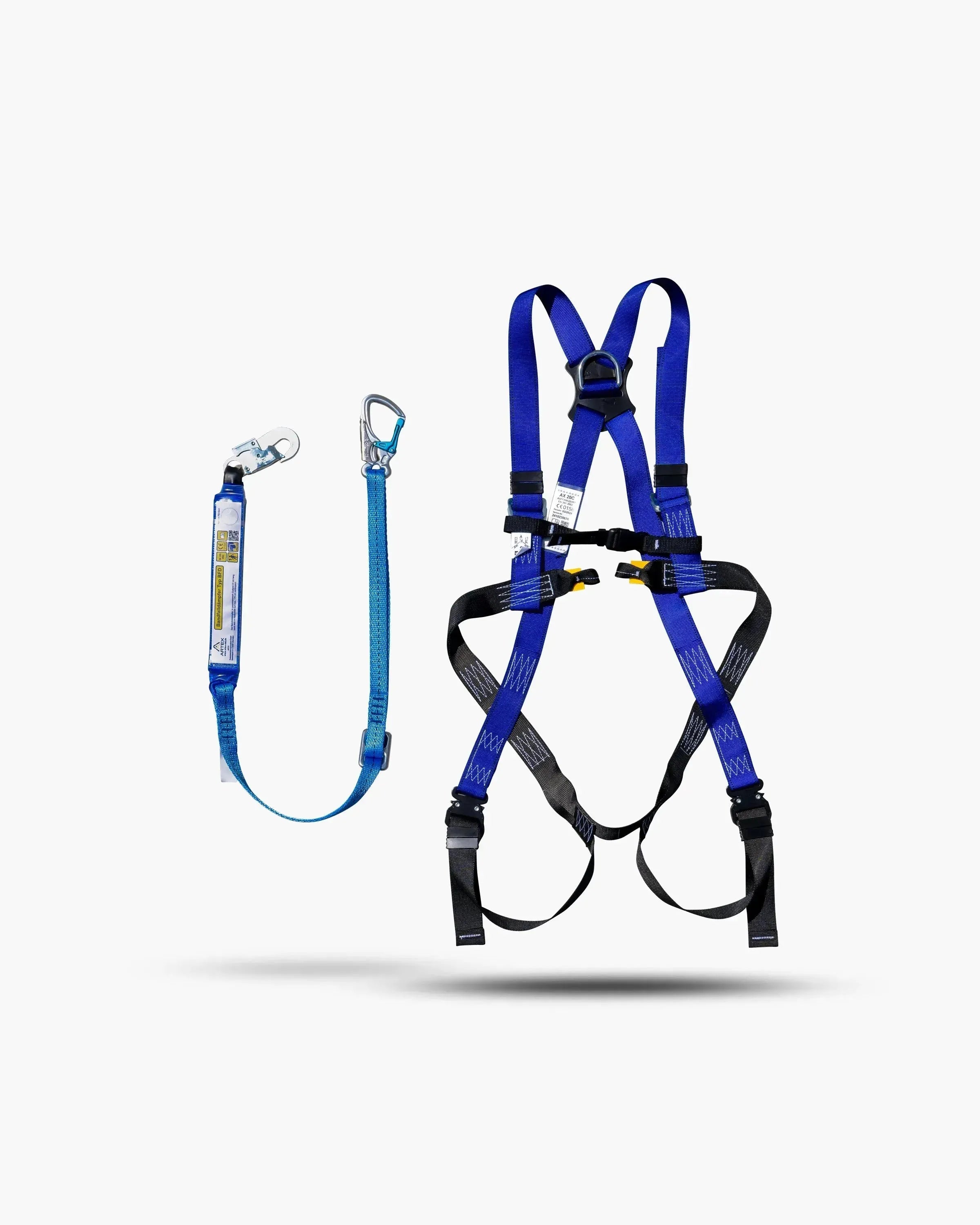
| PSAgA | Attach the harness to an approved anchor point. |
| Route | Mark or secure edges, covers, and slopes |
| load | Check load against diagram, secure material |
| communication | Identify guides, check radio connection |
If it rocks
Stay calm – no counter-movements . Gently reduce speed, retract the boom, and let it roll straight ahead. Only lower or reposition slowly once the oscillation has subsided.
Legal foundations and standards
The safe operation of work platforms is governed by DGUV Regulation 100-500 and EN 280. Both require trained operators, regular instruction, and the use of personal protective equipment against falls from height (PPEgA) for boom lifts.
Annual training sessions according to DGUV 1 are mandatory – they reinforce awareness of dynamic and stability risks.
Education, training and teamwork
Only those who practice regularly can recognize risks early. BIBERGER's SYSTEM-CARD® training courses provide practical knowledge about dynamics, load management, and emergency procedures. This ensures a calm stage presence – and a safe team.
Conclusion
The whiplash effect is not a coincidence, but physics in motion. With anticipatory driving , correct load distribution, and technical checks, the risk can be significantly reduced. Slow, linear, and load-appropriate – that's the rule for safe work at height.




Share:
Entering and leaving the work basket of a mobile elevating work platform in working position
Transporting work platforms safely – planning, implementation and costs
Our editorial quality standards
The subject content on biberger.de are editorially created, reviewed, and continuously updated. The basis is our daily work with aerial platforms, telehandlers, and industrial trucks – in rental, sales, operational planning, and technical support.
Each article draws on real-world experience and is editorially reviewed for clarity, accuracy, and practical relevance according to expert criteria. Technical statements are regularly compared against current industry standards and best practices.
The aim of our publications is to make reliable specialist knowledge accessible and to offer guidance to users, decision-makers and industry partners. BIBERGER sees itself as an independent information platform for safe, economical and modern height access technology – well-founded, comprehensible and free from advertising influence.