Reading now: More efficiency on the construction site: When a telehandler is worthwhile
Zusammenfassung What You Need to Know

ATelehandleris the ideal solution for many construction sites when you have heavy loadslift, transport or place precisely– even on uneven terrain or at great heights. Thanks to the extendable telescopic arm, you can easily reach roof edges, scaffolding or storage areas. You canMoving pallets, moving big bags, deploying work baskets or loading bulk goods– with just one device. The use is particularly efficient thanks tovarious attachments, high off-road capability and the possibilityLoads over obstaclesto move.

Renting a telehandler is always worthwhile if youwork on a project basis, want to remain flexible, or don't want to maintain your own machines. It's crucial that the load capacity, reach, and location match. This way, you avoid delays, reduce changeover times, and bring real efficiency to your construction site –safe, economical and needs-based.

Zusammenfassung What You Need to Know

ATelehandleris the ideal solution for many construction sites when you have heavy loadslift, transport or place precisely– even on uneven terrain or at great heights. Thanks to the extendable telescopic arm, you can easily reach roof edges, scaffolding or storage areas. You canMoving pallets, moving big bags, deploying work baskets or loading bulk goods– with just one device. The use is particularly efficient thanks tovarious attachments, high off-road capability and the possibilityLoads over obstaclesto move.

Renting a telehandler is always worthwhile if youwork on a project basis, want to remain flexible, or don't want to maintain your own machines. It's crucial that the load capacity, reach, and location match. This way, you avoid delays, reduce changeover times, and bring real efficiency to your construction site –safe, economical and needs-based.

A telehandler can make the crucial difference on a construction site – between delays and smooth operations , between muscle power and machine performance .

But when is it really worth using? And what should you consider when choosing? This article provides you with clear answers – for informed decisions and efficient use .

What is a telehandler – and what makes it special?

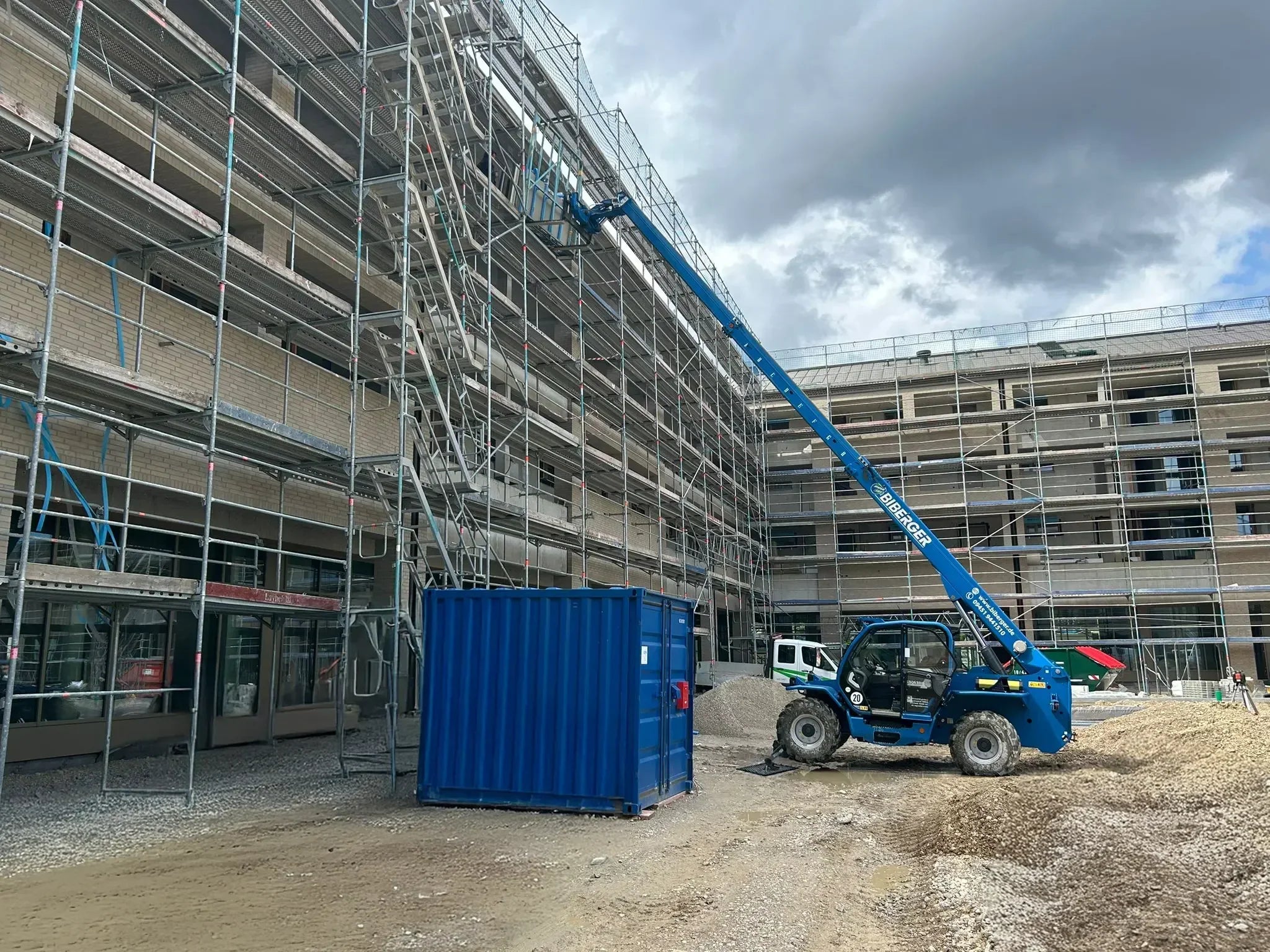
A telehandler (also called a telehandler) is an all-terrain, all-purpose machine that enables the lifting, transporting, and positioning of loads on construction siteseven at great heights or with lateral reach . Unlike conventional forklifts or rough terrain forklifts , it has an extendable telescopic arm that can also lift loads over obstacles or onto elevated levels.

Advantages at a glance :

  • Greater reach than standard forklifts
  • Flexible application possibilities through attachments (e.g. shovel, fork, work basket)
  • Full off-road capability , even on unpaved surfaces
  • All-round visibility from the cab , ideal for tight construction site areas

What jobs can be done with telehandlers?

Telehandlers are extremely versatile on construction sites – especially when heavy loads need to be not only lifted but also precisely positioned . Typical applications:

  • Pallet handling on uneven terrain
  • Material transport to elevated work areas (e.g. roofing, facade assembly)
  • Place concrete or formwork elements
  • Relocate big bags or bulk goods with a load hook or shovel
  • Create access solutions with work basket attachment
  • Lifting tools or equipment into multi-story shell buildings

Especially on larger or confusing construction sites, a telehandler reduces the number of devices – and saves time, personnel and travel .

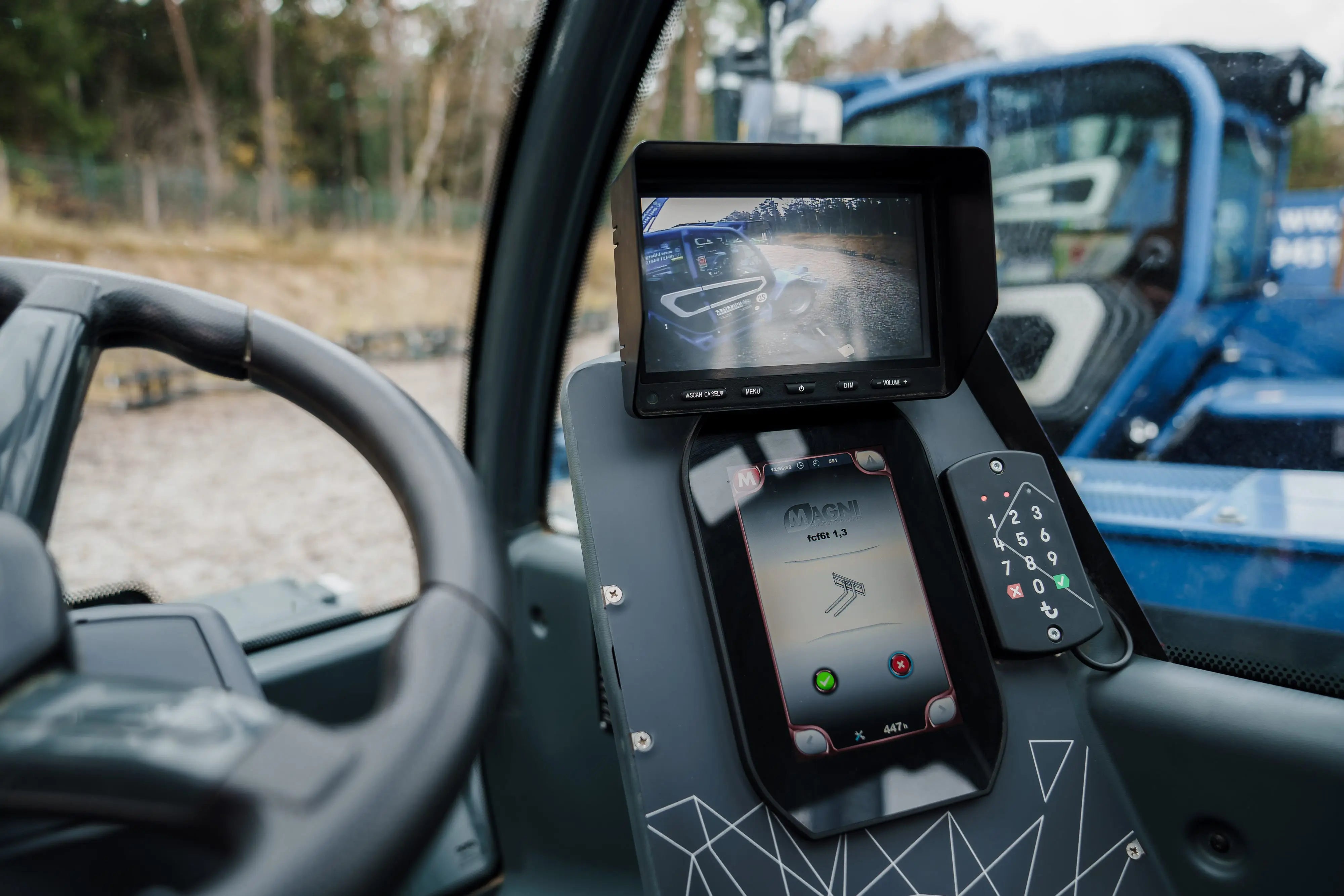
Load diagram in the telehandler: The screen shows in real time whether the reach, load and tilt angle are within the safe range – green means full work clearance.

For whom is renting worthwhile – and why?

Renting a telehandler is particularly useful if:

  • you do not need the device permanently , but only for specific projects
  • you want to remain flexible , e.g. when changing construction sites or requirements
  • you do not want to take on maintenance, storage or transport
  • you want to rely on new and tested technology with the latest safety standards

Typical tenants at BIBERGER are:

  • Construction companies (building and civil engineering)
  • Carpenters and roofers
  • Hall builders, window and facade fitters
  • Organizer and event logistics
  • municipal construction yards and service providers

What types of telehandlers are there?

At BIBERGER you will find two main categories of telehandlers – each with clear application profiles:

Rigid telehandlers

The classic version with an extendable telescopic arm. Particularly suitable for:

  • heavy lifting work up to 20 tons
  • Transport of building materials on narrow construction sites
  • Easy, safe maneuvering

Advantage: high load capacity and easy operation.

Rotating telehandlers (Roto)

With a rotating superstructure – for maximum flexibility in tight spaces. Ideal for:

  • Working with changing positions
  • Use as a crane or lifting platform replacement
  • Placement of loads around the vehicle

Advantage: 360° working radius – no relocation necessary.

Typical load capacities : 2.5 to 6 tons

Range : up to 30 meters depending on model and equipment

What should you pay attention to when choosing?

To ensure that the telehandler works effectively on your construction site, the following points are important:

  • How heavy is your load – and how far does it need to be lifted?
    → Select the machine with the appropriate load capacity and reach.
  • What does the terrain look like?
    → In mud, gravel or downhill conditions you need all-wheel drive and chunky tires .
  • Do you have enough space to maneuver – or is space limited?
    → Then a roto stacker has the advantage.
  • Does the device also need to serve as a platform or crane?
    → Use attachments and safe operators with PPE.
  • Who drives the device?
    → At BIBERGER, you can receive training or a certified operator upon request .

Conclusion: Efficiency begins with the right machine

A telehandler is always worthwhile when you need to move heavy loads quickly, precisely, and safelywhether in tight spaces, on uneven ground, or at height . Instead of organizing multiple machines, a modern telehandler can handle multiple tasks. Renting means minimal risk, maximum flexibility – all with proven technology and expert advice.

Talk to us – we’ll help you find the right telehandler for your project.

Rectangle_1 - BIBERGER
About the author

Martin Biberger

Managing Director

Martin is the founder and managing director of BIBERGER Arbeitsbühnen & Forklifts.

He is responsible for thetechnical areaTogether with his team, he is responsible for thetechnical purchasingthe machines thatFurther development of the machine inventoryand the smooth operation of over 1,500 BIBERGER rental devices.

From many years of experience he knows theStrengths and weaknesses of all device classes, the possibleAreas of applicationand thetechnical possibilities– always with a view to theDevelopment of the entire industryand future innovations.

Our editorial quality standards

The subject content on biberger.de are editorially created, reviewed, and continuously updated. The basis is our daily work with aerial platforms, telehandlers, and industrial trucks – in rental, sales, operational planning, and technical support.

Each article draws on real-world experience and is editorially reviewed for clarity, accuracy, and practical relevance according to expert criteria. Technical statements are regularly compared against current industry standards and best practices.

The aim of our publications is to make reliable specialist knowledge accessible and to offer guidance to users, decision-makers and industry partners. BIBERGER sees itself as an independent information platform for safe, economical and modern height access technology – well-founded, comprehensible and free from advertising influence.

Leave a comment

Please note, comments need to be approved before they are published.

This site is protected by hCaptcha and the hCaptcha Privacy Policy and Terms of Service apply.

Relevant topics

View all

DGUV 308-008, SYSTEM-CARD® oder IPAF: Welche Hubarbeitsbühnen-Schulung braucht dein Team wirklich?

DGUV 308-008, SYSTEM-CARD® or IPAF: Which mobile elevating work platform training does your team really need?

In Germany, several relevant training systems for mobile elevating work platform operators exist in practice: the DGUV principle 308-008 as the employers' liability insurance association basis, the SYSTEM-CARD® based on it as an association-organized quality system, and the international IPAF...

Read more

Typische Planungsfehler beim ersten Einsatz von Arbeitsbühnen – und wie du sie vermeidest - BIBERGER

Typical planning mistakes when using aerial work platforms for the first time – and how to avoid them.

Introduction Why errors occur even before deployment The safe operation of a work platform begins long before the basket lifts off. Mistakes don't happen during the lift itself, but in the preparation: assessing the ground conditions, selecting the right equipment,...

Read more

Wind und Arbeitsbühnen: Was Du für einen sicheren Einsatz unbedingt wissen musst - BIBERGER

Wind and aerial work platforms: What you absolutely need to know for safe use

Key problem: Why wind loads are so often underestimated Wind load is one of the most underestimated risks when using aerial work platforms. At ground level, wind force 6, with 12.5 m/s or around 45 km/h, often seems relatively harmless....

Read more

Arbeitsbühnen weltweit: Der internationale Vergleich von Märkten, Herstellern & Kosten - BIBERGER

Aerial work platforms worldwide: An international comparison of markets, manufacturers & costs

Aerial work platforms are indispensable on almost every construction site and in many industries. However, although the basic technology is similar worldwide, markets differ significantly in terms of regulation, manufacturing landscape, pace of innovation, and typical application profiles. Understanding international...

Read more

Arbeitsbühne Privat mieten – Was ist erlaubt? - BIBERGER

Renting a work platform for private use – what is allowed?

Aerial work platforms are primarily designed, standardized, and planned for commercial use. Typical applications include facade construction, plant and building technology, and industrial maintenance. Accordingly, equipment selection, insurance models, and rental procedures are geared primarily towards commercial users with trained...

Read more

Anschlagen von Lasten – Anschlagmittel richtig auswählen und sicher einsetzen - BIBERGER

Lifting loads – selecting and safely using lifting equipment

Safely attaching loads is one of the most demanding tasks when operating cranes , forklifts , and lifting equipment. Errors almost never occur during the lifting itself, but almost always result from misjudging the load capacity, type of attachment, or...

Read more

Staplerfahrer werden

Become a forklift driver: safely, trained and responsibly

A moment of inattention 7:15 a.m. A forklift driver begins his early shift. Routine. He only gives the forklift a cursory check – time pressure, the truck is waiting. On the third lift, the fork tine snaps at an old...

Read more

CAN-Bus und J1939-Diagnose bei Baumaschinen - BIBERGER

CAN bus and J1939 diagnostics in construction machinery

Modern construction machinery is now highly networked systems. Sensors, control units and safety modules communicate with each other constantly – and this happens via the so-called CAN bus . The CAN bus is essentially the nervous system of every modern...

Read more