



 What You Need to Know
Industrial plants are not a typical place of use for work platforms – they present complex, safety-critical and technically challenging conditions .
Anyone who plans incorrectly or delivers the wrong equipment here will delay entire shutdowns, jeopardize deadlines – or simply not be allowed onto the premises.
This article explains the requirements that industrial plants place on work platforms – and what really matters when selecting, planning and using them.
What are typical locations for stage use in industrial plants?
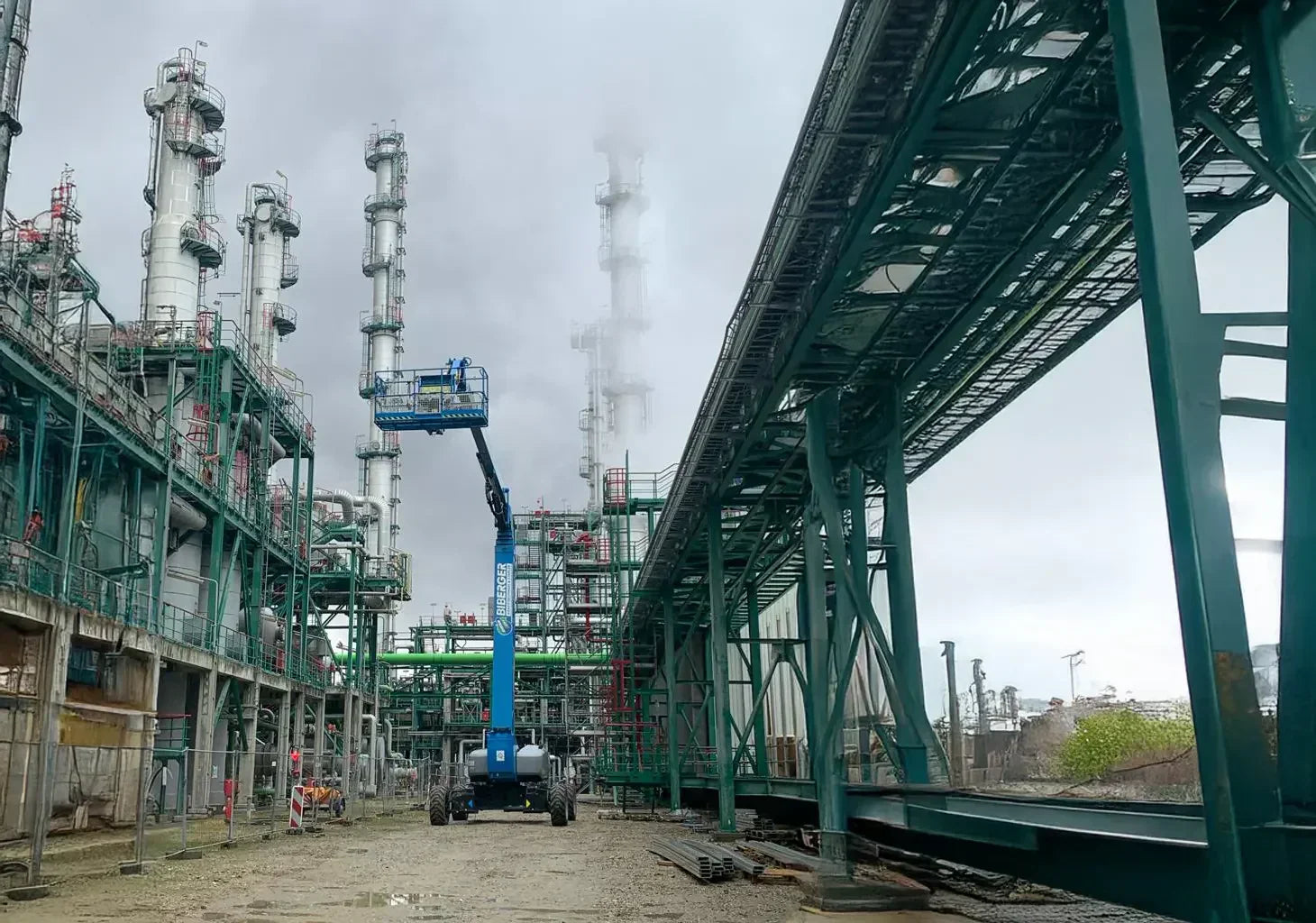
Refineries and petrochemical plants
- Work on columns, reactors, pipelines, tank roofs
- Use in hazardous areas (ATEX areas) , with diesel particulate filter or electric
- Maintenance, corrosion protection, modifications during planned plant shutdowns
Power plants (gas, coal, biomass, waste incineration)
- Boiler areas, cooling towers, electrostatic precipitators, conveyor systems, chimneys
- Narrow boiler houses , varying heights
- Working in high heat, dusty conditions or with limited ventilation
Large industrial parks / chemical plants
- Pipe bridge networks, pumping stations, stage platforms
- Interior areas with limited access , stepped levels
- Emission-free devices preferred (electric), depending on the sector
Typical uses where stages are required
- Replacement of insulation on pipelines or columns
- Maintenance and inspection of flange connections or brackets
- Plant modifications involving external trades (e.g. welding, dismantling)
- Cleaning and documentation during TÜV inspections
- Corrosion protection work , often in several stages at different levels
This often involves working across multiple shifts , sometimes with several stages simultaneously – in a very confined space, with coordinated access to defined work windows .
Which stage is suitable for which part of the plant?
| Area of application | Requirements | Suitable stage |
|---|---|---|
| Pipeline network (outside/top) | many obstacles, long reach, side access | Articulated telescope 20–28 m Diesel |
| Chimneys, reactors | great height, freestanding, high load-bearing capacity | Telescope 30–38 m Diesel |
| Courtyard with pipe bridges | narrow access road, small turning radius | Compact articulated telescope (e.g. 16 m electric) |
| Pumping station in Halle | emission-free, sensitive soil | Electric scissor lift with non-marking tires |
| boiler house or filter area | narrow passageways, clearance heights <2 m | Special articulated telescopic boom with hybrid drive or compact basket arm |
| Tank farm or loading area | ATEX requirements, no radio frequency, low floor load | ATEX-compliant scissor lift or special solution on request |
| Temporary installation work (cable trays, sensors) | flexible access to different heights, changing deployment locations | Self-propelled articulated platform with high lateral working area |
| Walkways with grating | low dead weight, large-area load distribution | Compact electric scissor lift with a wide base |
| Several stages operating in parallel | Space requirements, coordination, freedom from radio interference, coordinated work areas | Articulated telescopes with defined ranges of motion |
Telescopic or articulated platform
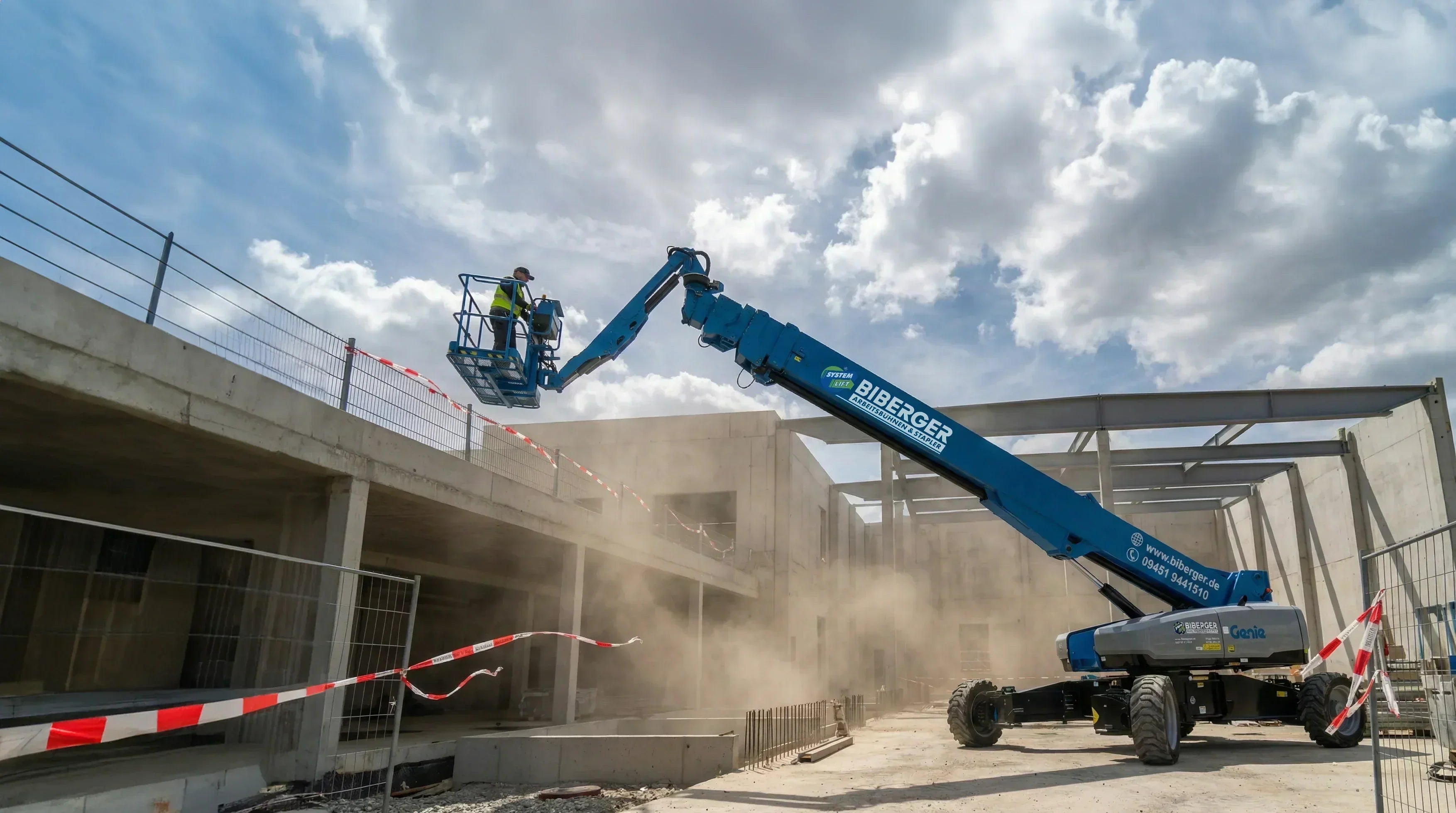
Telescopic platforms offer maximum height, a large reach, and are fast – but require clear space and plenty of room to swivel . Perfect for open areas, tank roofs, cooling towers, or vertical reactors .
Articulated telescopic booms are more flexible, compact, and ideal for working around corners, over pipe bridges, or between conduits . Especially in courtyards, pipe networks, or halls with intermediate levels, they are often the only practical solution.
Learn more here about the topic: When to use a telescope, when to use a hinged joint?
Important: It's not just about the height – but about whether you can even reach the work area without touching pipes or steel beams.
What operators specifically demand – and what is often forgotten
Some requirements are immediately clear: accident prevention regulations, CE marking, and documentation. But many projects fail due to details:
- Particulate filter forgotten → no access to emission-sensitive areas
- Equipment too wide or too heavy → no access to walkways or grating
- No machine documentation or test reports → prohibition of use by operator
- Stage with basket that is too small → no 2-person work with tools possible
Conclusion: Anyone who takes industrial applications seriously plans every detail – from machine dimensions to basket load and turning radius.
Things you absolutely must clarify before deployment
- What is the ground pressure at the installation site? (e.g., grating, asphalt, soil)
- Access heights, passageways, pipe bridges?
- Power consumption / Noise limits?
- Is the access road suitable for trucks?
- What are the operator's approval or release processes?
- ATEX zones? If so, standard stages are taboo.
Anyone who doesn't clarify these questions will end up on day X with the wrong equipment – or not even on the premises at all.
Conclusion: In industrial plants, expertise counts more than equipment height
Industrial applications in refineries, power plants, and chemical plants present technical and organizational challenges that go far beyond standard construction sites. Heights, obstacles, safety zones, and time pressure necessitate precise planning and suitable machinery.
A stage that fits on paper can be useless on site – or even pose a safety risk. Anyone working in these areas needs experience with sensitive equipment , technical understanding, and a rental company that knows what actually works.




Share:
Marquee construction with work platforms: Fast, safe and exactly on schedule
Risk assessment for mobile elevating work platforms: How to protect people, machines and projects
Our editorial quality standards
The subject content on biberger.de are editorially created, reviewed, and continuously updated. The basis is our daily work with aerial platforms, telehandlers, and industrial trucks – in rental, sales, operational planning, and technical support.
Each article draws on real-world experience and is editorially reviewed for clarity, accuracy, and practical relevance according to expert criteria. Technical statements are regularly compared against current industry standards and best practices.
The aim of our publications is to make reliable specialist knowledge accessible and to offer guidance to users, decision-makers and industry partners. BIBERGER sees itself as an independent information platform for safe, economical and modern height access technology – well-founded, comprehensible and free from advertising influence.